







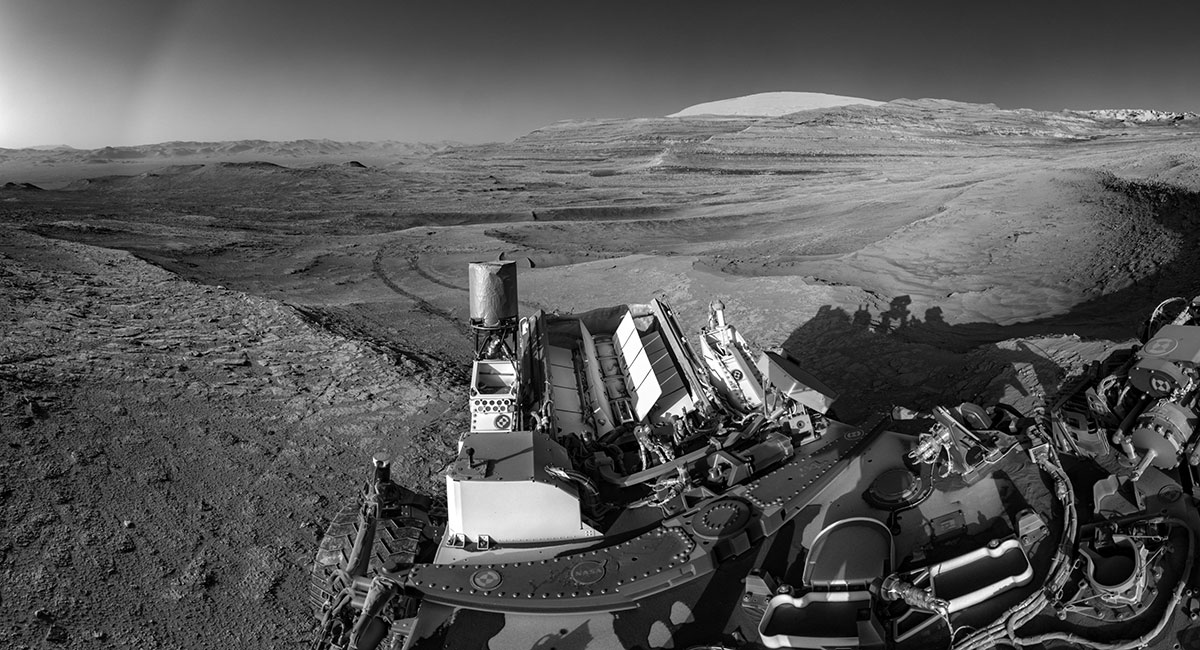
13 years after Curiosity landed on Mars, engineers continue to refine the rover’s capabilities, ensuring it remains productive on the Red Planet.
The six-wheeled robot now has greater autonomy and the ability to multitask –improvements aimed at maximising the energy generated by its multi-mission radioisotope thermoelectric generator (MMRTG).
Increased efficiency means the rover has sufficient power to pursue its ongoing mission: uncovering how the Martian climate evolves from a planet of lakes and rivers to the cold desert seen today.
Exploring boxwork formations
Curiosity recently drove into a region filled with boxwork formations – hardened ridges thought to be shaped by underground water billions of years ago. Spanning miles across parts of Mount Sharp, the 3-mile-tall (5-kilometre-tall) mountain at the centre of Gale Crater, these formations might help reveal whether microbial life could exist in the Martian subsurface during the planet’s gradual drying-out period.
To carry out this work requires significant energy. Alongside driving and deploying its robotic arm, Curiosity operates a suite of 10 scientific instruments, cameras, a radio, and multiple heaters that keep electronics and mechanical parts at optimal temperature. Unlike earlier missions such as Spirit, Opportunity, and InSight – which rely on solar panels – Curiosity and its younger sibling Perseverance draw power from their MMRTGs. These nuclear power sources convert the heat of decaying plutonium pellets into electricity to recharge batteries.
Although reliable, MMRTGs lose efficiency over time as the plutonium decays, meaning Curiosity’s batteries take longer to recharge and daily energy budgets need careful management. Every component that draws power is accounted for, with engineers noting that years of Martian dust, radiation, and temperature extremes reveal quirks not visible during Earth-based testing.
A teenage rover learns to multitask
“We were more like cautious parents earlier in the mission,” says Reidar Larsen of NASA’s Jet Propulsion Laboratory (JPL) in Southern California, which builds and operates the rover. Larsen leads the group of engineers who developed the new autonomy features.
“It’s as if our teenage rover is maturing, and we’re trusting it to take on more responsibility. As a kid, you might do one thing at a time, but as you become an adult, you learn to multitask.”
Traditionally, JPL engineers send Curiosity a list of tasks to complete sequentially, followed by a period of sleep to recharge. In 2021, the team began studying whether two or three activities can be safely combined.
For instance, Curiosity’s radio regularly transmits data and images to orbiters passing overhead, which then relay them to Earth. Tests confirm that the rover can communicate while simultaneously driving, operating its robotic arm, or taking images. These consolidated operations reduce heater time, trim instrument standby periods, and save energy.
Another innovation allows Curiosity to decide when to sleep. Engineers usually build in time buffers in case tasks overrun. Now, if Curiosity finishes early, it enters a nap mode ahead of schedule, reducing the recharge load on its MMRTG. Even trimming 10 to 20 minutes from daily activities adds up significantly over time, extending the rover’s science potential.
Mechanical challenges and workarounds
The JPL team introduced additional updates over the years. Mechanical wear requires changes to how the rover’s drill collects samples, and software upgrades improve driving performance. When the filter wheel in one of the two Mastcam cameras stops turning, engineers devised a workaround to keep panoramic imaging possible.
A wheel-protection algorithm was also developed after years of navigating sharp terrain left the rover’s aluminium wheels battered. Despite punctures, research shows the wheels have years of service left. In the unlikely event of severe damage, Curiosity can remove part of its tread and continue driving on the remainder.