




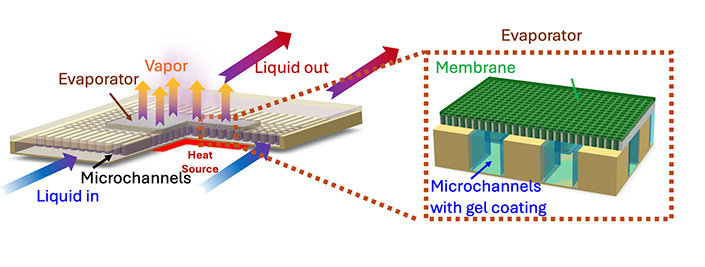
The innovation centres on a specially designed fibre membrane, capable of removing heat through evaporation without any need for additional energy input. Unlike conventional methods such as fans, heat sinks, or liquid pumps, the system leverages the natural capillary action of a porous membrane to draw cooling liquid across its surface, where it evaporates and extracts heat from the underlying electronics.
As the uptake of artificial intelligence (AI) and Cloud computing continues to rise, so too does the demand for data processing – and the thermal load that comes with it. Currently, cooling accounts for as much as 40% of the total energy consumption in a data centre. If growth continues unchecked, global energy use for cooling could more than double by 2030.
The UC San Diego team’s solution could help limit that impact. The membrane features a network of small, interconnected pores that optimise fluid flow and surface area for evaporation. It is positioned over microchannels that transport coolant beneath the membrane surface, allowing for passive and efficient heat dissipation.
“Compared to traditional air or liquid cooling, evaporation can dissipate higher heat flux while using less energy,” said Professor Renkun Chen of the Department of Mechanical and Aerospace Engineering at the UC San Diego Jacobs School of Engineering. He co-led the project alongside Professors Shengqiang Cai and Abhishek Saha, also of the same department. Mechanical and Aerospace Engineering Ph.D. student Tianshi Feng and postdoctoral researcher Yu Pei – both from Chen’s group – served as co-first authors on the paper.
Evaporation is already used in many common cooling applications, such as heat pipes in laptops and evaporators in air conditioning systems. However, applying it effectively to high-power electronics has posed challenges. Chen explained that earlier approaches using porous membranes often failed due to incorrect pore sizing – too small and the pores clog, too large and boiling occurs.
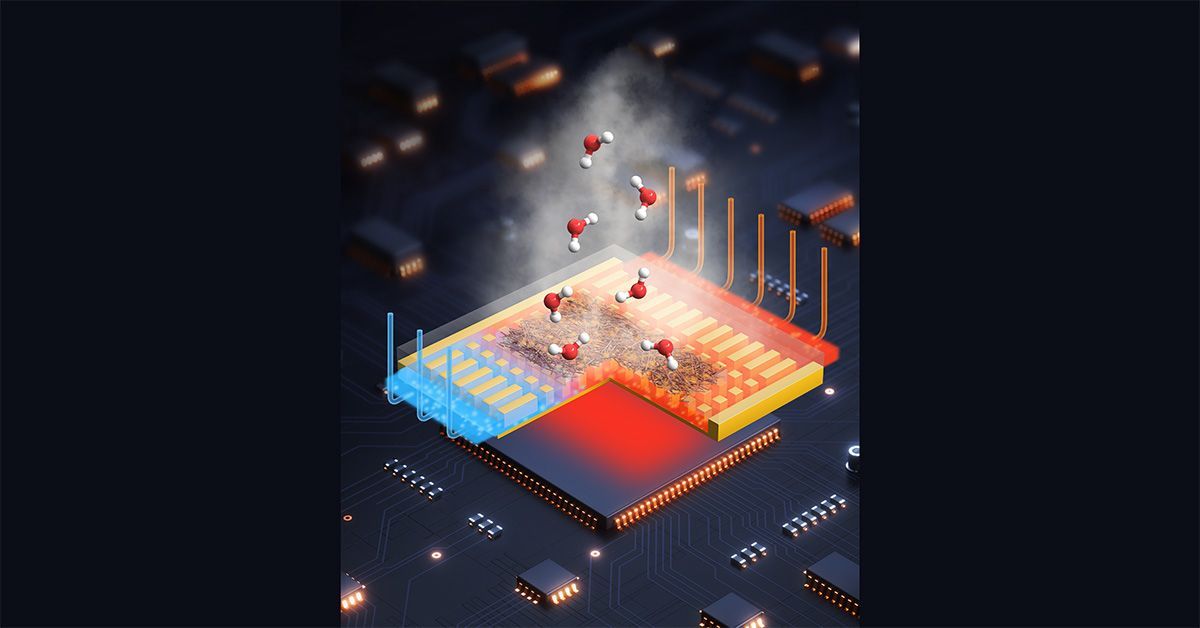
“Here, we use porous fibre membranes with interconnected pores with the right size,” said Chen.
When tested under various thermal conditions, the membrane demonstrated record-breaking performance, handling more than 800W/cm² of heat – among the highest recorded for this type of passive cooling system. It also remained stable over several hours of continuous operation.
“This success showcases the potential of reimagining materials for entirely new applications,” said Chen.
“These fibre membranes were originally designed for filtration, and no one had previously explored their use in evaporation. We recognised that their unique structural characteristics – interconnected pores and just the right pore size – could make them ideal for efficient evaporative cooling. What surprised us was that, with the right mechanical reinforcement, they not only withstood the high heat flux – they performed extremely well under it.”
Despite these promising results, Chen noted that the system still operated well below its theoretical maximum. The research team is now focused on enhancing the membrane’s efficiency further and plans to develop prototype cold plates that can be attached directly to CPUs and GPUs. A startup has also been formed to commercialise the technology.
The full study, ‘High-Flux and Stable Thin Film Evaporation from Fiber Membranes with Interconnected Pores’, can be found in Joule.