







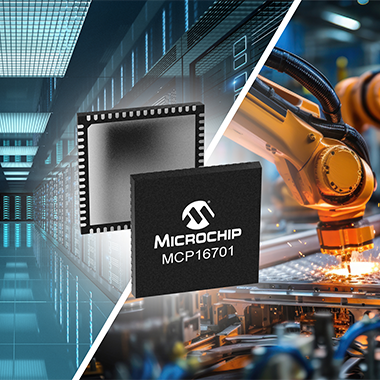
Microchip Technology announces the MCP16701, a Power Management Integrated Circuit (PMIC) designed to meet the needs of high-performance MPU and FPGA designers. The MCP16701 integrates eight 1.5A buck converters that can be paralleled, four 300 mA internal Low Dropout Voltage Regulators (LDOs) and a controller to drive external MOSFETs.
This highly integrated device can result in a 48% area reduction with less than 60% of the component count of a discrete solution. The MCP16701 is in a small-form-factor 8mmx8mm VQFN package to offer a compact and flexible power management solution for space-constrained applications. The MCP16701 meets diverse power needs and supports Microchip’s PIC64-GX MPU and PolarFire FPGAs with a configurable feature set.
“With the introduction of the MCP16701, Microchip is setting a new standard in PMIC technology by offering an unprecedented level of integration and flexibility,” said Rudy Jaramillo, Vice President of Microchip’s analog power and interface division. “This advanced PMIC is designed specifically for high-performance applications, enabling our customers to streamline their design process.”
The MCP16701 features an I2C communication interface to simply and enhance communication efficiency between the PMIC and other system components. The device operates within a temperature range of TJ −40°C to +105°C for reliable performance in diverse environmental conditions.
A key feature of the MCP16701 is its ability to dynamically change Vout levels for all converters in 12.5mV/25 mV increments. This maximum flexibility allows designers to fine-tune power delivery to meet specific application requirements, helping enhance overall system efficiency and performance.
The MCP16701 joins a family of Microchip PMIC products, including the MCP16502, MCP16501, and others – that are used to power high-performance MPU applications targeting industrial computing, data centres, IoT, and Edge AI.