
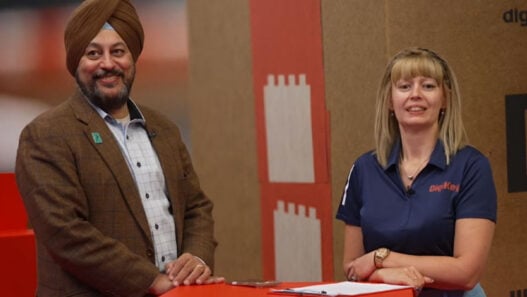


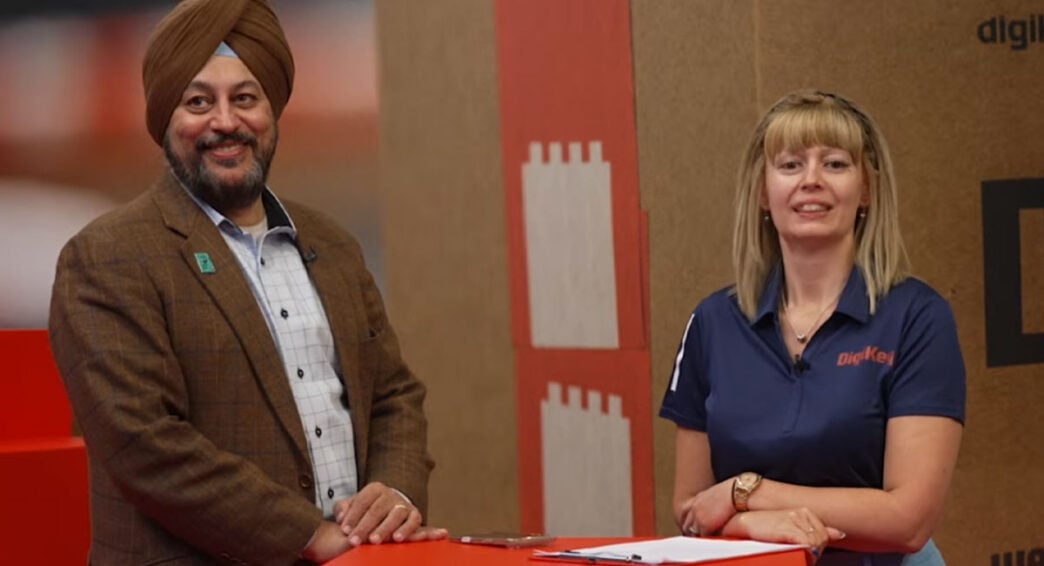
At electronica 2026 in Munich, Electronic Specifier’s Paige Hookway met Guneet Bedi, Senior Vice President and General Manager at Arduino, on the DigiKey booth. They talked about how Arduino is helping engineers move from prototype to production, its new VENTUNO Q board, and why physical AI is at the heart of its plans.
Guneet Bedi has been at Arduino for almost four years. He leads marketing, sales, developer relations, and community. “My official title is senior vice president,” he says, “but what I’m really excited about is my team is the one which takes these wonderful products and puts them in hands of millions of developers.”
From blink to think
For Bedi, the big question is how to turn an idea into a proof of concept and then a first solution, especially now that AI touches every layer of technology, from hardware, and sensors to software and applications. That’s where he believes Arduino shines.
“We joke that for 21 years we taught people how to blink an LED with electronics without writing hundreds and hundreds of lines of code,” he says. “We’re doing that now in the edge AI world. We call it from blink to think.”
The aim is to make powerful technology usable by anyone, from an 11-year-old to an advanced engineer, without needing to be a specialist in everything. It’s also accessible, affordable and widely available. “You can get these powerful technologies in less than a day in your hand. So you can go from an idea to a first solution in a matter of days.”
Prototyping in minutes
AI has made prototyping dramatically faster, and Bedi, a self-confessed vibe coder, clearly enjoys it. Arduino App Lab has a built-in AI assistant, and developers can also use tools such as Claude or Codex to generate a first prototype. “So without knowing anything about the underlying tech you can create a prototype in a matter of minutes,” he says. “Now production is slightly different,” he adds, because that stage needs more detail.
Meet VENTUNO Q
Arduino’s newest single-board computer, VENTUNO Q, is built for engineers working on AI at the edge, including robotics, drones, and industrial applications. It combines a Qualcomm Dragonwing IQ8 processor with a microcontroller for deterministic real-time control. Its NPU delivers 40 dense TOPS, so it’s “a really powerful machine which you can buy from DigiKey and get it at home the next day.”
It’s also designed for students and makers learning the basics of AI and electronics. Bedi says many universities, robotics companies, startups, drone, and industrial developers are already using it, and “we see humanoids running on it now.”
Solving three problems
Bedi sees VENTUNO Q solving three main problems for engineers:
- The dual-brain challenge. Connecting AI to the real world usually means designing two separate solutions: real-time control and a powerful application processor. VENTUNO Q puts both on one board, and “we’ve done the work of bridging the gap. So the engineer doesn’t have to bridge the gap.”
- Getting started without embedded expertise. Engineers who aren’t embedded specialists can use AI to do much of the initial coding and prototyping.
- Learning affordably. People who don’t have access to expensive platforms can start small and explore what’s possible.
Making edge AI accessible
Availability is the first step: VENTUNO Q is sold through DigiKey and Arduino’s other distribution partners. Next comes software. About 200 open-source AI models, from sources such as Hugging Face, are available on the product by default, because “at the end it’s Arduino, it’s open source.” Arduino’s “Bricks” work like Lego blocks that can be stacked to build AI applications with little or no code. Advanced users can go as deep as they like.
Why physical AI?
Arduino has always sat between the physical and virtual worlds. “We don’t build software which does not run on hardware,” Bedi says. AI in the cloud is now well understood, but bringing it into the physical world is the next step, and Bedi prefers to call it “physical AI” rather than edge AI.
Being part of Qualcomm gives Arduino access to cutting-edge technology at an affordable price. “It’s like getting a Ferrari for the price of a Fiat Punto, right?”
A path to production
Once a prototype is built, the hard work begins: certification, temperature ranges, form factors and more. To help, Arduino has launched Works with Arduino, a certification programme for production devices. Partners including SECO and Toradex offer industrial system-on-module solutions and software that are compatible with and certified for Arduino. Bedi compares it to the “Intel Inside” idea: “Works with Arduino allows you to kind of feel safe that the prototype you build also has a path to production.”
What’s next
Arduino is also expanding at the low end. It’s launching the Nano XL family with Microchip, with a connectivity Nano still to come, and plans an ultra-wideband (UWB) portfolio for location tracking. “Any new technology that comes up which is popular, we want to take it, make it easy to use, affordable, and with partners like [DigiKey] make it absolutely available to everybody.”
Watch the full interview
To hear more from Guneet Bedi, watch the full video interview: