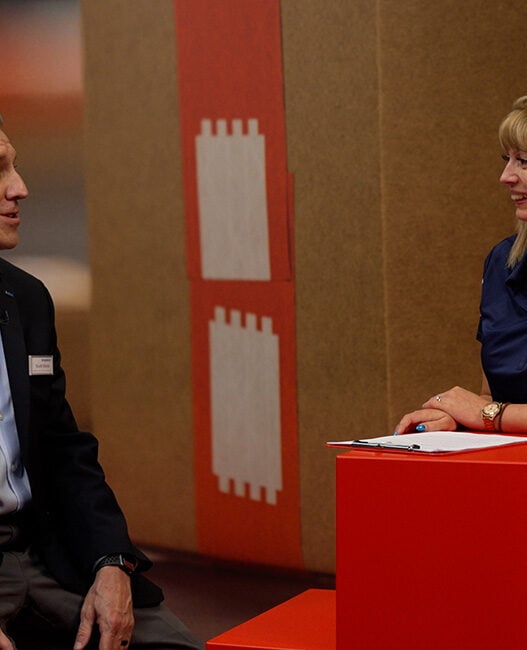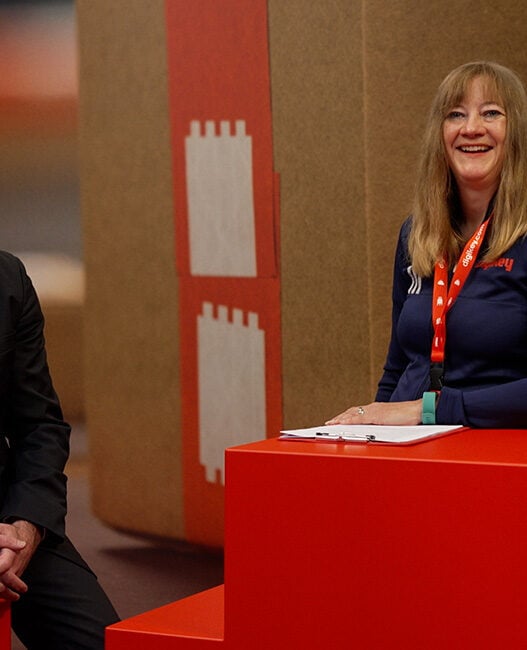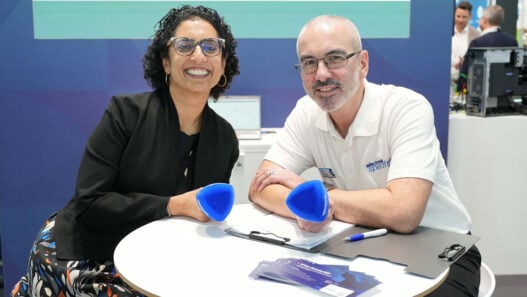


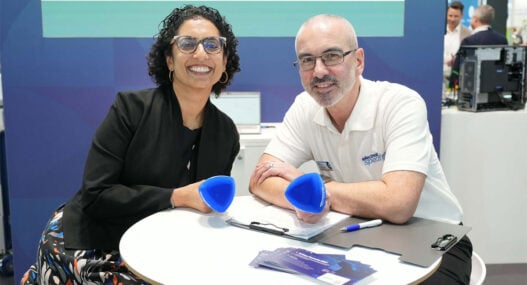
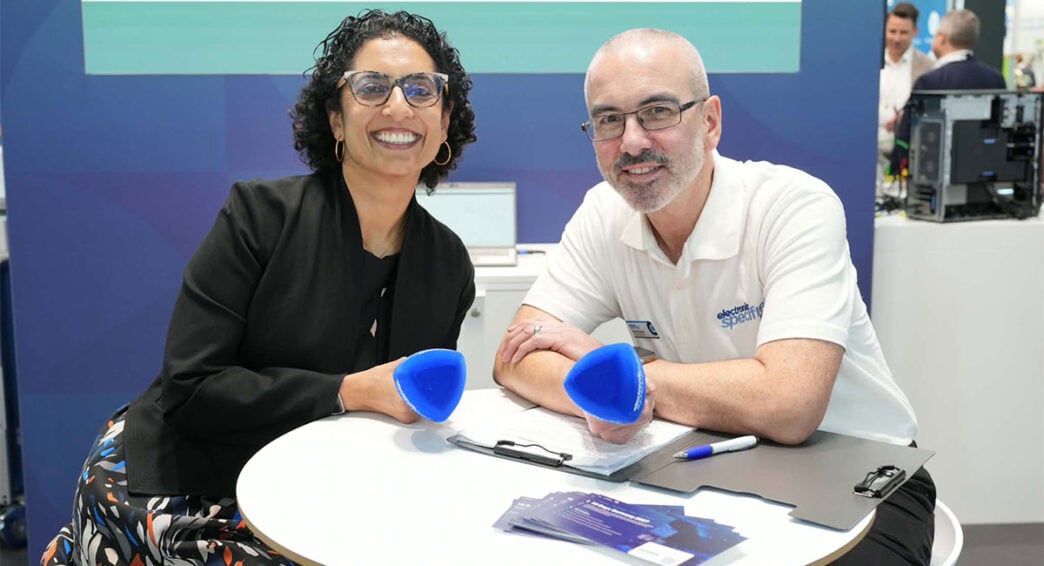
At electronica 2026 in Munich, Electronic Specifier Contributing Editor Mark Gradwell sat down with Ritu Favre, President of Emerson’s test and measurement business. They talked about how AI is helping engineers manage growing complexity, the launch of the NI device driver MCP Server, and why NI’s 50th anniversary feels like a beginning rather than a milestone.
It’s been a busy week for Emerson’s test and measurement team. “It has been amazing,” Favre says of the show. “We’re launching a few different things, so really excited to talk to you today.”
When complexity outpaces people
Favre has a clear view of why AI matters so much in test right now. Systems are becoming far more complicated, and “the ability to manage that complexity in test is outpacing human beings’ ability to manage all of that complexity.”
AI is starting to fill that gap by helping engineers make sense of complexity across their entire workflow. “It’s a really exciting time to be in test right now,” she says.
Where AI adds real value
Favre points to several practical places where AI can help test engineers day to day:
- Documentation: finding the right information quickly when it’s often hard to track down.
- Legacy code: “there are places where code has been written by people who have done it years and years ago, and they’re long gone.” AI can read that code, explain what it does, and rewrite it in better ways.
- System test design: as systems and interfaces grow more complex, AI can hide that complexity so engineers can work faster.
All of this is happening under rising commercial pressure. Favre notes that the push to get products to market keeps getting stronger, and AI helps with both challenges: managing complexity, and speeding up time to market.
A platform celebrating 50 years
NI marks its 50th anniversary this year, and Favre sees its platform as central to its next chapter. For its whole history, NI has given engineers a robust platform for solving the world’s hardest problems. “We can give you the tools to test your greatest innovations,” she says.
That platform has always been built on hardware and software. Now AI and data are becoming integral parts of it too, with AI built into abstract complexity so engineers can focus on getting great products to market.
Meet the NI device driver MCP Server
Emerson’s AI strategy has two strands. The first is building its AI agent, Nigel, directly into NI products, with several versions already released. The second, launched at electronica, is the NI device driver MCP Server.
The MCP Server connects NI hardware and device drivers to the AI tools engineers already use, giving those third-party platforms full access to NI’s capabilities. For Favre, that openness is central to what NI is. She describes the company’s DNA as open, flexible, modular, and scalable.
“We want customers to be able to be where they are,” she explains. “And so if they want to use Claude, OpenAI, ChatGPT, or Copilot… they’re able to plug these MCP Servers in as skills.” This gives those tools the context they need to work with NI hardware and device drivers.
Smoothing the whole workflow
Traditionally, test engineers worked out what to test, coded their programs, collected results, and dealt with plenty of inefficiency along the way. Emerson wants to ease every stage of that process: requirements gathering, test planning and development, code generation, and the insights and analytics that let engineers feed results back into the design.
Validation is where NI started, and Favre sees AI helping to bridge the gap between validation and production, especially in requirements, test development, and analytics.
Seeing it in action
To show what this looks like in practice, Emerson’s booth demo focused on semiconductor validation, specifically testing power management ICs. Favre described a scenario many engineers will recognise: a semiconductor test engineer who has to validate a new chip that has just come off the line. “As any semiconductor test engineer will tell you, there’s a lot of pressure to get those chips into the market and shipping as quickly as possible,” she says.
That’s where NI InstrumentStudio, with Nigel embedded, comes in. Nigel helps the engineer debug quickly and pinpoint where the problems are in the chip. The engineer can then go back to the design team with clear findings on what needs fixing, and the team can turn round the next iteration rapidly.
For Favre, it’s a practical example of AI making a real difference to everyday engineering. She calls it “a way that we can show how AI is helping as people are trying to do their validation work.”
A second demo with Austin Hill showed Nigel working inside NI SystemLink, which brings together data from multiple testers on a single server. Faced with a set of battery tests showing many failures, Nigel quickly found a correlation between test temperature, resistance, and test outcomes. Patterns like that are hard to spot by eye. “The more context that Nigel has, the better results it can give you,” Hill explains. With a simple request, Nigel replotted the data with temperature on the X-axis to show the issue clearly, ready to be turned into a report for the design team.
One platform, many starting points
Emerson continues to invest across the whole platform: hardware and I/O, software tools such as LabVIEW, TestStand, FlexLogger, and VeriStand with Nigel embedded, the wider AI ecosystem and its data platform. The goal is to give customers a starting point wherever they are, whether that’s NI hardware, or the MCP Server inside a third-party AI tool.
Just getting started
Ritu credits NI’s culture and innovation for its success: “for 50 years we have been a really cool company that’s done big things.” She’s clear that the best is still ahead. “For me, this is just the start of doing even bigger things to help… engineers and scientists solve the world’s biggest problems.”
Watch the full interview
To hear more from Ritu Favre, watch the full video interview: Electronic Specifier at electronica 2026 with National Instruments