


Littelfuse has announced the IXD704 Series, a family of non-isolated, dual-channel, 4A, low-side MOSFET and IGBT gate drivers with inverting or non-inverting outputs.
Designed to give power system engineers a faster, more reliable, and better-protected way to drive today’s demanding switching devices, they build on the Littelfuse IXD604 gate driver family. The IXD704 series adds tighter timing precision, additional under-voltage lockout (UVLO) protection, and a smaller package footprint, giving designers a straightforward upgrade path to higher-speed, higher-reliability power designs.
When multiple MOSFETs or IGBTs are paralleled or driven from tied outputs, small timing mismatches between channels can cause uneven current sharing and localised thermal stress. The IXD704 series addresses this directly with 2ns typical propagation-delay matching between channels, so paralleled devices switch together more predictably – a critical requirement in high-current, high-reliability power systems.
The new family also delivers a 9ns typical rise time and an 8ns typical fall time, supporting the higher switching frequencies that today’s compact, efficient power designs demand. A new 50ns minimum input pulse-width filter adds another layer of protection, screening out noise-induced glitches that could otherwise cause an inadvertent turn-on event.
Proprietary circuitry within the IXD704 prevents the driver’s internal high-side and low-side output transistors from conducting simultaneously, eliminating cross conduction and the current shoot-through that would otherwise occur during output transitions. This benefits designers by reducing wasted supply current, minimising heat generation in the driver itself, and protecting the output stage from the damage that repeated shoot-through events can cause over the product’s operating life.
For added fail-safe protection, the IXD704 series offers two selectable UVLO threshold variants – a feature not available on the IXD604 family. Devices are available with either a 12V nominal UVLO or a 9V nominal UVLO (“xA” variants), giving designers a way to shut the driver down safely whenever supply voltage falls below the minimum needed for reliable operation, minimising risk during brownout or startup conditions. In addition, the driver output is virtually immune to latch-up, preventing damage from reverse-bias current stress up to ±4A.
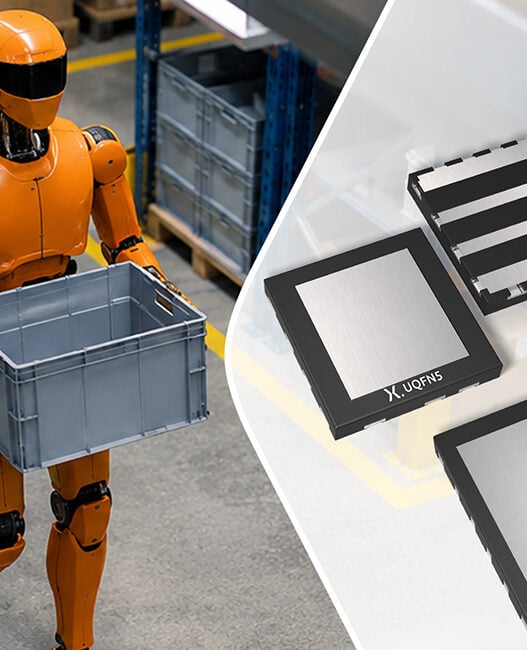
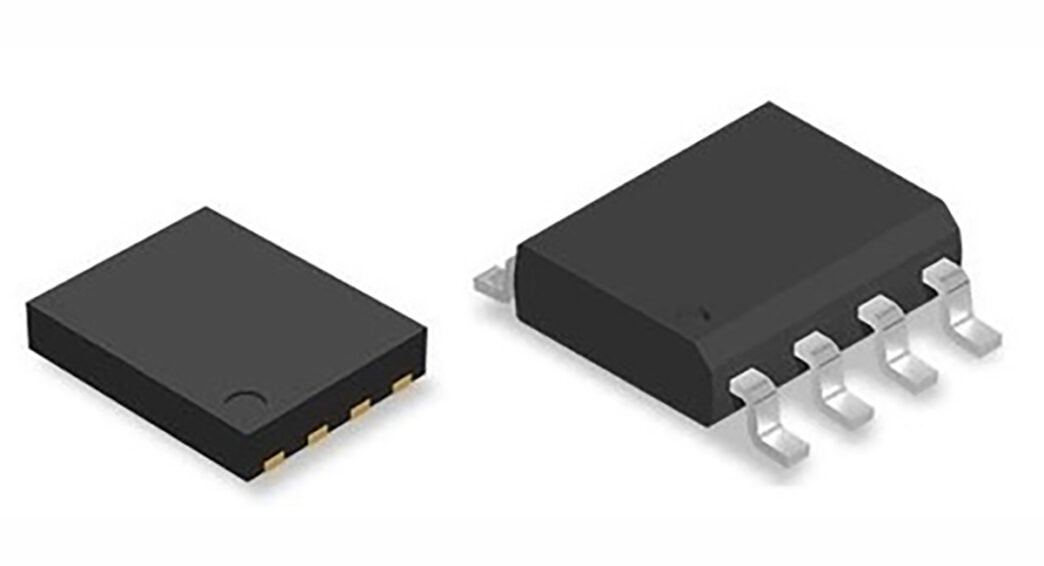
The IXD704 supports four gate-drive configurations: dual non-inverting, dual non-inverting with independent enable pins, dual inverting, and mixed inverting/non-inverting, so designers can select the logic behaviour that best matches their system architecture. Each configuration is available in a standard SOIC-8 and a thermally enhanced 8-pin SOIC with exposed pad (SOIC_EP). The dual non-inverting with independent enable pins configuration is also available in an 8-pin DFN package with exposed pad that is 20% smaller than the equivalent IXD604 DFN package, for designs where board space is at a premium.
With a +14V to +35V supply voltage range, 4A peak sink/source output current (8A when paralleled), and latch-up protection to 4A peak, the IXD704 series is well suited for industrial controls and automation, switch-mode power supplies, DC/DC converters, motor controllers, power inverters, Class-D switching amplifiers, and pulse-transformer drivers, delivering robust performance across diverse operating conditions. Its compact form factor, fast switching, and extended operating-temperature range also make it a strong fit for strategic growth markets such as medical electronics.
“The new IXD704 Dual-Channel 4 A Low-Side MOSFET Gate Driver delivers optimised performance for modern MOSFET and IGBT applications,” said Hugo Guzman, Product Marketing Manager at Littelfuse. “It enhances the capabilities of the IXD604 series by introducing 2ns typical propagation-delay matching, ensuring reliable operation when devices are paralleled or when outputs are tied together. With [a] faster 9ns typical rise time and 8ns typical fall time, the IXD704 is well suited for high-frequency switching applications.”