

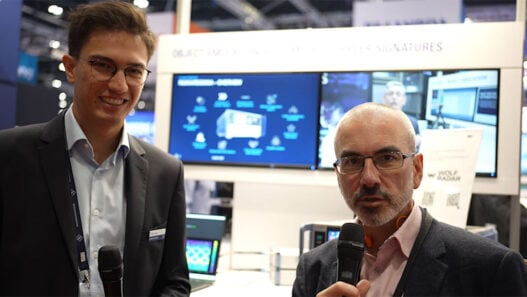

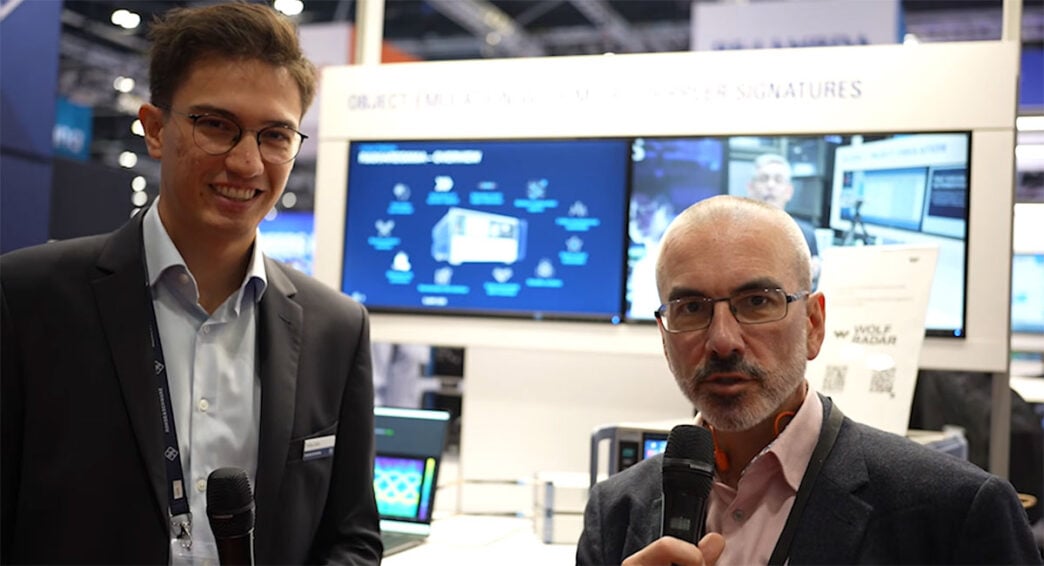
At European Microwave Week (EuMW), Rohde & Schwarz demonstrated how drone detection can be tested under repeatable, controlled conditions.
When two become one: radar and communications
Communication networks and radar have long been developed and commercialised as separate disciplines. Integrated sensing and communications (ISAC) is regarded as a key component of 6G, bringing the two together. The same spectrum, signals, and hardware serve both sensing and communications, so a network can carry data and also act as a radar that detects, locates, and tracks objects.
However, this unification brings with it fresh test challenges. Verifying sensing performance is new to wireless communications, and it requires either ground-truth knowledge of real objects or the ability to emulate objects with defined parameters. These include distance, speed, and radar cross sections.
Duplication a drone
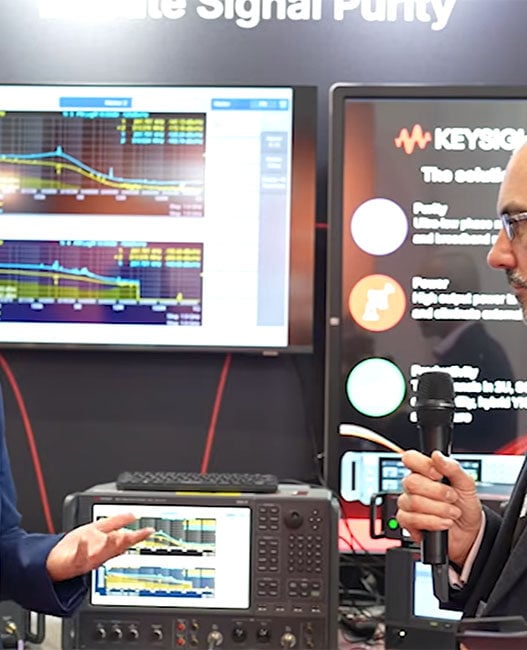
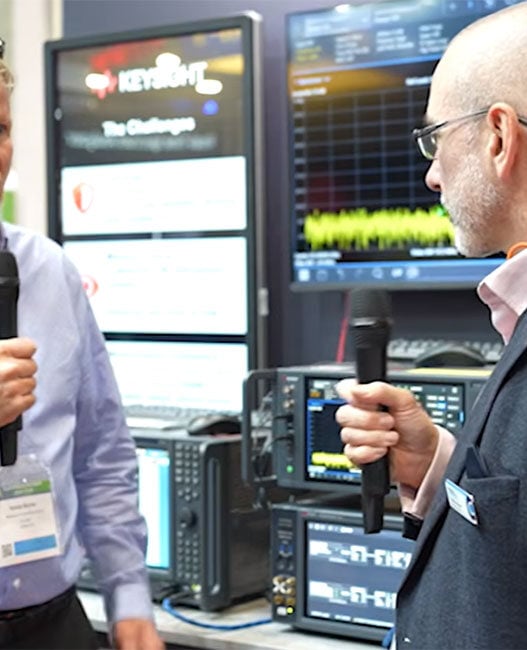
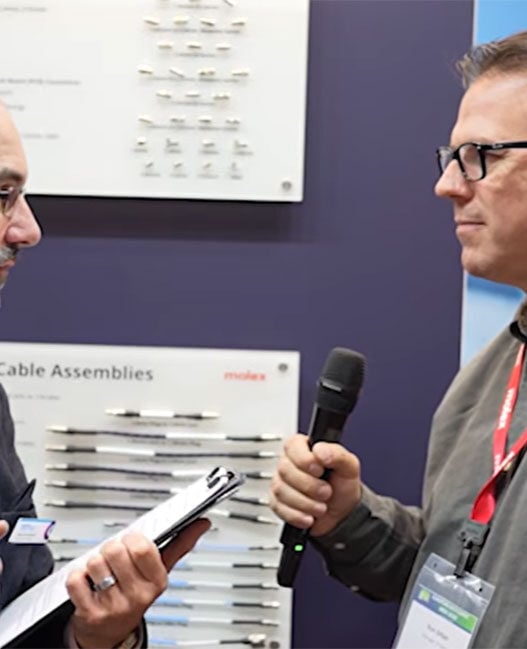
At the stand, Phillip Lölver, Product Marketing Manager at Rohde & Schwarz, spoke to Electronic Specifier’s Contributing Editor, Mark Gradwell, showing him the sensing side of the company’s 6G ISAC solution. The demonstration focused on the R&S AREG800A radar echo generator. “What this device does is it emulates objects for radar testing. We can define a range, attenuation, Doppler shift of this object we’re emulating,” Lölver explained.
To support ISAC test cases, Rohde & Schwarz is extending the generator’s capabilities. “We’re extending the functionality to also include micro-Doppler signatures and range extension,” he said.
Most targets have moving parts, and these produce secondary frequency shifts that can be used to classify and identify them. In the demo, the radar signal is received by an antenna, the micro-Doppler signature is applied, and the signal is returned to the radar. A drones propellors are shown as on-screen fluctuations.
From the field to the lab
The benefit of this technology is repeatability. Field conditions change from one test to the next, which makes results hard to compare. “You can do this without a physical object, hence you’re taking the testing from the field into the lab to create repeatable and reliable testing,” said Lölver.
Key components
The demo setup combined three elements:
- R&S AREG800A radar echo generator: creates the emulated objects
- R&S FE44S frontend: converter solution for FR2 covering 24GHz to 44GHz. Rohde & Schwarz says external frontends handle up- and down-conversion directly at the device under test, which improves performance at lower cost
- Rohde & Schwarz antennas: complete the over-the-air path
Together, these form the company’s laboratory test platform for ISAC. The AREG800A can generate multiple dynamic targets with different distances, sizes, and radial velocities, which allows realistic, densely populated scenarios to be simulated.
Research and partnerships
Rohde & Schwarz works with institutions on national and international projects, including KomSens 6G and 6G SENSATION, of which the latter is funded by the German Federal Ministry of Education and Research. It also collaborates with the China Mobile Research Institute on ISAC research and validation.
To watch the full interview, click on the video below.