






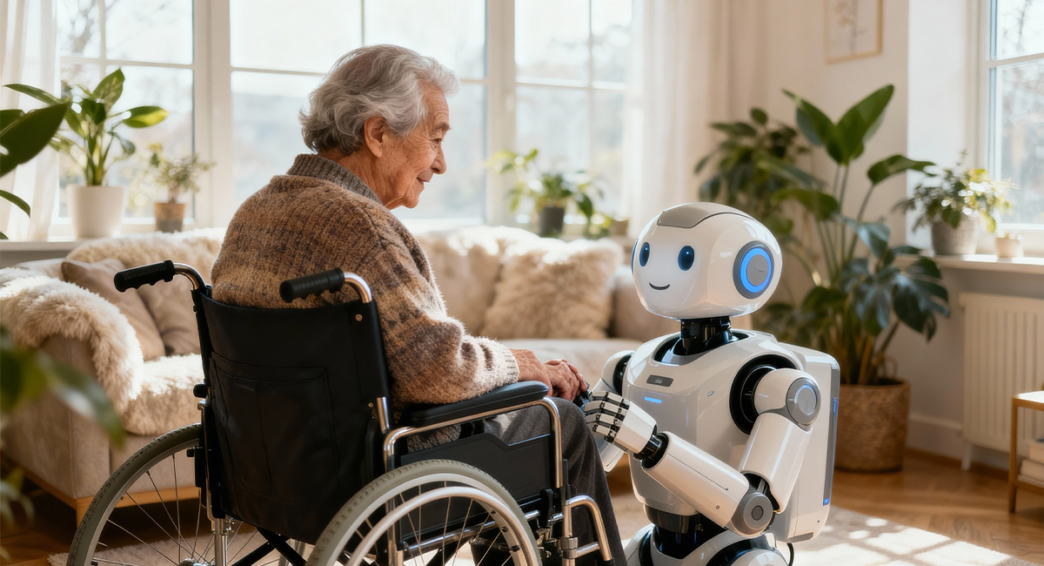
To understand where caregiving robots are headed, Mouser Electronics spoke with someone who has spent his career exploring what makes machines feel human. Hod Lipson, a Columbia University robotics and artificial intelligence researcher known for his groundbreaking work in soft robotics and expressive machines, argues that the future of caregiving will not hinge on strength or dexterity alone. Instead, it will depend on whether robots can earn our trust through subtle, deeply human signals – like a smile delivered at the right moment.
In this article, we explore how Lipson’s perspective reframes the entire caregiving roadmap and reveals why emotional comfort may be the real frontier of robot design.
Robotics’ moving target
Lipson runs a robotics lab that has spent years developing compliant materials, adaptive actuators, and force‑sensing systems that would let robots safely lift, steady, and assist humans in need. The most physically demanding caregiving tasks, such as lifting someone from a wheelchair, helping them bathe, or steadying them through transfers, are also among the most technically complex. They require exactly the kind of soft, compliant bodies roboticists have spent years trying to build.
But those tasks also require extraordinary trust.
And trust, Lipson has concluded, doesn’t start with a gentle touch. It starts with whether a robot’s face makes you feel safe enough to let it stay in the room.
“For 10 years, we were thinking soft robots are going to be soft hands, arms like an elephant trunk,” Lipson says. “But if you look around, you don’t see any of that. Faces are the soft robot that we did not see coming.”
Why lifting comes last – not first
It’s a common assumption that caregiver robots step in for the most physically demanding moments: lifting a person, steadying them down steps, helping with transfers, and assisting with bathing, tasks that strain human caregivers and carry real risk when something goes wrong. At first, Lipson also expected soft robots to tackle physical caregiving first. Now, he believes those tasks will come last.
“Originally, that’s what I thought soft robots would do,” he says. “But I think that’s actually going to be the hardest thing.” This is not because the technology is impossible, but because the stakes are too high to rush. “It’s dangerous because it has to lift the whole body,” Lipson explains. “It requires a lot of force and a lot of trust.”
One mistake during a transfer could lead to a serious fall. One misstep in shifting weight on a staircase could lead to an injury. Even if engineers perfect the mechanics, society will need time to accept robots performing personal, high‑risk care. Lipson estimates that it could take a decade for this trust and comfort to develop. The path to that future begins with something simpler than physical labour.
Getting to know caregiver robots
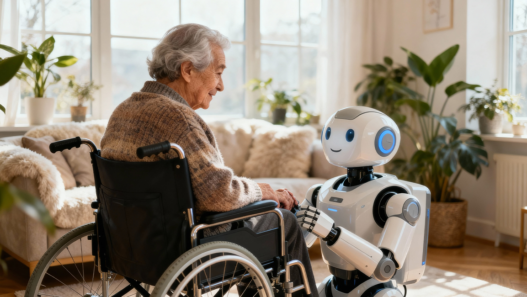
What Lipson discovered in his robotics work is that the first applications will be situations where the caregiver robot isn’t touching anyone. “Tidying things, bringing food, taking away things, clearing stuff,” he says. Only then does Lipson expect caregiving robots to move to the second stage: companionship.
“You’re already seeing robots that are like a pet,” Lipson says. “It can just be there.” This might sound peripheral, until you consider what companion robots actually provide. He puts it another way: “The part where the robot sits down and plays Scrabble, okay, and listens to the same joke 50 times, that’s the part that AI can do very well.”
Companionship matters beyond loneliness because it’s where robots earn permission to be present. If people can’t tolerate a robot during a simple conversation, they won’t accept it helping them get dressed, guiding them down stairs, or standing beside them in a bathroom. And that tolerance depends heavily on whether the robot’s face and behaviour feel right, whether it looks attentive without being intense, whether its timing matches the moment, whether its expression signals safety rather than uncertainty.
The 50‑degrees‑of‑freedom problem
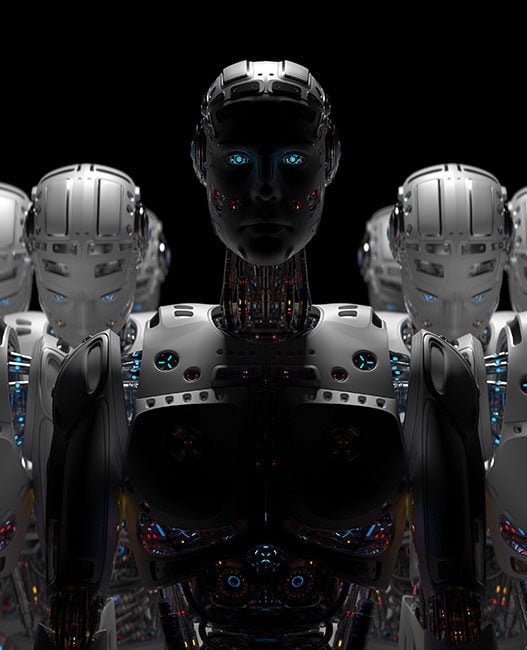
Walk through any robotics lab, and you’ll see humanoid robots performing impressive physical feats. What you won’t see are convincing faces. “A lot of people are building humanoids, they do backflips, they’re running, they’re walking,” Lipson says. “None of them have a face. They’re all missing a face because faces are really, really hard.”
“Human faces have about fifty degrees of freedom,” Lipson says. “Everything we do in terms of human communication has to do with moving those 50 muscles in a particular way: smiling, nodding, looking, talking, moving your lips, moving your eyes, frowning, everything.”
to do with moving those 50 muscles in a particular way: smiling, nodding, looking, talking, moving your lips, moving your eyes, frowning, everything.
Coordinating all those parts is extraordinarily difficult. But the real challenge isn’t only mechanical – it’s psychological.
“If you move your hands incorrectly, it’s okay,” Lipson says. “But if it smiles incorrectly, it’s really, really creepy.”
Humans read faces automatically and unforgivingly. A smile from a humanoid robot that’s slightly mistimed or asymmetrical doesn’t register as “almost right.” It triggers the uncanny valley – that visceral sense that something is amiss. And in caregiving, where trust is the whole game, a single wrong expression can undo weeks of confidence. That’s why getting the face right isn’t just a nice‑to‑have feature. It becomes a prerequisite for everything else.
Learning how to look normal
Still, the challenge isn’t just making the mechanics work. It’s about timing, context, and the thousands of micro‑adjustments humans make without thinking. A smile has to arrive at the right moment, match the emotional tone of the conversation, and fade naturally.
Get it right, though, and something remarkable happens.
“Once robots move their lips and use them in the correct way,” Lipson says, “they almost become alive. There’s something almost magical about that moment.”
That “magic” is what unlocks the door to physical caregiving, not because a face makes a robot stronger, but because it makes people willing to trust what comes next.
Compliance without softness
Although Lipson’s team has yet to achieve an authentic robotic smile in the way they set out to, they remain confident that compliant materials and adaptive control will become essential, just later in the timeline.
When robots do start performing physical tasks, they’ll need fundamentally different behaviours than factory robots.
“You can have a rigid robot that almost feels soft,” he explains, “just because the software makes it sort of … timid.” With enough sensors feeding back resistance data, even a metal‑framed robot can back off the moment it detects pushback, behaving less like a machine forcing its way through a plan and more like a cautious helper waiting for permission.
Whether this is achieved through physical materials or sophisticated software, compliance will matter enormously once physical assistance begins. But physical contact comes after trust, and trust is earned through repeated, uneventful success – day after day, interaction after interaction – until the robot feels normal enough to keep around.
Ask engineers about barriers to caregiving robots, and they’ll list complex technical challenges: actuators, sensors, power systems, and cost.
Lipson returns to something else. “The psychology of soft robots is going to be the biggest obstacle.” And the stakes only climb as the setting gets more sensitive.
Caregiving robots will follow a similar path, but with higher stakes and slower acceptance. The most capable robots won’t make a difference if people refuse to be near them. That’s why the deployment roadmap doesn’t match what engineers might assume. The most technically demanding tasks are also the ones that require the most trust. And trust has to be built from simpler interactions first: a robot that moves around the home without incident, a robot that doesn’t crowd you, a robot that can hold a conversation without unsettling you.
That’s why Lipson keeps coming back to the same deceptively simple standard. “It’s going to move in a normal way,” he says. “Getting it to be normal is the challenge.”
Normal for humanoid robots means a smile that doesn’t make you uncomfortable. A gaze that feels attentive without being intense. Lips that move naturally with speech. The tiny signals humans use to decide, in a split second, whether someone – or something – is safe to be near.
Robots that can do backflips still can’t smile naturally. And until they can, the path to physical caregiving – with all its sophisticated soft robotics technology – remains blocked by something as small as an expression.
The most complex caregiving tasks will eventually happen. But they’ll happen only after robots master something simpler: making a person feel comfortable enough to stay in the room. That starts with a smile.
Based on an interview with Mouser Electronics and Hod Lipson.
This article originally appeared in the July’26 magazine issue of Electronic Specifier Design – see ES’s Magazine Archives for more featured publications.