


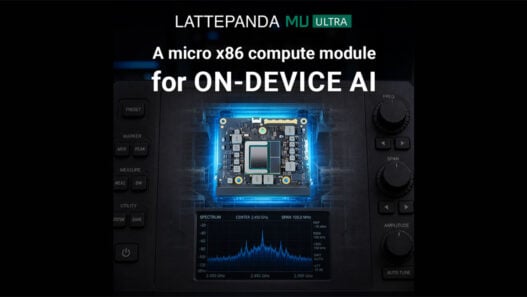

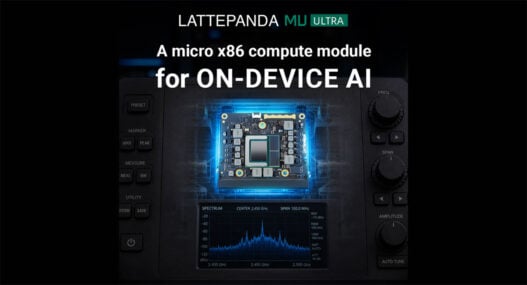
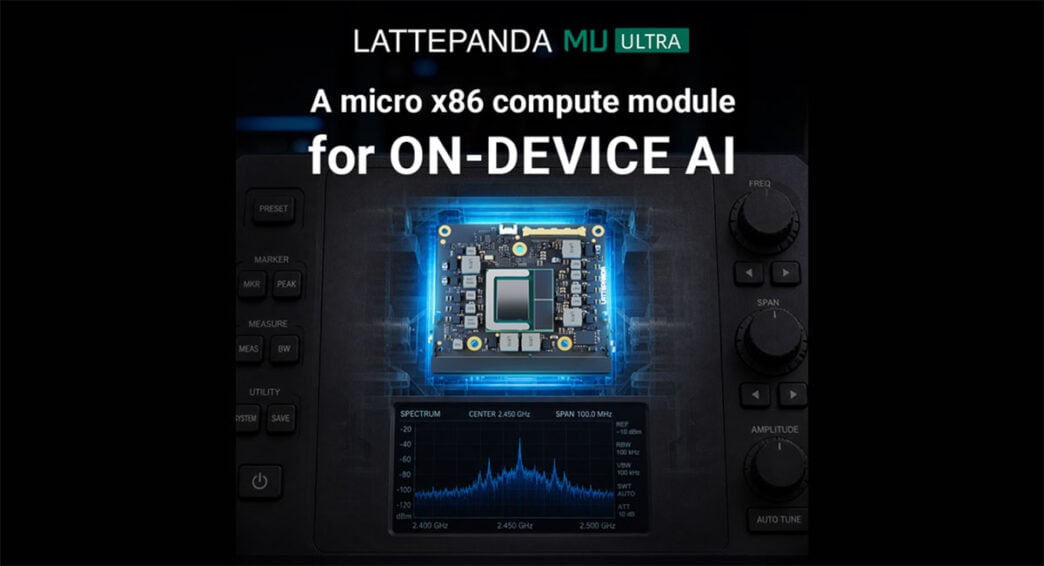
Run local conversational AI and vision workloads efficiently without Cloud reliance. The modular LattePanda Mu Ultra combines Intel Core Ultra processors with the x86 ecosystem for seamless system upgrades.
The integration of AI into physical devices has introduced hardware constraints regarding processing power, thermal dissipation, and space efficiency. While Cloud computing is an alternative, it introduces challenges like latency, bandwidth dependency, and data privacy vulnerabilities.
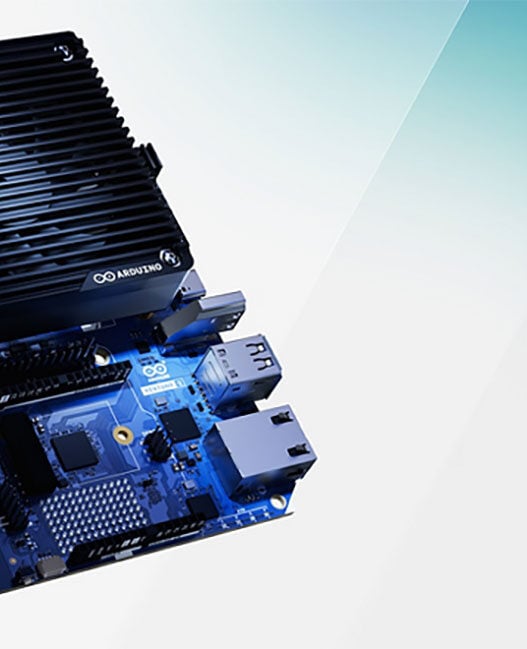
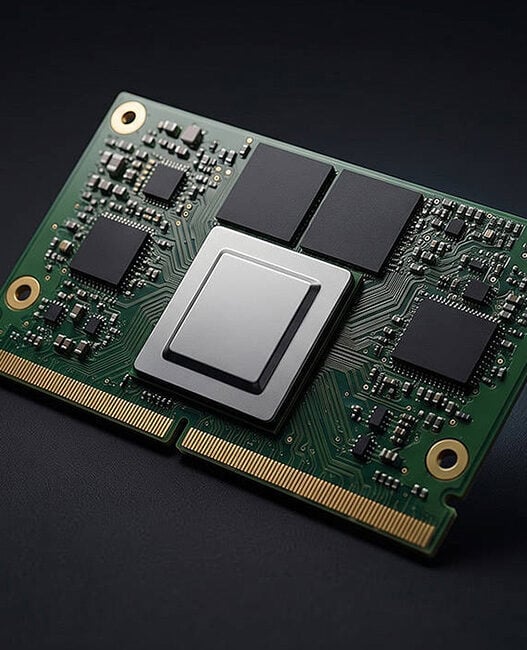
Addressing these hardware and software friction points, the LattePanda team has introduced the LattePanda Mu Ultra, a compact 69.6 × 60mm x86 compute module purpose-built for on-device AI. It brings local AI computing to engineering teams, system integrators, and OEMs across robotics, industrial automation, and intelligent Edge applications.
Architectural framework: 115 TOPS in a micro form factor
At the core of the LattePanda Mu Ultra lies a heterogeneous computing architecture powered by Intel Core Ultra processors. Depending on specific deployment requirements, system integrators can choose between the Intel Core Ultra 5 Processor 226V or the Intel Core Ultra 7 Processor 256V.
This system-on-module (SoM) delivers a total AI performance of up to 115 TOPS (INT8) by combining the processing bandwidth of its central processing unit (CPU), integrated graphics processing unit (GPU), and dedicated neural processing unit (NPU).
For intensive deep learning tasks, the dedicated NPU provides up to 47 TOPS INT8 of deterministic compute power. This offloads repetitive AI matrix multiplication workloads from the CPU and GPU, helping preserve compute resources for other system tasks.
Complementing the NPU is the integrated Intel Arc Graphics architecture, featuring up to eight Xe Cores, which handles parallel execution pipelines, computer vision arrays, and media decoding simultaneously.
This entire processing layout is compressed into a 69.6 × 60mm form factor, allowing the module to fit into space-constrained handheld diagnostics equipment or dense robotic control enclosures.
Memory architecture and on-device AI benchmarks
A persistent bottleneck in local AI inference is memory bandwidth. Large neural networks require rapid memory access to prevent processing cores from idling. The LattePanda Mu Ultra addresses this by embedding 16GB of LPDDR5X-8533 memory.
Furthermore, the system architecture allows for up to 11.6GB of memory allocated to the integrated GPU. This allocation capability enables the hardware to host larger language models and maintain a Key-Value (KV) Cache locally, helping reduce the risk of out-of-memory errors during prolonged operational cycles.
In performance benchmarks using the OpenVINO GenAI framework with INT4 quantisation on the integrated GPU (iGPU), the LattePanda Mu Ultra achieved a text generation speed of 18 tokens per second when running the Qwen3.5-9B model, and 55 tokens per second with the Qwen3.5-2B model.
These metrics demonstrate the module’s capacity to support responsive local conversational AI, local voice assistants, and offline document processing. This independent architecture removes reliance on external Cloud servers, reducing data transmission overheads while helping keep sensitive data on the device.
Thermal and power efficiency
Deploying field hardware requires a balance between computational output and strict power budgets. High power consumption leads to excessive thermal generation, which can be problematic in enclosed or battery-operated systems. The LattePanda Mu Ultra addresses this by maintaining an idle power consumption as low as 2.5W.
This efficiency makes the module suitable for always-on installations and portable, battery-powered medical or scientific instruments. When AI inference workloads demand peak computing spikes, the module scales its power delivery dynamically across its heterogeneous silicon to optimise performance-per-watt metrics.
Bridging the x86 ecosystem and modular hardware deployments
Transitioning an enterprise application from Cloud servers to physical devices often implies software rebuilding. The LattePanda Mu Ultra bypasses this barrier by supporting Windows and Linux operating systems, preserving compatibility with the established x86 software ecosystem.
Engineering teams can leverage open-source AI deployment tools and runtime frameworks such as Intel OpenVINO, llama.cpp, and Ollama. This allows legacy algorithms and existing x86 applications to be migrated directly to the device without rebuilding software architectures from scratch, reducing development costs.
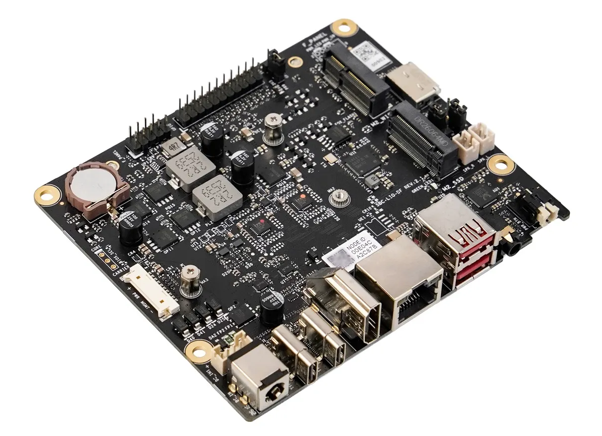
From a hardware integration standpoint, the LattePanda Mu Ultra retains the standardised form factor and connector layout of the wider LattePanda Mu family. This design ensures that the new module is compatible with existing carrier boards.
Hardware designers can swap out previous processing units and deploy the Mu Ultra module onto platforms like the 3.5-inch Lite Carrier Board, Mini Carrier, or the specialised M.2 M Key Carrier Board. This modular design saves companies from expensive carrier board redesign cycles, providing a straightforward upgrade path.
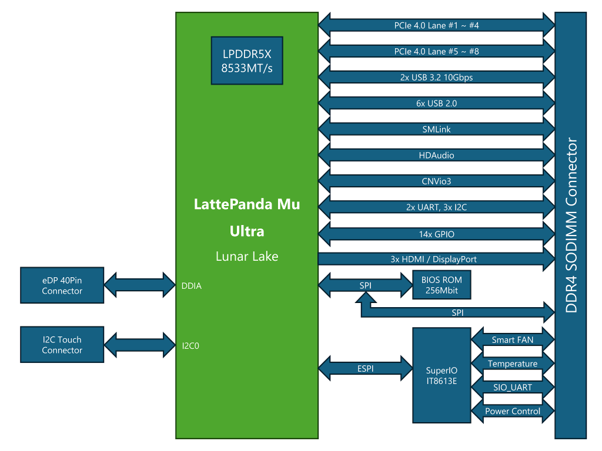
For hardware flexibility, the module breaks out an array of physical interfaces, including PCIe 4.0, USB 3.2 Gen 2, USB 2.0, HDMI / DisplayPort, eDP, GPIO, UART, and I2C.
Key application horizons
The architectural advantages of the LattePanda Mu Ultra support five primary application areas for intelligent design:
- Intelligent AI terminals: running LLMs locally for translation devices and voice command modules where low latency and data privacy are important parameters
- Portable instruments: integrating high-performance x86 computing blocks directly into handheld field devices, such as spectrum analysers and portable medical scanners, to enable real-time, AI-assisted analysis
- Autonomous mobile robots (AMRs): supporting real-time sensor fusion, SLAM navigation algorithms, and trajectory pathing within space-constrained robotic chassis designs
- Service robots: managing simultaneous multimodal AI workloads – including vision, voice, and LLM-based interfaces – on a singular, integrated compute module
- On-device vision AI: processing high-resolution video streams locally in automated smart security cameras and robotic inspection systems, facilitating low-latency defect detection while reducing cloud computing costs
Conclusion
As Cloud infrastructure operating costs increase, the demand for capable local hardware continues to grow. The LattePanda Mu Ultra addresses the on-device AI challenge by blending modular x86 flexibility with up to 115 TOPS of local AI performance in a compact footprint. Priced starting at $599, it provides system integrators and embedded engineers with a direct path to deploy advanced AI capabilities into real-world physical products.