







Emerging applications require flexible IoT device solutions that can support specialised requirements for hardware, software, and communications without compromising security or power budgets. In a growing number of applications, IoT devices are also expected to support multiple connectivity options. Each must be capable of maintaining reliable communications in increasingly crowded RF environments with various sources of radio frequency interference (RFI) and electromagnetic interference (EMI).
In these applications, different wireless protocols are essential for serving specific application requirements. Dual-band Wi-Fi 6 provides improved quality-of-service scheduling to maintain throughput in dense networks; BLE supports the need for low-power operation in short-range communications; and Thread enables large-scale, self-healing IPv6 mesh networks with device authentication and AES-128 encryption. These multiple connectivity options provide the foundation for the Matter protocol, which is an IP-based application layer that can operate over Wi-Fi or Thread, while relying on BLE for device commissioning and secure onboarding.
Meeting all of these requirements simultaneously has become a significant engineering challenge. Traditional discrete radio designs need multiple chipsets, RF front-ends, and host interfaces, which increases layout complexity, power consumption, and certification effort. Each added interface becomes a potential failure point during compliance testing or when operating across multiple protocols.
As development schedules tighten and regulatory expectations expand, more teams are moving toward standalone wireless microcontroller unit (MCU) modules that combine radio subsystems, processing resources, and integrated security within a single, prequalified component.
The u-blox IRIS-W10 series of MCU modules provides an integrated solution designed to meet the emerging challenges of advanced IoT design. By addressing multiprotocol coexistence, network efficiency, and protection of code and data at the module level, the IRIS-W10 series provides engineers with a reliable foundation for developing connected devices that can move from prototype to certification and deployment with fewer unknowns.
How the IRIS-W10 module architecture meets emerging demands
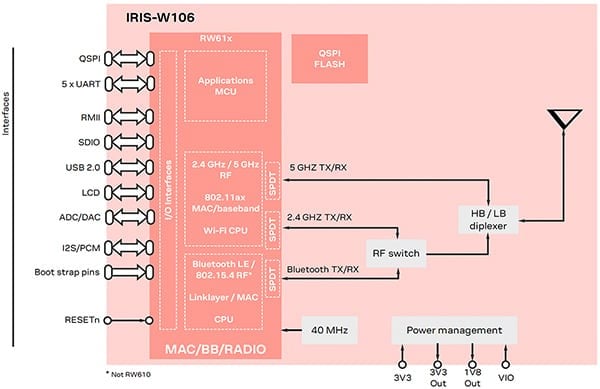
The IRIS-W10 series is a complete wireless system (Figure 1) that integrates high-performance processing, multiband radio subsystems, eXecute-In-Place (XIP) Flash memory, and hardware-based security to form a self-contained platform for building advanced IoT products.
Based on NXP’s RW612 and RW610 wireless MCUs, which integrate an Arm Cortex-M33 core and multiradio subsystem, IRIS-W10 modules combine high-performance processing with multiple connectivity options, including dual-band Wi-Fi 6 (IEEE 802.11 a/b/g/n/ac/ax), BLE 5.4, and Matter over Wi-Fi. Variants built on the RW612 MCU additionally support IEEE 802.15.4, Thread, and Matter over Thread.
The two families in the IRIS-W10 series meet different integration needs: IRIS-W106 modules integrate a printed circuit board (PCB) antenna, while IRIS-W101 modules bring out the RF signal for installations requiring external antenna configurations.
Within each family, specific members support different memory and connectivity requirements as follows:
- RW610-based modules (IRIS-W106-30B and IRIS-W101-30B) include 8 megabytes (Mbytes) of Flash memory
- RW612-based modules provide 8 Mbytes (IRIS-W106-00B and IRIS-W101-00B) or 16 Mbytes (IRIS-W106-10B and IRIS-W101-10B) of Flash memory, as well as IEEE 802.15.4-based connectivity, as mentioned above
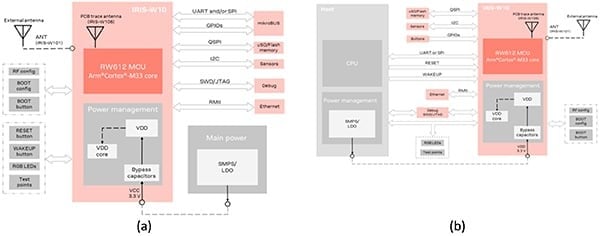
The consistent architecture of these modules enables developers to scale their existing designs more easily, meeting new requirements. In fact, any of these modules can operate as a standalone host (Figure 2a) in designs built for minimal power and footprint or as a companion processor to a separate host (Figure 2b) in designs with more complex functional requirements.
With its multiple connectivity options, the series helps ensure reliable communication in congested RF environments. Wi-Fi 6’s use of orthogonal frequency-division multiple access (OFDMA) and target wake time (TWT) scheduling improves channel efficiency in these environments, while BLE’s adaptive frequency hopping (AFH) minimises interference. IEEE 802.15.4 capability extends connectivity to Thread networks for low-power mesh and Matter interoperability.
Since the different RF technologies are never active simultaneously, the modules’ radios share a single RF chain and operate sequentially, using an internal RF switch to route radio traffic to the shared antenna or RF output.
While the availability of multiple connectivity protocols has become essential for a growing number of IoT applications, those applications increasingly require the ability to ensure the security of communications transactions within a trusted operating environment. To meet these security requirements, the IRIS-W10 series modules feature a hardware root of trust.
Application security begins with secure boot from validated non-volatile memory or USB sources using a secure bootloader preserved in the MCU’s embedded read-only memory (ROM). The foundation for application security rests on a trusted execution environment based on Arm TrustZone-M.
Additional security features include the critical elements required in any security chain, such as a hardware cryptographic engine, encrypted Flash memory, and protected debug interfaces, which safeguard firmware authenticity and operational data.
At the application level, these security features enable WPA2/WPA3 authentication, Wi-Fi enterprise security, Transport Layer Security (TLS) encryption, HTTPS, and BLE secure connection pairing. Together, these mechanisms establish a secure baseline for both firmware integrity and communications protection. With their tightly integrated protections, these modules enhance application cybersecurity without requiring additional discrete security devices.
By integrating high-performance processing, multiprotocol radio, and hardware-based security in a globally certified package, the IRIS-W10 series helps developers meet the combined demands of throughput, interoperability, and regulatory compliance.
For implementing advanced IoT devices, this integrated architecture provides a robust technical foundation for the rapid development of custom IoT applications using a comprehensive set of u-blox evaluation kits (EVKs) and development tools.
Accelerating the development of advanced IoT designs
Designed to complement IRIS-W10 series hardware, u-blox’s EVKs and associated software resources enable developers to progress efficiently from evaluation to application design. Together, these resources help developers examine module performance, verify radio behaviour, and build custom devices.
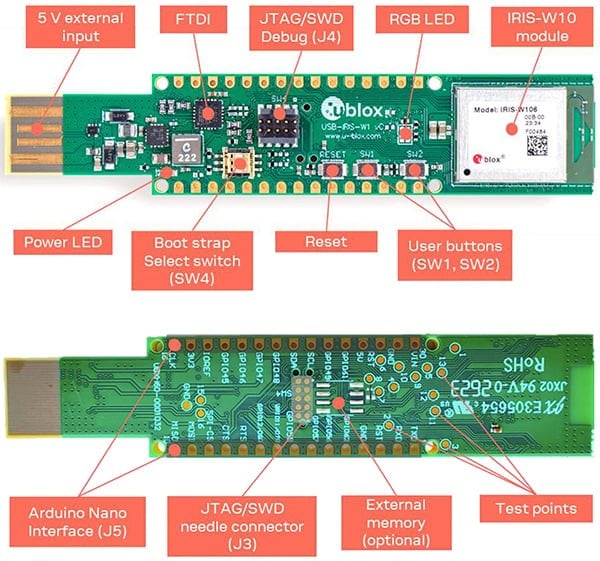
For initial evaluation and prototyping, the u-blox USB-IRIS-W1 evaluation tool enables developers to quickly explore the capabilities of the IRIS-W10 module. This kit integrates an IRIS-W106 module, basic user interface (UI) controls, and multiple interfaces on a small-form-factor PCB equipped with a USB Type-A connector (Figure 3).
The USB-IRIS-W1 comes preloaded with a Wi-Fi command line interface (CLI) application, allowing developers to plug it into a USB port on their workstation and immediately begin evaluating the module’s Wi-Fi capabilities.
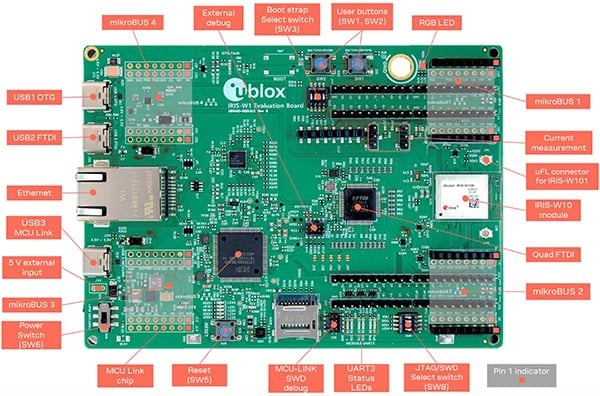
While the USB-IRIS-W1 kit offers a quick-start tool for module bring-up and CLI evaluation, the u-blox EVK-IRIS-W1 evaluation kit (Figure 4) provides a more comprehensive, standalone platform for evaluating each module, gaining experience with its features, and extending its capabilities.
This kit includes the EVK-IRIS-W106 board with an IRIS-W106-10B module or the EVK-IRIS-W101 board with an IRIS-W101-10B module. Along with the respective board, the kit includes an RJ45 Ethernet connector, a USB cable, and an antenna with a U.FL connector (for the EVK-IRIS-101 only).
Each board exposes multiple module interfaces, including UART, SPI, I²C, and USB ports. In addition, the board provides LEDs, basic UI controls, power measurement headers, a 10-pin debug connector, and four mikroBUS (MikroElektronika) connectors to extend the board’s capabilities.
Developers can quickly bring the board up by providing power through any of its four 5 VDC power inputs, including:
- The IRIS-W10 USB port provided by a USB peripheral
- The debug/UART port
- The MCU-LINK USB port
- The power header
The EVK-IRIS-W106 and EVK-IRIS-W101 each come with a preloaded demonstration image that enables immediate evaluation of Wi-Fi 6 and BLE after power-up. Module firmware enables engineers to measure throughput and latency, evaluate power consumption, and inspect configuration registers through the serial console.
Using the EVK’s power-measurement headers, developers can quantify current draw during various communication states to validate energy-performance trade-offs in designs that must meet low-power or battery-operated requirements.
Multiple software resources help simplify application development
For custom application development, the IRIS-W10 series follows an open CPU operating model, which u-blox supports with its Open CPU repository of open-source reference code designed to run on the EVKs.
In this operating model, the module processor is available for running custom applications built with NXP’s MCUXpresso software development kit (SDK) or Zephyr, and is developed using popular integrated development environments (IDEs) and toolchains, including NXP’s MCUXpresso IDE, the GNU compiler collection (GCC), or IAR’s Embedded Workbench.
The NXP SDK offers a comprehensive set of libraries, connectivity stacks, support utilities, and reference code for developing applications based on NXP MCUs. In a runtime environment, the SDK’s modular architecture helps ensure isolation of hardware-dependent layers and drivers from higher-level application logic.
By referencing sample code in the Open CPU code repository and SDK, developers can quickly implement the custom firmware needed to support their IoT application’s unique requirements.
For loading their custom firmware, the EVK-IRIS-W1 and USB-IRIS-W1 evaluation kits support flashing firmware through an external debugger. In addition, EVK-IRIS-W1 kit boards support firmware updates through their onboard debugger, while the USB-IRIS-W1 supports firmware updates via the UART port using NXP’s MCU bootloader host application. For ongoing test and debug, both kits support standard JTAG and SWD interfaces through onboard ports.
Because all hardware, software, and certification assets remain consistent across module variants, no major design rework is required to scale an existing design to support additional memory or communications protocols. When designs are complete, developers use the same IRIS-W10 modules and development environment to transition to production.
Finally, the global certification of all IRIS-W10 modules simplifies end-product integration and regulatory documentation in target regions.
Conclusion
Meeting the growing demand for secure, multiprotocol connectivity in IoT devices continues to present significant challenges in achieving low power consumption, robust wireless performance, and global certification within tight development schedules.
The u-blox IRIS-W10 series combines embedded processing, multiradio connectivity, and integrated security within a globally certified module platform. Using hardware evaluation kits and software resources optimised for the IRIS-W10 modules, developers can rapidly evaluate, prototype, and deploy secure, interoperable IoT systems efficiently.
This article originally appeared in the May’26 magazine issue of Electronic Specifier Design – see ES’s Magazine Archives for more featured publications.