




As power density demands intensify across both automotive and data centre applications, the packaging technologies used to deliver that power are becoming just as critical as the silicon itself.
In this first instalment of a four-part series exploring Texas Instruments’ latest advances in sustainable energy design, we look at how isolated power modules are helping engineers meet the dual challenge of higher performance and smaller footprints.
Isolated power modules with IsoShield technology
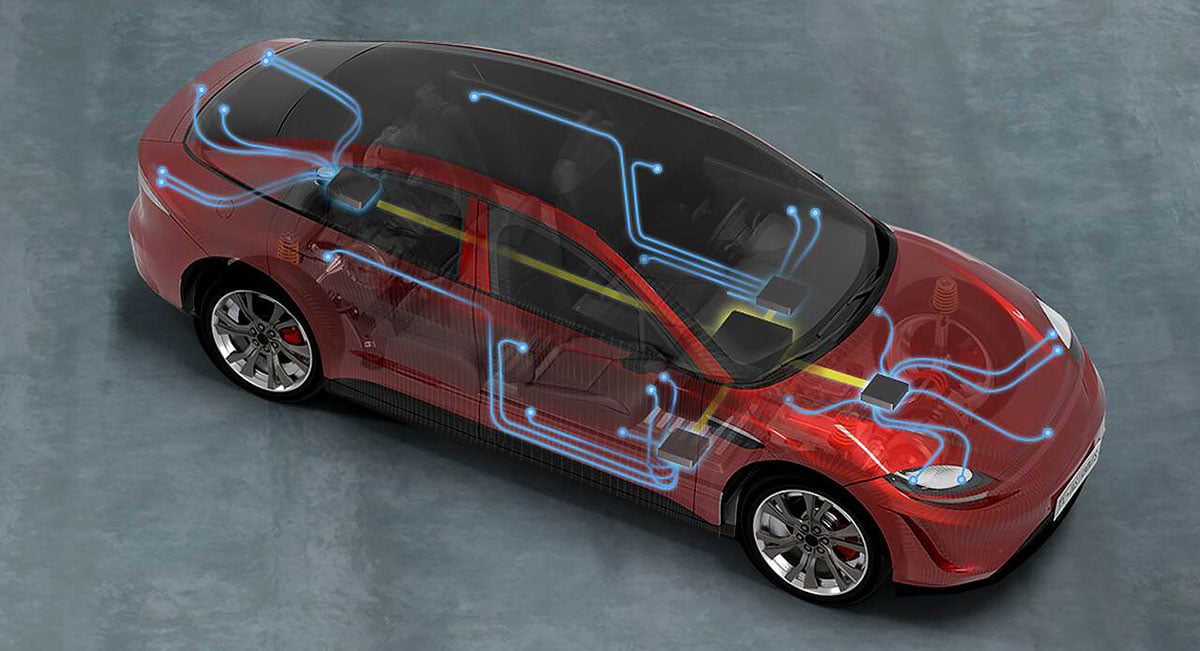
Expectations of EV performance continue to evolve, requiring engineers to support high battery voltages and faster-switching FETs while reducing vehicle weight, improving efficiency, and providing galvanic isolation to protect systems from transients and noise in harsh environments with extreme temperatures, vibration, and electromagnetic interference (EMI).
Meanwhile, AI computing demands require greater power density in data centres, with designers tasked to pack more power into smaller spaces while facing similar isolation challenges in multi-kilowatt PSUs, backup battery units (BBUs), and server racks.
Isolated power modules using TI’s proprietary IsoShield packaging technology address these constraints by integrating transformers, switching devices and passive components to meet isolation requirements while reducing size by as much as 70% compared to existing solutions.
Why packaging is the next frontier in power design innovation
Compared to just a decade ago, today’s vehicles deliver a fundamentally different experience. Drivers benefit from smoother acceleration, enhanced safety through advanced driver assistance systems, seamless over-the-air feature updates, and longer battery range in electric vehicles.
Each of these advancements is enabled by the addition of electrical components onto a circuit board. But to do so, engineers must integrate more power, intelligence and functionality into a tightly constrained space.
TI unveils high-performance isolated power modules
Texas Instruments (TI) recently unveiled new isolated power modules, helping enable increased power density, efficiency and safety in applications ranging from data centres to electric vehicles (EVs). The UCC34141-Q1 and UCC33420 isolated power modules leverage TI’s IsoShield technology, a proprietary multichip packaging solution that achieves up to three times higher power density than discrete solutions in isolated power designs.
Power modules
Make power easy. TI’s power modules integrate both active and passive components of a power design into a single package. The integration of these functions allows our power modules to be simpler and more efficient than standard discrete solutions, while still capable of delivering plenty of power.
TPSM8F7620
The TPSM8F7x20 is a power-dense quad-channel buck power module designed to provide efficient and reliable power conversion for a wide output voltage range from 0.6V to 11V. The module integrates MOSFETs, inductor, and select capacitors to reduce board space and layout complexity. The module can be configured into both multiphase and multi-output rails by supporting 2, 3, and 4-phase stackability with interleaved phases. Under steady-state conditions the module operates in FCCM with a fixed-frequency that is resistor adjustable from 400kHz to 2.2MHz and synchronisable to an external clock.
TPSM8287B15
The TPSM8287Bxx is a family of pin-to-pin, stepdown, DC/DC power modules with differential remote sensing and I2C interface. The power modules use TI’s MagPack technology to integrate a synchronous step-down converter, an inductor, input and output capacitors to simplify design, reduce external components and save PCB area. The low-profile and compact design is designed for assembly by standard surface mount equipment. The TPSM8287Bxx family implements an enhanced control scheme that supports fast transients. The TPSM8287Bxx can operate in fixed-frequency or power save mode.
TPSM65630
The TPSM656x0 is a family of 3A, 2A, 1A, 65V (70V tolerant) input synchronous step-down DC/DC power module that combines power MOSFETs, integrated inductor, and passives in a compact and easy-to-use 5.8mm × 5.2mm × 2.93mm, 19-pin enhanced HotRod QFN package. With the pin-selectable fixed-output voltages of 3.3V and 5V and adjustable output voltage from 1V to 24V, the TPSM656x0 is designed with ZEN 1 technology to quickly and easily implement a low-EMI design in a small PCB footprint. The module only requires the input and output filter capacitors to finish the design and eliminates the magnetics and compensation part selection from the design process.
Isolated power modules (integrated transformer)
TI’s portfolio of isolated power modules combines high-density integrated field-effect transistor and integrated transformer technology to help reduce your bill of materials and simplify your isolated DC/DC designs. By integrating transformers with advanced packaging, including our new IsoShield technology, these modules deliver enhanced performance, smaller solution sizes and improved system reliability. The portfolio includes a variety of input/output voltages, output power and certified isolation levels for both automotive and industrial sectors.
UCC33420
The UCC33420 is an industrial DC/DC power module with integrated transformer technology designed to provide 1.5W of isolated output power. It can support an input voltage operation range of 4.5V to 5.5V and regulate 5.0V output voltage with a selectable headroom of 5.5V.
UCC34141-Q1
UCC34141-Q1 is an automotive qualified, reinforced isolation, high working voltage, DC/DC power module designed to provide power to SiC and IGBT isolated gate drivers. TI’s proprietary integrated transformer and advanced control architectures achieve high power density, low noise, and a low system bill of materials. This device is capable of delivering 1.5W typical output power at 85°C ambient temperature. The highly accurate dual-output voltages, easily set by resistor dividers, enables low on-resistance, fast and reliable switching for SiC/IGBT. The low-latency feedback control reduces the output capacitance for fast load transient and supports dynamic voltage programming. The wide input voltage and adjustable VIN UVLO supports both wide battery voltage of electric vehicles and regulated input rails. The device is operational from 5.5V to 20V VIN, and can withstand VIN overvoltage transients up to 28V.
Together, these power module families illustrate a broader shift in power design: packaging innovation is now doing as much heavy lifting as component-level advances in driving efficiency and density gains. As TI continues to expand its IsoShield and MagPack portfolios, engineers across the automotive and data centre sectors gain more flexibility to meet isolation, thermal, and space constraints without compromising on performance.