








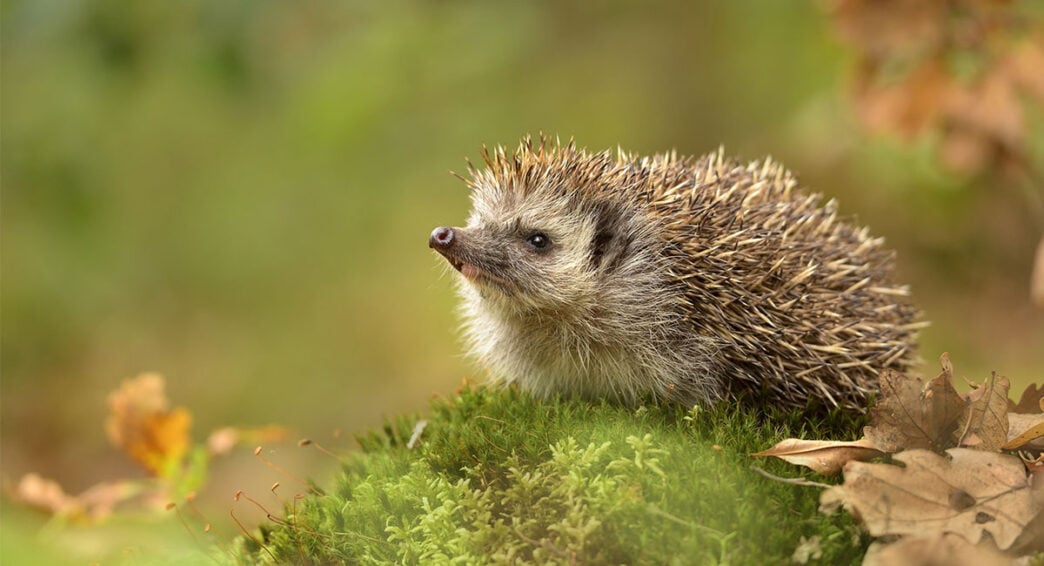
Hedgehogs are lovable additions to the countryside, and increasingly, in urban areas. But these adorable creatures are in decline in the UK. According to The State of British Hedgehogs reports, since 2000, British hedgehog numbers have dropped by up to 75% in rural areas. According to the International Union for Conservation of Nature in 2024, the European hedgehog was classified as ‘near threatened’ due to their rapidly declining population.
In recent years there have been efforts into helping hedgehogs in gardens. Hedgehog highways are small openings cut at ground level in fences or walls, so hedgehogs can move freely between gardens and green spaces. This has been adopted by some of the big housebuilding companies in the UK, and has proven to be successful. On a smaller scale, people are becoming more educated on how to deal with hedgehogs in their gardens, such as minimising chemicals and slug pellets, leaving out shallow bowls of water, and providing cat and dog food to any unexpected prickly guests.
But outside of these natural solutions, technology is coming to save hedgehogs’ day, and a whole host of technologies are being used to track and save hedgehogs.
How Satellite data and AI can help hedgehogs
One of the ambitious technologies coming to the rescue is TESSERA, an AI model developed by researchers at the University of Cambridge. Rather than tracking individual hedgehogs, TESSERA analyses thousands of satellite measurements to generate detailed maps of the Earth’s surface. In partnership with the Cambridge Conservation Initiative, the team behind TESSERA has been using the tool to map hedgehog habitats across the UK, with the aim of better understanding the environmental pressures driving the animals’ decline.
Rural hedgehogs have suffered the highest losses as their habitats are increasingly fragmented by open fields and busy roads that cut off connections between remaining populations. Professor Anil Madhavapeddy, who co-leads TESSERA’s development, believes the tool could help identify where these pressures are most critical and guide efforts to protect or reconnect habitats before it’s too late.
TESSERA works by processing petabytes of satellite data, treating each pixel as a stack of information about a 10m x 10m patch of the Earth’s surface, dense enough to fill in gaps caused by cloud cover. For the hedgehog project, researchers trained the model to recognise light patterns that are produced by bramble bushes, as this is the type of tangled cover hedgehogs depend on for shelter and protection from predators.
In order to validate the output of TESSERA, the researchers went out and checked sites it had flagged around Cambridge. Every one turned out to contain brambles – including one surprising hit in a residential area that turned out to be an overgrown building site, its brambles growing wild while houses were demolished and awaiting redevelopment. The researchers are still working through the full set of habitat maps and hope to publish their findings later this year.
How ultrasound can help hedgehogs
Another breakthrough has come from researchers at the University of Oxford, who have discovered that hedgehogs can hear in ultrasound. This finding could pave the way for devices to steer them away from roads. Road traffic accidents are believed to be a major cause of hedgehog deaths, which are thought to kill up to one in three in local populations, and until recently, it wasn’t known whether hedgehogs could perceive the high-frequency sound that a repellent device would need to use.
The research team tested the hearing of 20 rehabilitated hedgehogs from wildlife rescue centres in Denmark, using electrodes to measure the brain’s response to sound played through a small speaker. The results showed hedgehogs can hear frequencies from 4 up to at least 85kHz, with peak sensitivity around 40kHz, comfortably sitting in the ultrasonic range, which starts above 20kHz. Micro-CT scans of a hedgehogs ear revealed unusually small, dense middle-ear bones and a stiffened joint between the eardrum and the first bone, features shared with ultrasound specialists like bats, which allow high-pitched sounds to pass through efficiently.
These findings suggest that it should be possible to build ultrasonic repellents that hedgehogs can hear but humans and pets cannot, potentially warning them away from roads, robotic lawnmowers, and garden strimmers. Lead researcher Dr. Sophie Lund Rasmussen said the next step is finding car industry partners to help fund and design such devices – work that, if successful, could meaningfully cut one of the biggest threats facing Europe’s declining hedgehog population, and keep the prickly friends safe. This would, in theory, help to minimise deaths to hedgehogs caused by the devices that are most harmful to the creatures by alerting them to the dangers before they present themselves.
GPS and tracking
A project led by Ulster Wildlife is taking a more hands-on approach by fitting hedgehogs with tiny GPS ‘backpacks’ and enlisting a specially trained detection dog to track them. The project attaches a small device to the lower back of male hedgehogs (females are left undisturbed to avoid disrupting nesting) to map exactly where they travel every night; from which gardens they pass through, which roads they cross, and where they find food and shelter.
Research shows that hedgehogs are increasingly retreating into towns and cities, making urban gardens their last refuge, yet little is known about how they actually navigate these environments or what obstacles they face there.
Helping fill the gaps in the research is Russell, a young cocker spaniel and Ireland’s first hedgehog detection dog, trained by Conservation Detection Dogs NI. Russell’s handler, Patrice Kerrigan, explained that most existing data comes only from hedgehogs that visit feeding stations – so Russell is being used to track down hedgehogs that don’t, as well as to relocate tagged animals whose GPS devices stop transmitting.
The data gathered through tracking is intended to directly inform conservation action, including practical changes people can make in their own gardens.
A safer future for hedgehogs
What all of these projects are trying to protect is something increasingly rare: just a small garden visitor that we are seeing less and less of. Hedgehogs travel further and range wider than most people realise, up to 3km in a single night, and across territory spanning 20 hectares. This means that their survival requires group effort, not dependent on just one garden, hedge, or field, but the connection between them all, as well as the small choices people make in regards to slug pellets, strimmers, fences, and the upkeep of their gardens.
Technology is trying its hardest in helping hedgehogs and their quickly plummeting numbers across the UK and Europe. However, at the end of the day, hedgehog’s fate still comes back to fairly low-tech solutions. From gaps in fences for them to pass through, a patch of brambles to hide in, and a garden free of chemicals for it to forage safely.
With research now underway, mapping their habitats from space, learning how they hear, and tracing their nightly journeys, is really just trying to answer old questions with new precision: where do hedgehogs go, what do they need, and what’s standing in their way. Answering these questions properly, and implementing the change needed, may be the difference between a familiar garden visitor and a memory of one.