





Connected and digitised vehicles, machines, and energy systems place new demands on electronics. From now on, electronics must not only deliver high-performance but also detect cyberattacks, contain disruptions, and enable secure updates. Cyber resilience is therefore becoming a key factor for trust, availability, and market success.
electronica 2026, taking place in Munich from 10-13th November, will showcase the technologies that are essential for this.
Industrial systems, vehicles, and energy systems are increasingly evolving into networked electronic systems that are controlled, updated, and secured via software. Security mechanisms can therefore no longer be added as an afterthought but must instead be integrated right from the start into the system design, particularly for interfaces, updates, and software-defined functions.
At the same time, customers, regulators, and operators expect solid proof of the security and updatability of electronic systems. “As the world’s leading electronics trade fair, electronica 2026 in Munich brings together key players from across the entire value chain. In doing so, it creates a framework for addressing cybersecurity not in isolation, but as a shared architectural challenge for the electronics industry,” explains Caroline Pannier, Exhibition Director of electronica.
Studies show growing pressure to act
Recent studies show how important an issue this is. The ENISA Threat Landscape 2025 report, for example, identifies attacks on public administration and the transport sector as the most common targets of cyberattacks, with phishing being the most frequently used method. In many cases, hackers target companies’ operational technology (OT).
However, according to a PwC study, only about 15% of German companies have so far invested specifically in proactive security and resilience measures. The vast majority remain reactive: Investments are only made after incidents occur or as part of regular updates, without a systematic transformation concept for prevention.
Increasing regulation of cybersecurity
To encourage companies to take action and integrate security into products from the outset, the European Union has enacted the Cyber Resilience Act (CRA). It specifically regulates products that companies place on the European market. Among other things, it requires that products with digital components remain secure throughout their expected service life and address vulnerabilities throughout their lifecycle. It covers a wide range of electronic products, not just internet-enabled devices, but essentially all products with a direct or indirect logical or physical connection to a device or network.
Effectively countering cyberattacks
As a result, the CRA makes security a key development requirement. At the same time, AI-based systems give rise to new risks: data poisoning, model poisoning, and adversarial attacks can manipulate AI models and lead to incorrect decisions. Developers are responding to this with ‘security by design’ – that is, with security mechanisms integrated from the outset into the architecture, secure firmware, and verifiable updates.
At the component level, this includes a hardware root of trust, Secure Boot, and Trusted Platform Modules (TPMs). Secure microcontrollers (MCUs) implement security functions directly within the device, ensuring, for example, that only authenticated firmware or signed code is executed during system startup.
Exhibitors showcase relevant technologies
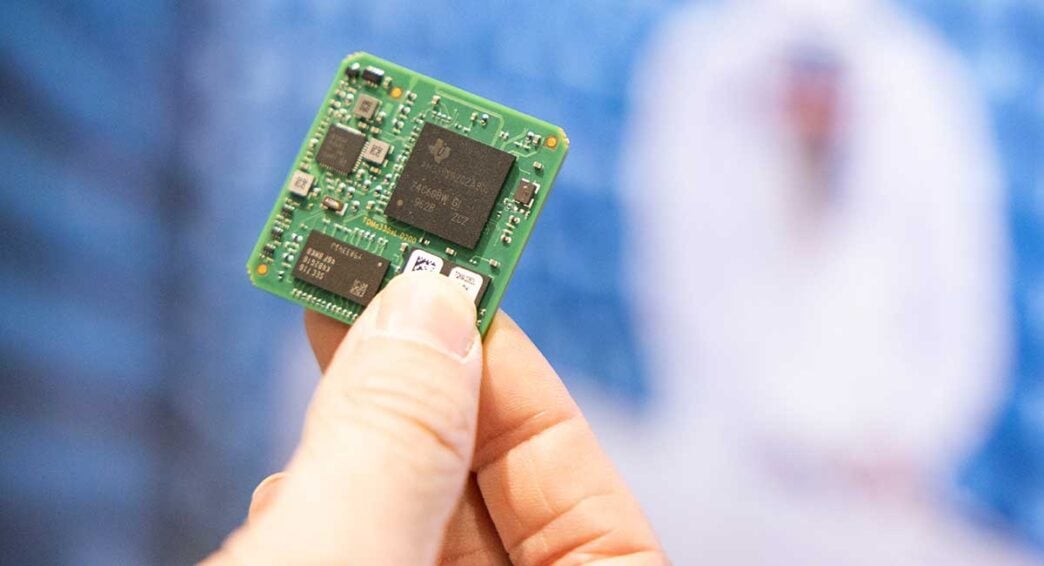
At electronica, numerous exhibitors will present their innovations and solutions for resilient electronics. Infineon, for example, will address the issue of cyber resilience with, among other things, its ‘Optiga’ security solutions for embedded security. In the context of secure, connected devices, Renesas primarily offers its secure ‘RA’ microcontrollers, including isolated cryptographic operations, secure key storage, Arm TrustZone technology, and protection measures against side-channel attacks. Texas Instruments is expanding its product portfolio with its AM263x Sitara MCUs, providing, among other things, Secure Boot, cryptographic keys, and a hardware security module.
electronica as a platform for resilient electronics
The supporting program at electronica will also focus on cyber resilience, for example in the Cyber Security Forum and in a series of presentations and workshops on the Cyber Resilience Act. Industry experts will provide insights into the latest technologies as well as practical approaches and strategies for resilient electronic products. With this framework, electronica 2026 will provide developers, technical decision-makers, and CEOs with concrete guidance on how to make their companies more resilient against cyberattacks.
Here you can find more information about the focus topic cyber resilience.