




1. Industry background: intelligent driving accelerates adoption, automotive LiDAR enters a period of rapid growth
The global automotive industry is rapidly advancing toward L3/L4 autonomous driving. As a core sensing component of intelligent vehicles, the stability of automotive LiDAR directly impacts the safe operation of autonomous driving systems. Whether in mechanical or solid-state LiDAR architectures, the transmitter module, receiver module, and backend computing unit all place stringent demands on power quality and component reliability. Any performance fluctuation in critical electronic components can lead to reduced sensing accuracy, abnormal system response, and ultimately affect vehicle decision-making and driving safety.
2. Existing technical challenges in the automotive LiDAR industry and key pain points for Tier 1 suppliers
At present, global automotive LiDAR Tier 1 suppliers and vehicle manufacturers continue to face challenges related to conventional component selection during the mass-production stage. These issues are primarily concentrated in three key areas:
1) Technical reliability and safety risks
Under automotive operating conditions involving repeated high- and low-temperature cycling, MLCCs can generate internal mechanical stress due to the inverse piezoelectric effect, resulting in performance degradation or even component failure. This issue can directly affect LiDAR response accuracy and operational stability, potentially compromising vehicle active safety functions.
2) Cost pressure and after-sales burden
Abnormal LiDAR operation may lead to inconsistent performance of critical functions such as automatic emergency braking and collision avoidance. Once such failures reach the end market, they can result in significant maintenance costs. In the event of large-scale recalls, manufacturers may face substantial financial losses, while also suffering long-term damage to brand reputation.
3) Supply chain stability risks
The MLCC industry has long been affected by price fluctuations and supply shortages. Historical instances of price increases and supply disruptions have delayed project schedules for multiple automotive manufacturers. As a result, supply chain stability has become a critical consideration in vehicle development and production planning.
3. Root cause analysis: technical limitations and failure mechanisms of MLCC solutions
The root cause lies in the mismatch between the physical and electrical characteristics of MLCCs and the demanding operating environment of automotive LiDAR systems. MLCCs utilise ceramic dielectric materials that exhibit an inverse piezoelectric effect when subjected to an electric field, causing high-frequency micro-vibrations within the capacitor body. Automotive LiDAR systems, meanwhile, operate continuously under severe vibration and wide temperature fluctuations. The combination of internal and external stresses can easily generate microcracks within the MLCC structure, leading to increased leakage current, capacitance degradation, and ultimately component failure.
Conventional solutions, whether based on Japanese or other MLCC brands, cannot fundamentally eliminate the inherent material characteristics and piezoelectric effects associated with ceramic dielectrics. For LiDAR applications, where long-term reliability is critical, the industry is increasingly recognising the need for alternative capacitor technologies that can overcome these intrinsic limitations.
4. YMIN hybrid aluminium electrolytic capacitor solution: advantages in technology, manufacturing, and quality control
To address these industry challenges, YMIN has developed a dedicated hybrid aluminium electrolytic capacitor solution, providing a new option for automotive LiDAR power supply systems.
Why choose YMIN
1) Leading market position and automotive mass-production experience
YMIN is one of China’s leading suppliers of hybrid aluminium electrolytic capacitors by shipment volume, with extensive experience in mass-production automotive projects. Its technological maturity and market acceptance rank among the industry’s leading players.
2) Advanced quality control system
YMIN has established a high-standard quality management system, featuring 98% production-line automation, 95% digitalisation coverage across manufacturing processes, and 70% intelligent manufacturing coverage. Product quality and reliability are benchmarked against leading international brands.
Key technical advantages
1) No piezoelectric effect
Unlike ceramic-based MLCCs, YMIN hybrid aluminium electrolytic capacitors utilise a hybrid aluminium electrolytic technology platform and dielectric materials that do not exhibit piezoelectric effects. This fundamentally eliminates vibration-induced performance degradation associated with MLCCs.
2) Excellent vibration resistance
The hybrid structure combines the low ESR characteristics of polymer capacitors with the self-healing capability of liquid electrolytic capacitors, providing significantly higher mechanical robustness than conventional MLCC solutions.
3) Stable performance across wide temperature ranges
Electrical parameters remain stable throughout automotive-grade operating temperature ranges, ensuring reliable performance in the complex and demanding environments faced by automotive LiDAR systems.
5. Recommended product models and application points
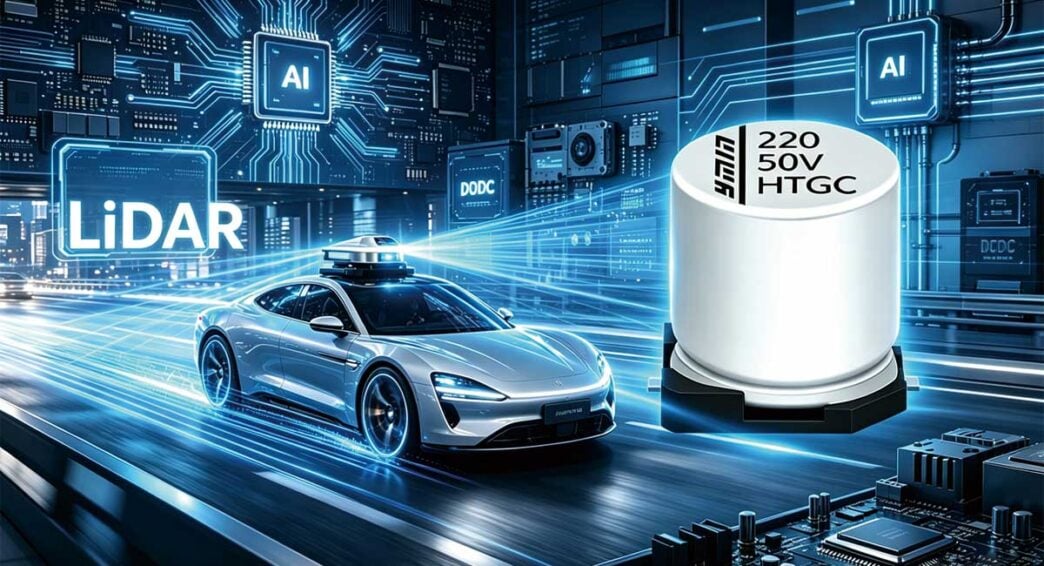
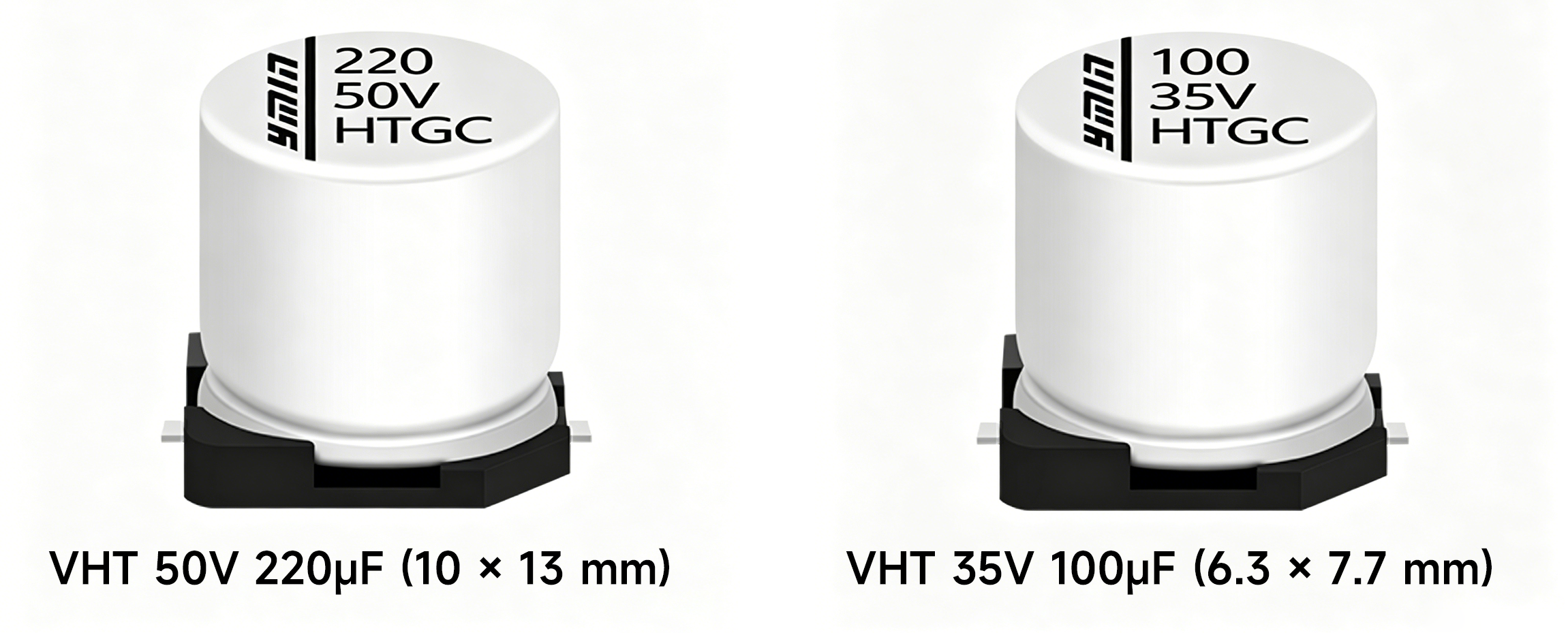
For key automotive LiDAR circuits, YMIN recommends the VHT Series Hybrid Aluminium Electrolytic Capacitors:
1) VHT 50V 220μF (10 × 13mm)
This capacitor is recommended for the input stage of LiDAR transmitter circuits and high-performance computing modules. It provides a stable and sufficient energy supply, helping maintain voltage stability during high-power pulse transmission and ensuring reliable system operation.
2) VHT 35V 100μF (6.3 × 7.7mm)
This capacitor is designed for the output stage of DC-DC converter circuits. With its low ESR characteristics, it effectively suppresses ripple voltage and delivers clean power to sensitive downstream devices such as computing processors and FPGAs, minimising the risk of data-processing errors caused by power supply noise.
6. Real-world results and full lifecycle value analysis
After adopting the YMIN hybrid aluminium electrolytic capacitor solution, customers achieved measurable technical and commercial benefits.
Technical results
- The solution fundamentally eliminates LiDAR response inconsistencies and operational instability caused by MLCC performance degradation
- DC-DC converter output ripple is significantly reduced, improving power-supply cleanliness for high-performance computing cores and substantially lowering system bit error rates (BER)
Commercial benefits (TCO perspective)
1) Overall cost optimisation
Compared with high-capacitance automotive-grade MLCC solutions, the YMIN solution offers a more competitive per-component cost while simplifying PCB EMC design requirements, resulting in a lower overall BOM cost.
2) Improved space efficiency
A single capacitor can replace multiple parallel-connected MLCCs, supporting LiDAR miniaturisation and enabling more compact product designs, thereby enhancing end-product competitiveness.
3) Reduced after-sales risk
By eliminating the root causes of performance degradation associated with conventional capacitor solutions, the risk of vehicle field failures is significantly reduced. This effectively converts unpredictable after-sales expenses into controllable procurement costs.
4) Strategic value for vehicle programs
The solution meets automotive lifetime and reliability requirements, helping support the successful mass production and market deployment of L3/L4 autonomous driving vehicles.
Why re-evaluate from a TCO perspective?
Even when there are differences in unit purchasing prices, the total cost of ownership should be evaluated across the entire product lifecycle. A modest investment in more reliable components can help offset repair expenses, warranty claims, brand reputation risks, and safety-related liabilities. From a TCO perspective, the YMIN hybrid capacitor solution reduces hidden downstream costs and delivers a lower overall ownership cost while improving long-term system reliability.
7. Driving the future of autonomous mobility together: YMIN looks forward to deep collaboration with global Tier 1 customers
As the automotive LiDAR industry evolves from merely achieving functionality to pursuing ultimate reliability, component selection is no longer just a technical consideration – it has become a strategic decision encompassing safety, cost optimisation, and supply chain resilience.
With its ability to address the inherent limitations of conventional solutions, deliver quantifiable Total Cost of Ownership (TCO) benefits, and maintain an industry-leading quality control system, YMIN hybrid aluminium electrolytic capacitors have become a preferred solution for many leading Tier 1 suppliers and automotive manufacturers.
We welcome partners across the global automotive electronics industry to engage with YMIN for sample evaluation and technical support. Together, we can help build a safer, more reliable foundation for the next generation of intelligent driving systems.
Website: www.ymin.cn
Email: ymin-sale@ymin.com