






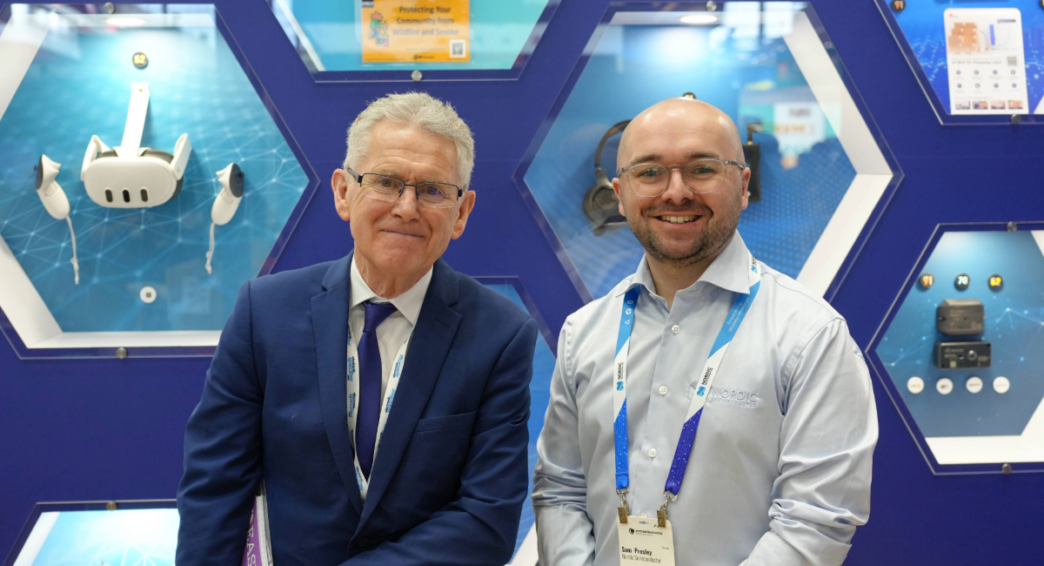
At embedded world 2026, our editor Mick Elliott speaks with Sam Presley, Technical Product Manager and Geir Kjosavik, Product Director at Nordic Semiconductor.
Nordic Semiconductor used this year’s embedded world to showcase a series of significant announcements, spanning new silicon, Edge AI capabilities, Cloud services, and advanced battery management technology, spotlighting the company’s ambition to lead the next generation of connected, intelligent devices.
Expanding the nRF54L series
Presley spoke about how Nordic has been intensively growing its nRF54L portfolio since the series first came to market at the end of 2024, and two new devices were announced at the show. The first, the nRF54LS05A, represented the new entry point within the 54L series. A half-megabyte Bluetooth Low Energy SoC, designed to offer a cost-effective solution for customers whose applications do not demand the highest levels of memory or feature complexity, while still delivering ultra-low power Bluetooth performance. Applications for the device are “wide-ranging”, from asset trackers and PC peripherals to advanced HID gaming devices.
Edge AI comes to the nRF54L series
The second major announcement was the nRF54LM20B, Nordic’s first device featuring an integrated AI acceleration engine. First revealed at CES, the device reached a new milestone at embedded world with the release of its accompanying software and the broad availability of development kits through distributors. The nRF54LM20B is designed to enable on-device Edge inference at very low power consumption, delivering significantly faster performance than would be achievable using a CPU alone.
Lifetime FOTA through nRF Cloud
A significant announcement was the new Cloud service offering, built on Nordic’s acquisition of Memfault. The nRF Cloud platform has expanded to include a lifetime FOTA (Firmware Over-the-Air) solution – a development Presley highlighted as particularly timely given incoming regulations such as the EU’s Cyber Resilience Act, which is set to take effect in 2027. For a one-time fee, customers would be able to deploy firmware updates to their products over their entire product lifetime, with no recurring costs. Presley highlighted how this gave customers a highly predictable cost model for what was becoming an essential compliance requirement.
Building on that foundation, Nordic also offers optional observability features through nRF Cloud, allowing manufacturers to monitor how their deployed devices are performing in the field. Through integration with the Memfault SDK, companies can track metrics such as battery life and fault occurrences, and correlate issues with specific firmware updates, enabling them to pause rollouts and address problems before they affect the wider user base. Presley notes that no amount of pre-shipment testing can fully anticipate how users will behave or the environments in which products will be used, making real-world telemetry a powerful tool for continuous product improvement.
PMIC fuel gauging and battery health monitoring
Kjosavik then discussed innovations around Nordic’s PMIC product line, specifically a new approach to battery health monitoring. Nordic’s PMIC already provides host SoCs and MCUs with precise battery current, voltage, and temperature data to calculate state of charge through a sophisticated algorithm. The new development extends this by allowing the mathematical model underpinning that calculation to adapt continuously as a battery ages, tracking the loss of capacity and increase in internal resistance that occurs over a battery’s lifecycle.
Kjosavik explained that while battery state of health data may be of limited interest to individual consumers of lower-cost products like smartwatches or headphones, it is incredibly valuable to device manufacturers. A company that needs to deploy millions of devices in the field could use the data to monitor whether batteries were degrading faster than designed for, and make subtle adjustments to charging behaviour to preserve longevity – all without any noticeable impact on the end user’s experience.
This functionality is accessible through Nordic’s Memfault-powered Cloud services within the nRF Cloud ecosystem, which does not require the use of a Nordic SoC or microcontroller as it works with almost any MCU on the market. The nPM1300 and nPM1304 are the initial supported PMICs, with more to follow. At the time of the show, this service was open for limited sampling, with an official launch planned for June 2026, accessible to all customers via Nordic’s sales team.
Watch the full interview to hear first-hand how the company is broadening its reach.