





The announcement that Qualcomm Technologies, Inc. would acquire Arduino was one of the most significant shifts in the embedded technology landscape of 2025. It brought together the world’s leader in open-source hardware and a powerhouse in high-performance processors and AI, a pairing that, according to Arduino CEO Fabio Violante, is about acceleration, not deviation.
The first product of this new era, Arduino UNO Q, is the physical embodiment of a sweeping strategic vision: to democratise advanced technology, specifically Edge AI and high-performance computing, for a community of over 33 million developers.
“Twenty years ago, we democratised electronics; today we want to democratise artificial intelligence,” Violante affirms, stating that joining forces with Qualcomm Technologies allows Arduino to “supercharge our commitment to accessibility and innovation”.
The vision: AI as a common language
The core philosophy remains: technology should not be a black box reserved for specialists. Arduino’s next chapter is defined by bringing the immense power of sophisticated processing and AI, once confined to Cloud data centres or expensive development kits, into the accessible, familiar, and affordable format of the Arduino UNO. This move is essential because, as Violante sees it, the future of electronics is “more invisible but intelligent, more powerful but sustainable”.
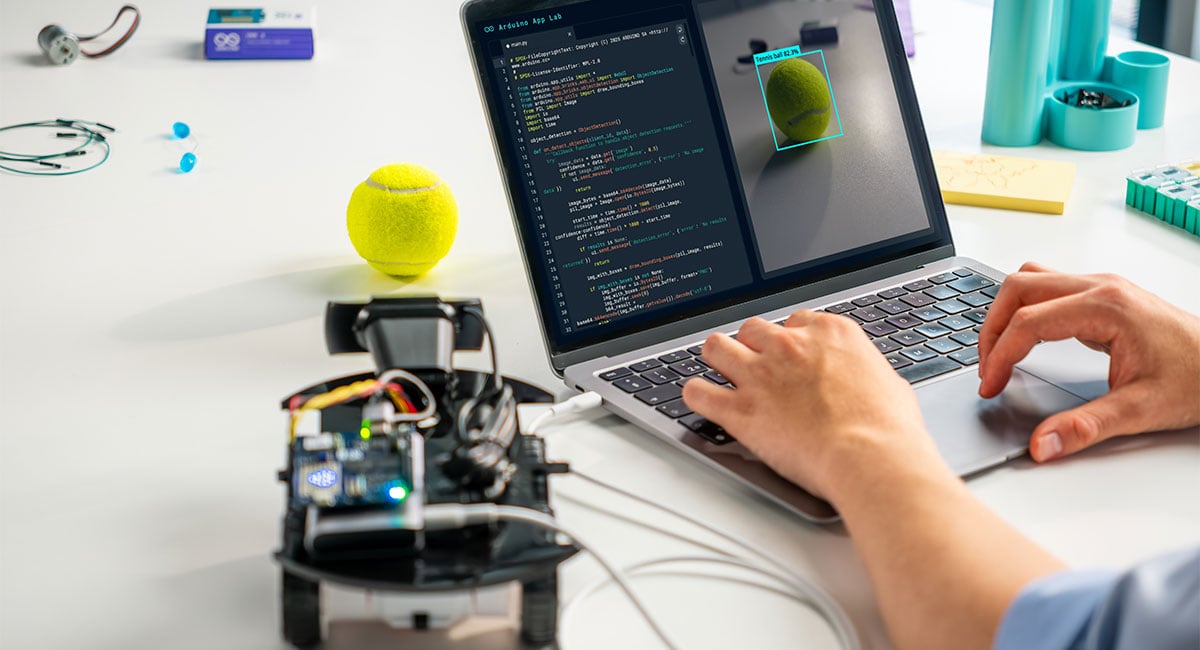
Arduino UNO Q serves this vision by being the first board to feature a ‘dual brain’ architecture, combining a Linux-capable microprocessor, the Qualcomm Dragonwing QRB2210, with a real-time microcontroller. This design is engineered to allow seamless development for complex AI-powered vision and sound solutions while maintaining the low-latency control crucial for robotics and industrial applications.
Violante highlights that this integration is key to solving real-world problems: “The main theme is not technology in itself, but the problem it helps to solve,” he says, pointing to the need for machines that can detect problems, trigger alarms, or make autonomous decisions based on sensory data.
New opportunities for the global community
The acquisition instantly unlocks powerful new opportunities for the entire Arduino ecosystem – entrepreneurs, educators, hobbyists, and industrial professionals alike.
For developers and entrepreneurs, the biggest barrier to innovation often lies in the complexity of bridging a proof-of-concept prototype to a commercially viable, globally scalable product. Arduino UNO Q and the integrated Arduino App Lab – a new environment unifying Real-time OS, Linux, Python, and AI workflows – address this directly. By leveraging Qualcomm Technologies and its global reach, developers gain a clearer, faster path to commercialisation.
As Violante notes, the goal is to lower the barriers to allow “professionals without a specific training in artificial intelligence to access it,” focusing on their domain expertise to solve real problems.
He also assures Arduino’s commitment to education remains central to its mission. Arduino UNO Q will enable educators to teach high-level computing concepts, Edge AI, and robotics using a platform that is already universally trusted for its simplicity and affordability. It allows students to transition from simple coding exercises to building sophisticated systems that utilise machine vision and full operating systems. Violante emphasises the importance of sparking the next generation’s curiosity: “Arduino was born to turn curiosity into action,” a philosophy that continues as they bring advanced AI tools to schools and universities.
Openness as the foundation
Despite the change in ownership, Arduino’s leadership has been adamant that the principles that built the community will be preserved. The company will retain its independent brand, mission, tools, and crucially, its commitment to the open-source ethos and multi-vendor support.
“Arduino was born open, and it will stay open,” Violante confirmed, reassuring the millions of users that the software licenses, public repositories, and documentation remain accessible. This openness, combined with Qualcomm Technologies’ deep resources and scale, is what defines the next generation of solutions.
Arduino UNO Q is merely the first demonstration of what this strategic alignment can achieve. It marks the moment when Arduino truly stepped into the high-performance computing space, ensuring that the transformative power of AI is not a niche technology but a tool for every developer globally, continuing the company’s legacy of making the impossible accessible.
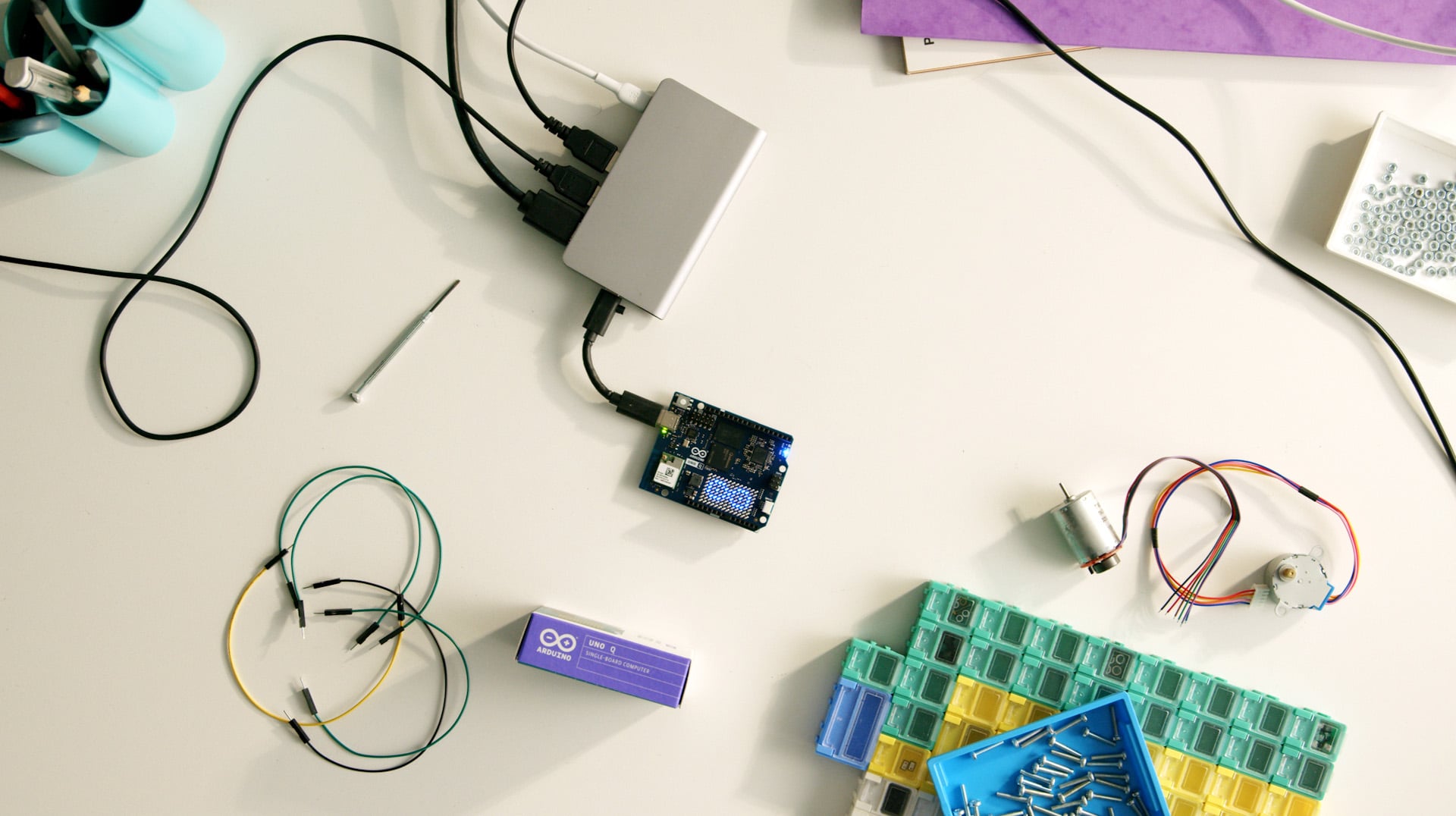
Arduino UNO Q maintains the classic Arduino UNO form factor and is compatible with the numerous libraries and projects that have been built and shared over the company’s 20 years. The core of its innovation is its ‘dual-brain’ architecture, featuring:
- A high-performance, Dragonwing QRB2210 quad-core microprocessor, running a full Debian Linux OS. This MPU includes a Qualcomm Adreno GPU and dual ISPs, providing the computational muscle needed for complex tasks like computer vision, running Python scripts, and deploying containerised AI models
- A real-time STMicroelectronics STM32U585 microcontroller running the Arduino core on Zephyr OS. This dedicated MCU handles the low-latency, deterministic control necessary for sensors, actuators, and classic Arduino tasks
Find out more at https://www.arduino.cc/product-uno-q
Qualcomm branded products are products of Qualcomm Technologies, Inc. and/or its subsidiaries.
This article originally appeared in the February’26 magazine issue of Electronic Specifier Design – see ES’s Magazine Archives for more featured publications