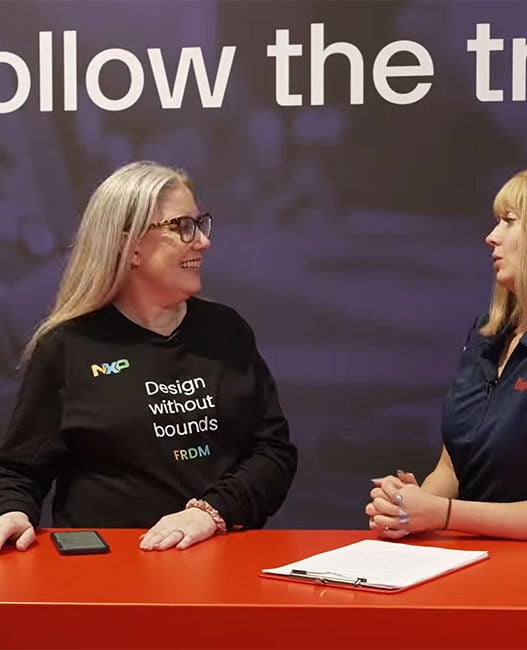







At embedded world 2026, on the DigiKey booth, Lucy Barnard speaks with Guneet Bedi, Senior Vice President & General Manager at Arduino about the company’s latest developments.
Arduino recently celebrated more than two decades of development, and according to Bedi the company now supports a global community of around 33 million developers. Built on an open-source model, the platform has long been synonymous with entry-level embedded development, often serving as the first step for students and engineers learning electronics.
“We’ve spent the last 20 years teaching people how to blink an LED,” Bedi explained. “Now we’re moving from ‘blink to think’ – enabling developers to build intelligent systems that can sense, process, and act using AI at the Edge.”
This shift centres on what Arduino describes as physical AI – systems where AI models run directly on hardware to interact with the real world through sensors and actuators, rather than relying on Cloud processing. Running AI locally enables faster response times, lower latency, and improved privacy, which are essential for applications such as robotics, industrial automation, and smart home systems.
A key part of this strategy is simplifying the traditionally complex development workflow required to combine real-time control with high-level computing. Historically, developers often had to use separate systems: a Linux-based single-board computer for application processing and AI workloads, alongside a microcontroller responsible for deterministic real-time control.
Arduino’s answer is what Bedi describes as a “dual brain architecture.” This approach integrates both environments into a single platform. A Linux-based processor handles AI models and application logic, while a microcontroller manages real-time operations such as motor control, sensing, and timing-critical tasks.
By bringing these two elements together, developers can run inference and application software while simultaneously controlling hardware from the same device and development environment.
Supporting this approach is a new development environment called Arduino AppLab, designed to streamline both AI and embedded software workflows. AppLab introduces modular “bricks” that encapsulate AI models or application logic, alongside traditional Arduino sketches written in C++. The goal is to enable developers, educators, and students to build sophisticated systems without the typical complexity associated with embedded Linux and real-time programming.
Generative AI also plays a role in the development process. Arduino’s tools now include an AI assistant capable of generating code from prompts, helping beginners quickly prototype ideas even without deep programming expertise.
Hardware announcements at embedded world reinforced this direction. Arduino previewed its Ventuno Q platform, marking the company’s 21st anniversary. The new high-performance single-board computer is designed specifically for Edge AI workloads and combines a processor featuring CPU, GPU, and neural processing capabilities with a microcontroller for real-time tasks.
The platform is aimed at enabling applications such as robotics, machine vision, home automation, and industrial monitoring, where sensing, inference, and actuation must happen locally.
Crucially, Arduino’s broader ecosystem remains central to its strategy. The platform offers more than 11,000 open-source libraries and a large partner network that helps developers transition from rapid prototyping to industrial production.
For Bedi, the ultimate goal is to maintain Arduino’s role as an entry point into innovation while expanding its relevance in professional embedded AI development.
“We want anyone to be able to experiment with AI,” he said. “Whether it’s a student, a maker, or an engineer building the next generation of intelligent devices.”