




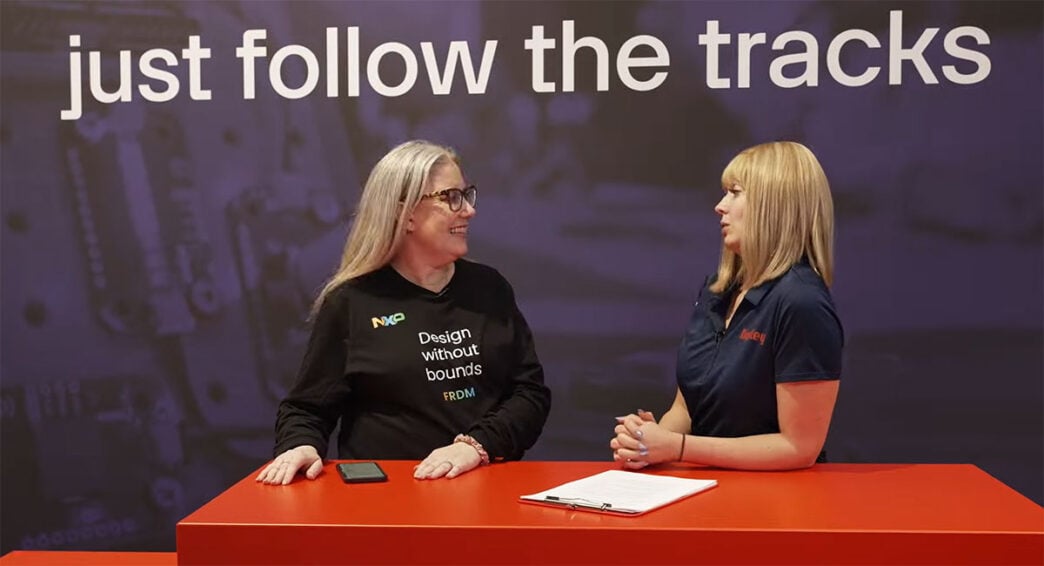
At embedded world 2026, on the DigiKey booth, Paige Hookway speaks with Kathleen Jachimiak, Marketing Manager at NXP Semiconductors, about how to use FRDM boards for your next Edge AI application.
NXP Semiconductors is on a mission to build “future-driven, very innovative technologies,” helping customers across automotive, industrial, and consumer sectors create next-generation products. The company’s portfolio spans microcontrollers and microprocessors through to wireless connectivity solutions, serving industrial and IoT markets, and how that portfolio translates into practical Edge AI development through the Freedom Development Board platform.
Freedom by name, freedom by nature
The Freedom Development Board platform is built around “giving customers freedom – the freedom to move away from proprietary solutions, the freedom to design without bounds,” says Jachimiak. Central to this is a strong emphasis on ease of use, with hundreds of sample demos and example code allowing engineers to be “up and running in minutes.”
But selecting the right board requires careful thought, and when it comes to Edge AI, “not one size fits all.” The choice depends heavily on the intended use case, the AI model being deployed, and the accuracy requirements. For straightforward tasks like basic image detection or object classification, a Cortex-M33 MCU is sufficient. However, more complex workloads – such as multi-stream video analysis capable of detecting whether a person has fallen or been harmed – demand higher processing power, pointing engineers toward the i.MX family or the new Ara240 discrete NPU module.
EIQ: the software foundation
Regardless of which hardware a developer chooses, NXP’s EIQ software platform is the unified starting point for Edge AI development. “Whether you’re working with an MCU or an MPU, all the developers are going to start with EIQ,” Jachimiak explains. The platform is designed to lower the barrier to entry – developers can bring their own pre-trained model, or start from raw data, using EIQ to create, test, refine, and ultimately deploy a model to their target system. Crucially, much of this workflow can be completed in software before a developer even purchases a board.
Applications across every sector
The range of industries exploring Edge AI continues to expand. Jachimiak notes she is consistently impressed by the creativity of NXP’s customers, with applications spanning healthcare, asset tracking, retail, smart home, and factory automation. “I haven’t found an application that isn’t interested in learning about AI,” she says, highlighting how broadly the technology is being adopted to extract additional value from connected systems.
The road ahead
Looking to the next generation of Edge AI, Jachimiak identifies autonomy, safety, security, privacy, and scalability as the defining requirements. NXP’s portfolio – spanning from low-cost MCUs to high-performance MPUs and discrete NPUs – is positioned to serve that full spectrum. The Freedom platform’s scalability and low entry cost make it accessible for teams at any stage of development.
Watch the full conversation here: