




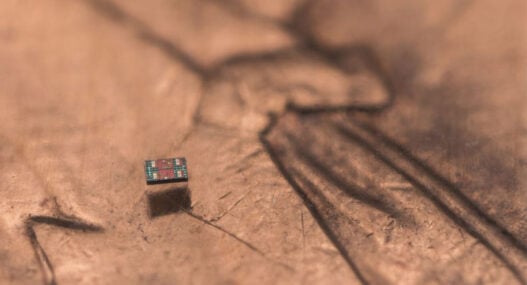
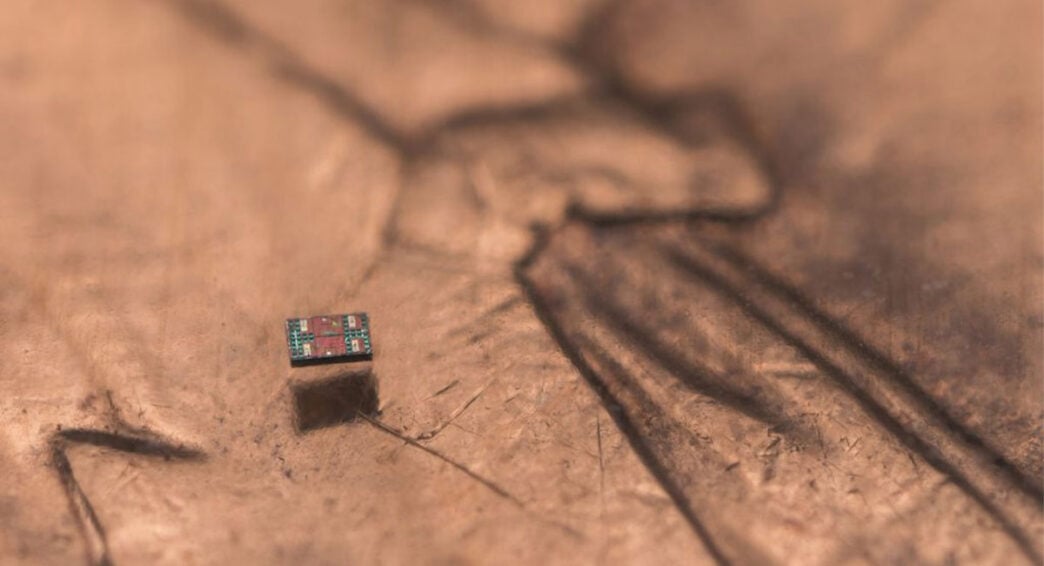
Researchers at Penn’s School of Engineering and Applied Science, alongside collaborators from the University of Michigan, have created the world’s smallest fully programmable, autonomous robots: microscopic swimming machines that can independently sense and respond to surroundings, operate for months, and cost a penny each.
Each robot measures approximately 200x300x50 micrometres, smaller than a grain of salt, and barely visible to the naked eye. Operating at the scale of biological microorganisms, the autonomous robots have the capability to advance medicine by monitoring the health of individual cells, as well as manufacturing by helping construct microscale devices.
The robots are powered by light, carry microscopic computers, and can be programmed to move in complex patterns, sense local temperatures, and adjust paths accordingly. The robots operate completely without tethers, magnetic fields, or joystick-like control from the outside, making them the first truly autonomous, programmable robots at such a scale.
The microscopic robot that can think for itself
“Building robots that operate independently at sizes below one millimetre is incredibly difficult,” said Marc Miskin, Assistant Professor in Electrical and Systems Engineering at Penn Engineering. “The field has essentially been stuck on this problem for 40 years.”
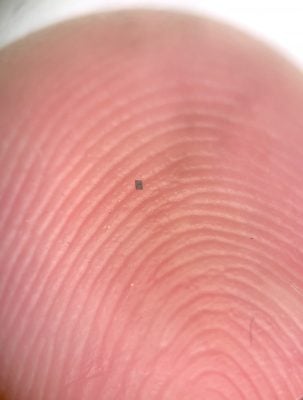
The reason for this comes down to physics. At the human scale, gravity and inertia are the dominant forces, but shrink an object down to the size of a single cell, and an entirely different set of rules takes over. Surface area-dependent forces, such as drag and viscosity, become overwhelming. “If you’re small enough, pushing on water is like pushing through tar,” says Miskin.
This means that conventional approaches to robotic movement don’t translate. “Very tiny legs and arms are easy to break,” says Miskin. “They’re also very hard to build.” Limbs and joints, the standard in larger robots, struggle at the microscale, where the physics of locomotion bear almost no resemblance to what engineers are used to working with.
The team had to design an entirely new propulsion system, one designed from the ground up to work with the unique physical forces of the microscopic world, rather than fight against them.
Unlike conventional designs, these micro robots generate an electrical field that nudges ions in the surrounding solution, which in turn push on nearby water molecules to animate the fluid around them. “It’s as if the robot is in a moving river,” says Miskin, “but the robot is also causing the river to move.”
By adjusting the field, the autonomous robots can move in complex patterns and travel in coordinated groups, like a school of fish, at up to one body length per second. And because the electrodes have no moving parts, they’re durable. “You can repeatedly transfer these robots from one sample to another using a micropipette without damaging them,” says Miskin. Powered by an LED, they can keep swimming for months.
Giving the robots brains
True autonomy demands a lot from a tiny package: a computer, sensors, propulsion electronics, and solar panels – all on a chip a fraction of a millimetre across. That’s where David Blaauw’s team at the University of Michigan came in. Blaauw’s lab holds the record for the world’s smallest computer, and when he and Miskin met at a DARPA presentation, the fit was obvious. “We saw that Penn Engineering’s propulsion system and our tiny electronic computers were just made for each other,” says Blaauw. Even so, it took five years to produce a working robot.
The core electronics problem was power. “The solar panels are tiny and produce only 75 nanowatts of power. That is over 100,000 times less power than what a smart watch consumes,” says Blaauw. The Michigan team solved this with circuits running at extremely low voltages, cutting power consumption by more than 1,000 times. Space was equally scarce – the solar panels take up most of the chip, leaving little room for a processor and memory. “We had to totally rethink the computer program instructions,” says Blaauw, “condensing what conventionally would require many instructions for propulsion control into a single, special instruction to shrink the program’s length to fit in the robot’s tiny memory space.”
Robots that sense, remember, and react
The result is the first sub-millimetre autonomous robot with a true computer – processor, memory, and sensors – onboard. Temperature sensors accurate to within a third of a degree allow the robots to seek out warmer areas or monitor the health of individual cells. To relay their readings, they communicate in an unexpected way. “We designed a special computer instruction that encodes a value, such as the measured temperature, in the wiggles of a little dance the robot performs,” says Blaauw. “We then look at this dance through a microscope with a camera and decode from the wiggles what the robots are saying to us. It’s very similar to how honey bees communicate with each other.”
The robots are programmed and powered by pulses of light, with each carrying a unique address so different instructions can be loaded onto different robots. “This opens up a host of possibilities with each robot potentially performing a different role in a larger, joint task,” says Blaauw.
Only the beginning
The current design is best understood as a platform: its propulsion works seamlessly with electronics, its circuits can be manufactured cheaply at scale, and it’s built to accept new capabilities.
“This is really just the first chapter,” says Miskin. “We’ve shown that you can put a brain, a sensor and a motor into something almost too small to see, and have it survive and work for months. Once you have that foundation, you can layer on all kinds of intelligence and functionality. It opens the door to a whole new future for robotics at the microscale.”