







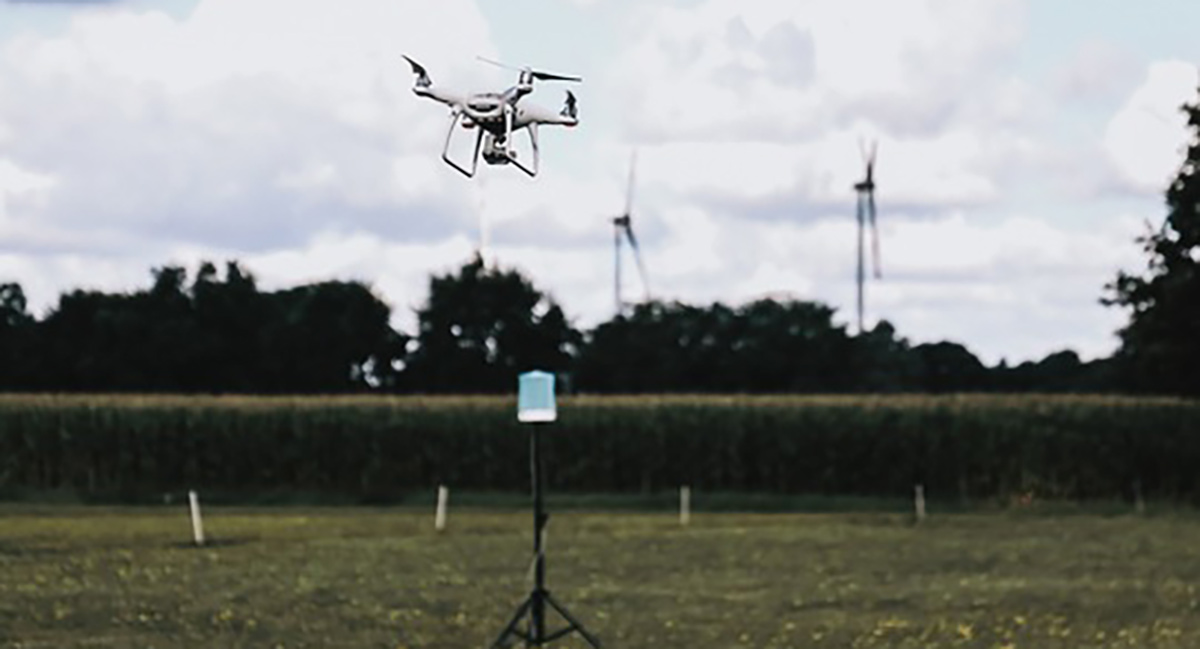
When a drone (also known as an unmanned aerial system, or UAS) approaches a security-critical area without permission, it poses a potential threat. In some cases, optical sensors, radio, and radar are disrupted by terrain, weather, or technical measures and cannot reliably detect a drone.
The Fraunhofer Institute for Digital Media Technology IDMT in Oldenburg has developed an integrated acoustic sensor solution for drone detection and localisation. In view of the increasing threat posed by unmanned aerial vehicles in security-critical areas, the system fills a crucial gap: it “hears around corners”. Acoustics can be combined with radar, camera, and LiDAR to form a robust sensor data network. Unlike purely optical and radar-based methods, which rely on line of sight, the technology enables drone operations to be detected even in built-up or forested areas.
Since 2016, the Oldenburg Branch for Hearing, Speech and Audio Technology has been advancing the acoustic detection of drones in the publicly funded joint projects AMBOS (BMBF) and ALADDIN (H2020). Twelve partners participated in the AMBOS project under the leadership of the Fraunhofer Institute for Communication, Information Processing and Ergonomics FKIE. For ALADDIN, 18 partners from nine European countries joined forces, including the CS Group as project manager. The algorithms and system components were continuously refined in numerous internal projects. Today, in addition to easily integrable algorithms for the detection and localisation of UAS, researchers can also rely on a fully integrable system solution.
Fibre-optic-controlled drones or autonomous flying objects often remain hidden from radio reconnaissance, while high-resolution radar and camera systems require high costs and energy-intensive computing power. The acoustic solution from Fraunhofer IDMT, on the other hand, operates with low energy consumption, enabling autonomous operation with rechargeable batteries. The ability to wake up additional sensor components after acoustic contact also offers advantages. The technology can achieve 360° coverage. Depending on the noise environment, the detection and localisation ranges are between 50 and 200 meters, with a temporal resolution of one second. An extension to other acoustic events, from vehicles to gunshots, is conceivable. Thanks to their high availability, the acoustic sensors can be deployed across large areas.
“With our acoustic technology, we offer an inexpensive and low-maintenance addition to existing drone detection systems,” explains Christian Rollwage, Head of Audio Signal Enhancement at Fraunhofer IDMT.
The target customers for the new technology are primarily companies in the defence and security sector that are already developing drone detection systems based on radar, optics, or LiDAR, as well as system integrators who want their own sensor technology and drone manufacturers who want to detect signals from the air.