









Whitepaper: Infineon Technologies, in association with EBV Elektronik
As edge AI drives richer, higher-bandwidth sensor data, choosing the right interconnect has become a strategic design decision. This whitepaper from Infineon examines how USB 3.x compares with MIPI and Ethernet for embedded vision and sensor-rich systems.
Complete the form below to download your free copy of this whitepaper.
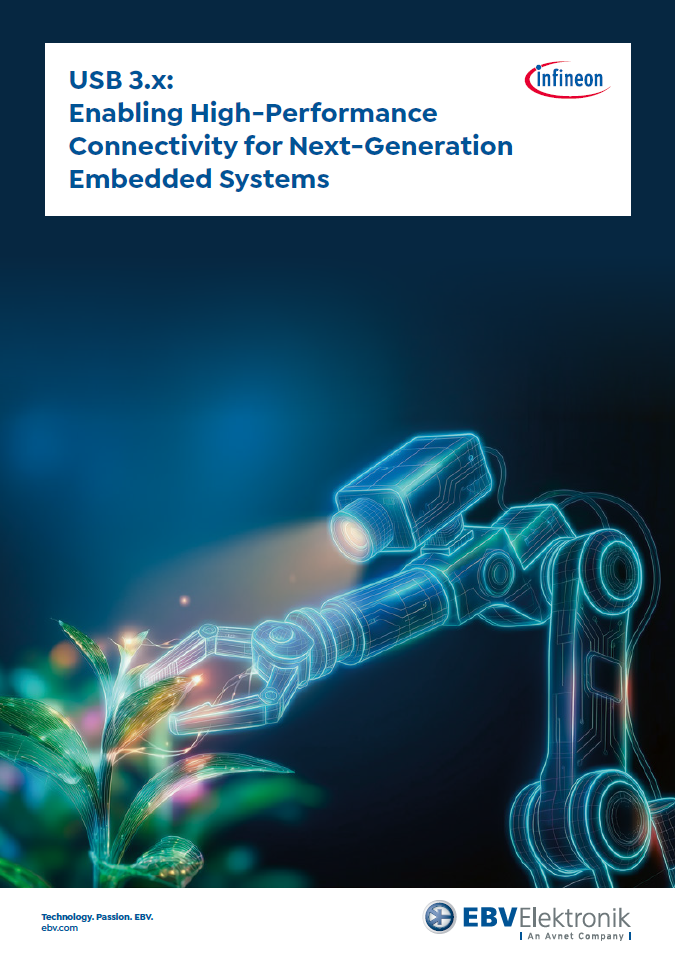
This whitepaper from Infineon, presented with EBV Elektronik, explores where USB 3.x fits alongside MIPI CSI-2, GMSL and 10 Gbit Ethernet, and why its combination of speed, market maturity and cost-effectiveness makes it a viable option for next-generation embedded designs.
The paper also looks in detail at Infineon’s EZ-USB FX10 peripheral controller, including its architecture, autonomous data movement and security features, and how it supports compliance with regulations such as the EU Cyber Resilience Act.
Key Takeaways
- Edge AI is generating richer, feature-heavy data that must be moved efficiently from sensors to processors
- Every interface involves trade-offs, and understanding them is essential to choosing the right one
- Real-time performance depends on low-latency data transport
- USB offers a strong balance of speed, maturity and cost-effectiveness
Who Should Read This
Embedded systems engineers, vision system designers, robotics and automation engineers, automotive and transport engineers, medical device designers, and technical managers evaluating high-speed interconnect options for sensor-rich, AI-enabled products.
Complete the short form above to access the whitepaper.