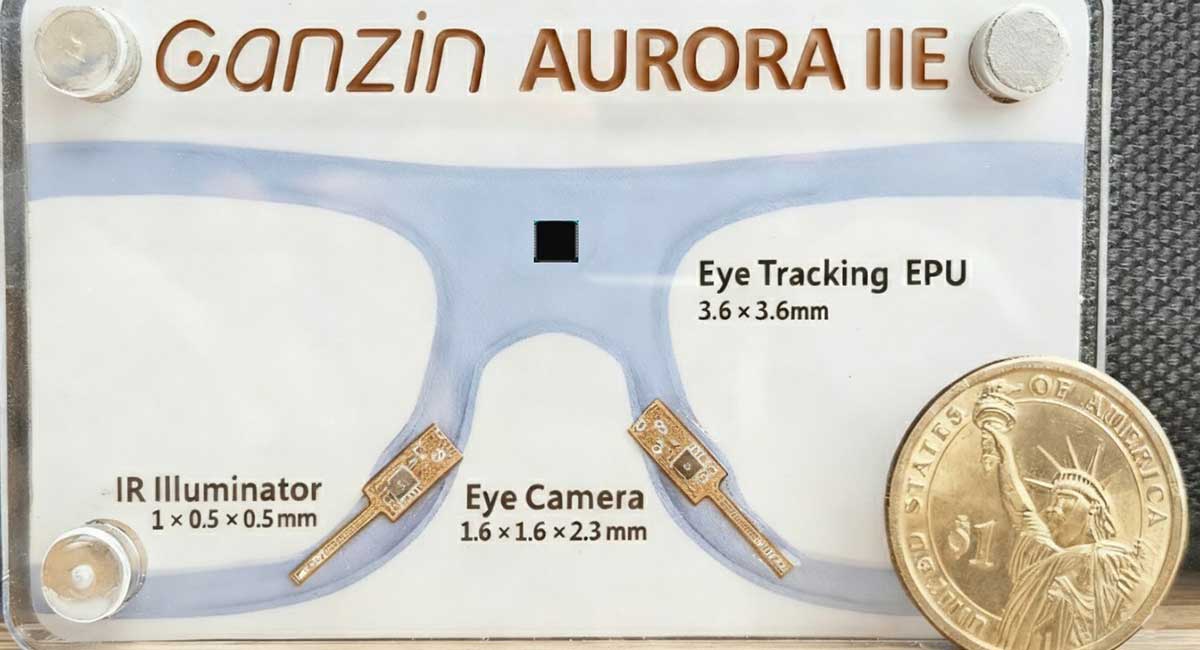






The demand for immersive virtual reality (VR) and augmented reality (AR) experiences continues to accelerate, driven by advancements in display technology, sensor integration, and low-latency processing. Figure 1 shows the market size for VR and AR headsets, collectively referred to as extended reality devices, over recent years and their projected growth in future years.

Headset manufacturers face ever-increasing challenges in delivering compact, power-efficient, and responsive hardware with high-performance features while also maintaining comfort and extended battery life.
GreenPAK programmable mixed-signal devices provide a versatile platform for addressing these challenges. By integrating logic, timing, power sequencing, interface translation, and sensor control into a single, highly configurable IC, GreenPAK reduces component count, board space, and power consumption – key factors in next-generation VR/AR designs.
This article explores the role of GreenPAK technology in enabling the design of more efficient and more cost-effective VR/AR headsets, highlighting GreenPAK’s ability to streamline system design and while also improving both reliability and user experience.
Data communication and protocol conversion
One important application of GreenPAK in extended reality devices is in data communication. Wearable devices are typically limited by their size, and it is often necessary to convert data from parallel output to serial input and vice versa to enable communication across different components. In some cases, this involves converting more than a dozen lines of data into a single serial stream. Protocol conversion is also a common requirement as specialised protocols are often required.
GreenPAK can use its dedicated I²C or SPI macrocells to convert up to 16 data lines into the required format and enables the implementation of custom data communication protocols (e.g. protocols such as OneWire).
For more details, refer to the application notes I2C to SPI Converter using SLG47011V and SPI Serial to Parallel Converter.
I/O expander
An I/O expander is a type of circuit that makes additional general-purpose input/output (GPIO) pins available to a microcontroller, processor, or SoC when the device’s native GPIO count is insufficient. Instead of redesigning hardware around a larger MCU, engineers can connect aGPIO expander over a standard serial bus (most often I²C or SPI) to instantly gain additional configurable pins. These pins can be configured as either inputs or outputs, with extra features such as programmable pull-ups/pull-downs for easier signal handling and low-voltage operation, which are especially useful for battery-powered designs.
I/O expanders are widely used in space-constrained systems such as VR/AR headsets, where PCB area and MCU pin count are limited.
GreenPAK is well-suited for this application by taking advantage of its I²C macrocell. Access to the GreenPAK pin state is accomplished by a read command, and up to 16 pins can be used to increase the number of GPIOs available. Optionally, a pin can be implemented as an interrupt for continuous pin monitoring.
For a deeper dive into this particular GreenPAK application, refer to GPIO Expander/Single Wire Interface.
PCB routing simplification and error fix
Regarding PCB routing, using GreenPAK helps to reduce the number of required PCB layers and, in general, simplifies overall PCB complexity. The Renesas GreenPAK IC enables routing of complex interconnections through its Connection Matrix which only requires a minimal PCB footprint and incurs little to no additional delay. One other advantage is that PCB errors can be corrected in the GreenPAK design rather than on the board, eliminating the need for expensive redesigns.
Camera noise management
Cameras are another critical subsystem in many VR and AR headsets, providing the sensing capabilities required for accurate tracking, depth perception, and real-time environment mapping. These devices are often referred to as mixed reality systems. Camera performance directly impacts latency, field of view, resolution, and power efficiency, all of which can negatively affect the overall user experience if not accounted for.
Cameras are highly sensitive to noise, as even small fluctuations in power delivery or electromagnetic interference can degrade image quality, tracking accuracy, as well as system stability. The application note Noise Component Role in Forming Image Quality illustrates this phenomenon in detail.
Integration of multiple high-resolution sensors in compact, lightweight designs further increases the challenge of managing power integrity while also adhering to heat and space constraints. Figure 3 demonstrates a conventional multi-IC solution compared to using a Power GreenPAK solution.
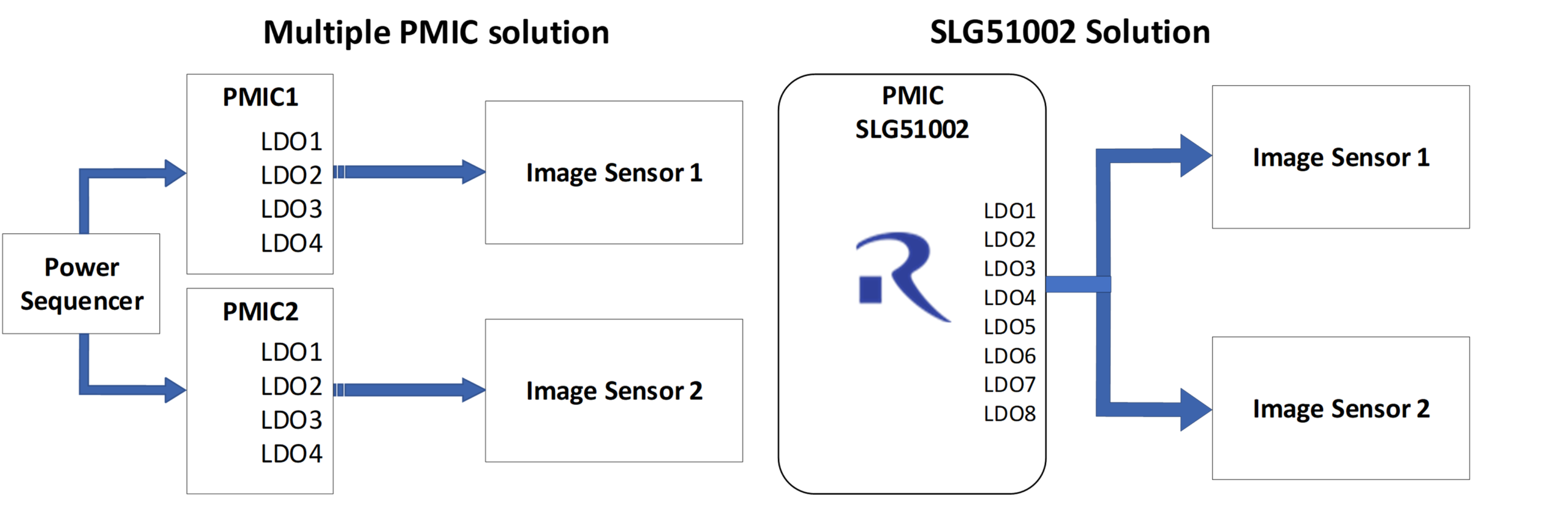
The Power GreenPAK subfamily of devices offers an efficient solution to these challenges by improving thermal performance, minimising thermal noise, and ensuring that clean, stable power is available for image sensors while also meeting the stringent size, efficiency, and performance requirements of next-generation wearable systems. Additional advantages include integrated EMI filtering, low-noise operation, and simplified system integration through selectable I²C slave addresses via pin configuration. These features can be used to help streamline the design process, especially in VR and AR headsets implementing multi-camera setups where multiple PMICs may need to be used, reducing the risk of address conflicts and ensuring reliable communication with the system’s main controller.
Other applications
In addition to the applications mentioned previously, GreenPAK can also be used in immersive extended reality devices such as glue logic, level shifters, watchdog timers, power sequencers, voltage monitors, ship mode controllers, and many other components.
A ship mode controller acts as an ultra-low-power button monitor that can save battery life while the product is not yet with the end user, such as while it is in transit or being ‘shipped’ to the end user. This enables a better first experience for the user as the battery will still have charge available upon arrival. Figure 4 illustrates a basic schematic of a ship mode controller based on using the SLG46826, and Figure 5 shows the internal GreenPAK design.

When a device with ship mode functionality arrives at the end user, both the Enable Ship Mode and Exit Ship Mode signals are HIGH, and the device power is disabled. Once the device’s button (usually the power button) is pressed for the first time, Pin 2 is pulled LOW. After debounce macrocell filtering and inversion, DFF3 triggers on the rising edge and outputs a HIGH-level signal, which then causes LUT3 to output a HIGH-level signal, turning on the external transistor T1 and thus enabling power.
Implementing a level shifter with GreenPAK is discussed in detail in the whitepaper Level Shifter Circuits – Design Basics and Applications.
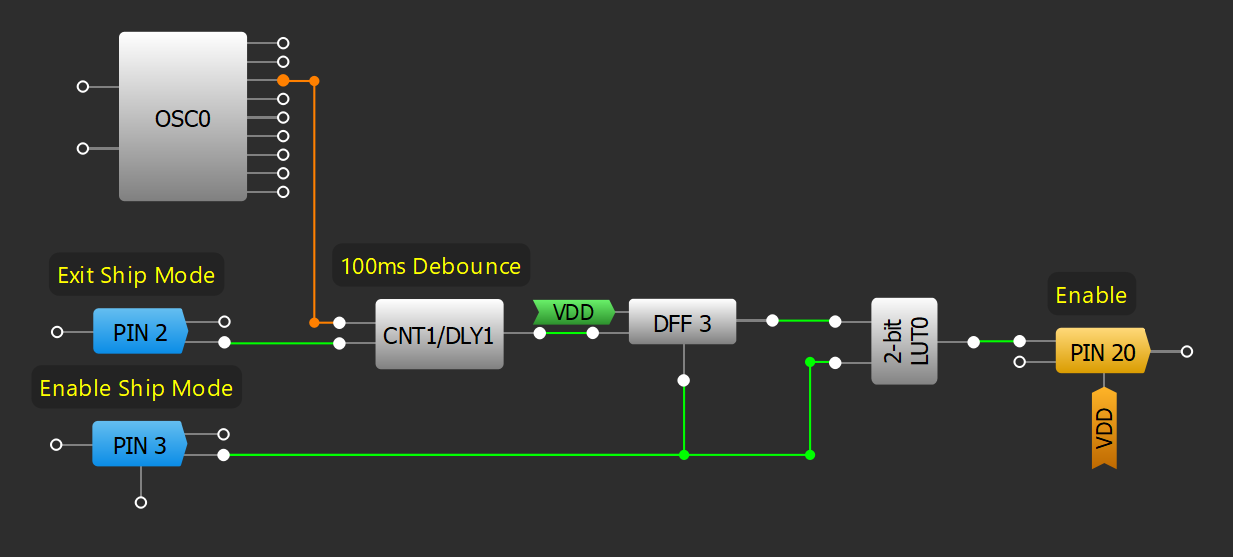
Figure 5. GreenPAK design of a ship mode controller
The GreenPAK platform offers a flexible process to design a fully customisable system reset IC. Other complex, code-based integrated circuits are often vulnerable to lock-ups, which may cause issues such as reduced user satisfaction, hardware damage, safety risks, and even negative impacts on product sales. To address this, Renesas provides detailed instructions on how to implement a reset IC solution, available through the following resource: GreenPAK Reset IC.
All of these applications and much more are available in the GreenPAK Cookbook.
Conclusion
As VR and AR headsets advance toward greater performance and efficiency, GreenPAK technology offers a practical solution to key design challenges. Its ability to integrate multiple functions, such as sensor interfacing, power sequencing, and system monitoring, into a compact, low-power device helps reduce component count, save board space, and streamline development. By enabling efficient, flexible system design, GreenPAK supports the creation of lighter, longer-lasting, and more responsive headsets – contributing to the next generation of immersive, user-centered extended reality experiences.

This article originally appeared in the January’26 magazine issue of Electronic Specifier Design – see ES’s Magazine Archives for more featured publications.