





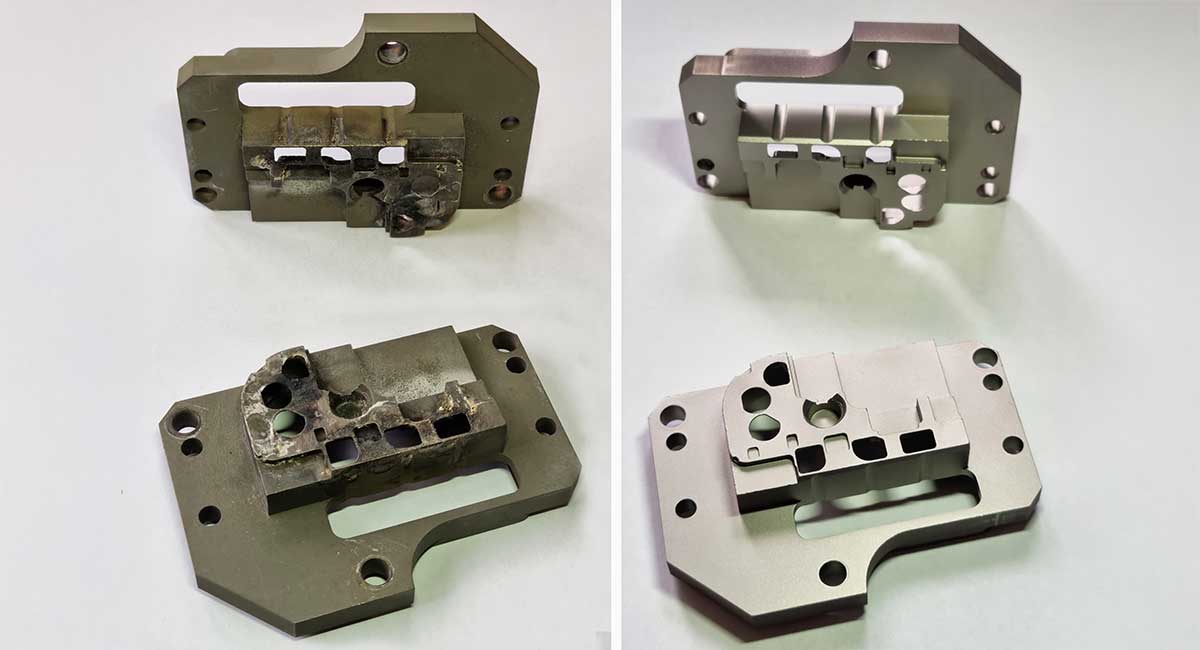
Titanium solder masks are important precision tools in the mini wave soldering process because they ensure reproducible process control, protect sensitive component areas from unwanted solder contact, and precisely define the wetting points of the solder joint.
Due to the high thermal, chemical, and mechanical stresses to which the masks are exposed during series production, regular inspection and professional refurbishment are necessary to ensure consistently good process quality. Eutect offers this professional refurbishment of titanium soldering masks.
“Through structured refurbishment and maintenance, we ensure that titanium soldering masks retain their original precision and functionality over many process cycles. The combination of material-appropriate cleaning, precise heat treatment, and practical validation guarantees consistently high soldering quality, thereby enhancing cost-effectiveness and process reliability in mini wave soldering,” explains Lars Iwers, Sales Manager at Eutect. During mini wave soldering, titanium masks are repeatedly exposed to high temperatures. Contact with solders, fluxes, and process gases leads to oxidation and changes in the surface structure over the service life. In addition, wear and tear on fitting and fixing elements can occur, which has a negative effect on the precision of the soldering process.
After use, the masks are first dismantled and undergo systematic pre-cleaning. This removes flux residues and tin deposits. Eutect uses specially designed processes that do not attack titanium and at the same time ensure complete removal of organic and metallic residues. This step ensures the basis for precise subsequent processing. This is followed by controlled surface treatment, during which oxidation layers and contaminants are removed without altering the fit or surface structure of the masks. After cleaning, the masks are visually inspected. Critical geometries such as bridges, phases, baffles, and contact points are checked for dimensional accuracy, flatness, and parallelism. This is followed by targeted heat treatment of the titanium.
“Titanium is a preferred material for our solder masks due to its high strength, low density, and excellent temperature resistance. Targeted heat treatment after cleaning serves to optimise the properties for use in the soldering process,” explains Iwers. Since mini-wave soldering processes involve frequent temperature changes, it must be ensured that the solder mask remains dimensionally stable during subsequent use. Targeted heat treatment ensures that the structure of the titanium stabilises and thermal expansion is predictable. This keeps the fit between the mask, assembly, and soldering module constant even over many process cycles. “This means that even delicate geometries, such as thin partitions and webs, retain reliable stability even after reworking,” says Iwers. Every reworked titanium solder mask undergoes a practical functional test at the Eutect technical centre. Only after passing validation is the mask released for series production.
The systematic refurbishment of titanium solder masks significantly extends their service life and reduces the need for new production. “Although this is not directly related to our cradle-to-cradle approach, we are still pursuing true sustainability here, which is designed to conserve resources and maximise reusability,” emphasises Iwers, inviting visitors to this year’s productronica to discuss the possibilities of refurbishing titanium solder masks directly at booth 439 in hall B2.