





In the rapidly evolving landscape of advanced technologies, precision timing has emerged as a critical enabler for artificial intelligence, automotive, aerospace and defence, industrial automation, and the Internet of Things (IoT).
As applications in these sectors demand ever-greater guarantee of performance, engineers are prioritising the design of timing architectures – such as the ‘clock tree’ – much earlier in the hardware development process.
The 2025 State of Time Report reveals a significant shift in design priorities: half of engineers now view the selection and integration of timing components as a critical factor at the very earliest stages of defining design concepts and requirements. Another 36% address timing immediately after choosing core components and producing initial schematics. This trend underscores just how pivotal timing has become in modern electronics design.
This shift is further supported by breakthroughs in timing solutions, notably the adoption of MEMS-based technology. Unlike traditional quartz, MEMS timing guarantees consistent precision under virtually any condition, streamlining system architecture and ensuring robust performance for end-users.
The convergence of precision: a new era of synchronised systems
In recent years, the boundaries between once-separate technological fields have begun to blur, ushering in a transformative period marked by the convergence of precision engineering and system synchronisation. Nowhere is this quiet revolution more evident than in the defence, automotive, and industrial automation sectors, where a fundamental breakthrough in synchronising disparate systems with remarkable accuracy is unlocking possibilities that would have seemed the stuff of science fiction not long ago. This new era promises not only enhanced capabilities and efficiencies but also paves the way for innovations that continue to reshape the modern world.
Defence: when milliseconds mean mission success
In contemporary military operations, the line between identifying a threat and responding effectively is measured in fractions of a second. Take, for example, a cutting-edge air defence system safeguarding a forward base. A network of radar arrays, electro-optical devices, and infrared sensors tirelessly surveys the surrounding environment. When an enemy drone swarm emerges, each sensor registers distinct elements of the threat at marginally different intervals.
Historically, such systems handled sensor data one after another, resulting in delays that could compromise mission success. With the advent of precise timing synchronisation, however, information from all sensors is fused instantly, delivering a comprehensive and real-time operational picture. The technology goes beyond recognising individual drones, it anticipates the group’s movements, pinpoints the most imminent danger, and orchestrates several defensive actions at once. Weapon systems driven by advanced motors track targets with astonishing, sub-millisecond precision, while navigation solutions unaffected by GPS interference ensure pinpoint accuracy, even when faced with electronic disruption.
The automotive revolution: orchestrating safety at speed
Precise timing is changing how we travel. Autonomous vehicles on highways rapidly process huge volumes of data from sources like LiDAR, cameras, radar, and inertial sensors, updating hundreds of times each second. Without accurate synchronisation, these data streams can become disjointed, making safe driving impossible.
Imagine an autonomous car approaching a busy intersection: LiDAR identifies pedestrians, cameras spot traffic lights, radar tracks moving cars, and GPS pinpoints location. If these systems aren’t closely aligned, down to the microseconds, the vehicle might place a pedestrian incorrectly or misjudge an approaching vehicle’s speed. With Precision Timing, synchronisation helps all sensors combine their inputs into a unified, real-time picture of the surroundings, enabling steering and braking decisions to be carried out with consummate precision.
These technological improvements go beyond what’s required for safety and reliability. They open doors for innovations across the automotive industry, such as smooth coordination between cars and smart infrastructure (think intelligent stoplights and connected roadways), advanced driver-assistance features, and direct car-to-car communication. By syncing everything to the microsecond, manufacturers can create vehicles that both react accurately to their environment and anticipate complex, ever-changing traffic situations. With this level of integration, we can look forward to fewer accidents, less congestion, and cities that are redesigned for smarter, safer transportation networks.
The industrial transformation: synchronised automation for unmatched efficiency
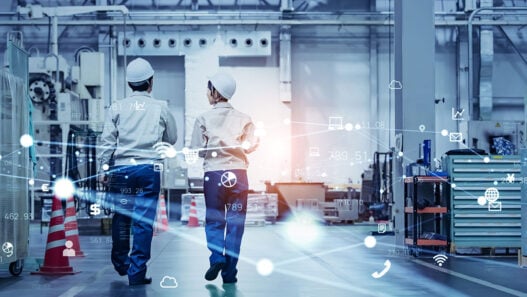
Precision synchronisation is equally revolutionising the landscape of industrial automation. In modern factories, robotic arms, conveyor systems, and smart sensors must operate in flawless harmony alongside humans to maintain productivity and uphold safety standards. Imagine an assembly line where each robot performs its task with microsecond timing, seamlessly passing components along without hesitation or error. In this environment, synchronised control systems ensure that every sensor reading and motor movement is perfectly coordinated, eliminating bottlenecks, reducing waste and safety issues This integration allows for real-time adjustments to shifting demands, rapid identification of faults, and adaptive optimisation of workflows. As manufacturing continues to evolve, synchronised automation not only increases throughput and product quality, but also empowers industries to respond swiftly to changes in consumer demand and global supply chains, driving a new era of resilience and competitiveness.
Much like the advances seen in defence and automotive spheres, the convergence of precision timing and system synchronisation in industrial automation is setting new benchmarks for what is possible. Factories are becoming smarter and more responsive, with machines that communicate and collaborate in real-time, unlocking levels of efficiency and flexibility previously unattainable. This technological leap is not only transforming production processes but is also contributing to a safer, more sustainable industrial future, where synchronised systems underpin both operational excellence and environmental stewardship.
The future perfect: synchronised intelligence across every sector
Precision timing is fundamental to synchronised systems, forging a future where intelligent machines collaborate with an elegance once reserved for the natural world. As advances in defence, automotive, and industrial automation demonstrate, the ability to harmonise sensors, actuators, and control systems down to the nanoseconds – it is an operational reality. This new standard is enabling machines not just to react to their environment, but to understand, anticipate, and coordinate with a depth reminiscent of natures most sophisticated systems. The boundaries between fields are dissolving: automotive-grade sensor fusion is finding its place in military vehicles, industrial robotics are adopting defence-level timing, and manufacturing is learning from aerospace reliability. As these innovations mature, we stand at the threshold of an era defined by resilient, adaptable, and truly intelligent systems: systems that will continue to transform the way we defend our nations, navigate our roads, and build our world, shaping the future with every precision-timed, perfectly synchronised moment.
About the author:

Sundar Vanchinathan, General Manager at SiTime