





Condition-based monitoring (CbM) helps prevent equipment failures through predictive maintenance, but designing an effective system has typically required the optimal integration of precision sensing, low-noise signal chains, power management, and wireless connectivity.
This article provides a brief overview of CbM. It then introduces a drop-in solution from Analog Devices that enables immediate deployment of wireless CbM with Edge AI.
Challenges and requirements in condition-based monitoring
For all its benefits, CbM deployment can stall due to complex requirements and the need for multidisciplinary expertise. To deliver full value, CbM solutions must provide reliable operation and timely analysis based on accurate measurement data. However, industrial motors, drivetrains, and heavy rotating equipment subject measurement devices to continuous vibration, shock, temperature extremes, and electromagnetic interference (EMI).
Effective predictive maintenance therefore requires vibration sensors capable of detecting subtle changes that indicate early shaft imbalance, misalignment, or bearing wear.
While vibration data is traditionally analysed in a central host or Cloud-based system, advanced CbM solutions increasingly shift analysis to the Edge, reducing latency and network traffic. Edge AI inference using convolutional neural network (CNN) models enable real-time vibration analysis but increase computational demands, complicating implementation within power, size, and cost limits.
Power consumption becomes a greater concern as CbM expands into rotating, remote, or mobile equipment where wired connections are impractical. In these scenarios, Bluetooth Low Energy (BLE) provides a suitable balance of range, power consumption, and reliability compared with alternative connectivity options (Table 1).
| Range | Power consumption | Reliability | Robustness | Total cost of ownership | MESH capable | Security | |
| Wi-Fi | 100 m | High | Low single RF channel | Low | High | Yes | Yes, WPA |
| BLE | 20 m to 100 m | Low/medium | Medium/high | Low | Medium | Yes | Yes, AES |
| Zigbee, Thread | 20 m to 200 m | Low/medium | Low | Low | Medium | Yes | Yes, AES |
| Smart-MESH | 20 m to 200 m | Low | High | High | Low | Yes | Yes, AES |
| LoRa-WAN | 500 m to 3,000 m | Medium | Low | Low | High | No, Star Topology | Yes, AES |
Table 1: Among wireless connectivity standards, BLE offers a combination of characteristics suitable for wireless vibration monitoring. (Table source: Analog Devices)
The challenge is finding a BLE connectivity solution able to operate within the power constraints of a wireless sensor system. In a CbM system expected to perform CNN inference, both battery and power management become increasingly critical. The challenge here lies in orchestrating multiple regulators, sequencers, and charging systems to reduce power consumption while ensuring stable operation.
Evaluation kit provides a drop-in wireless CbM solution with Edge AI
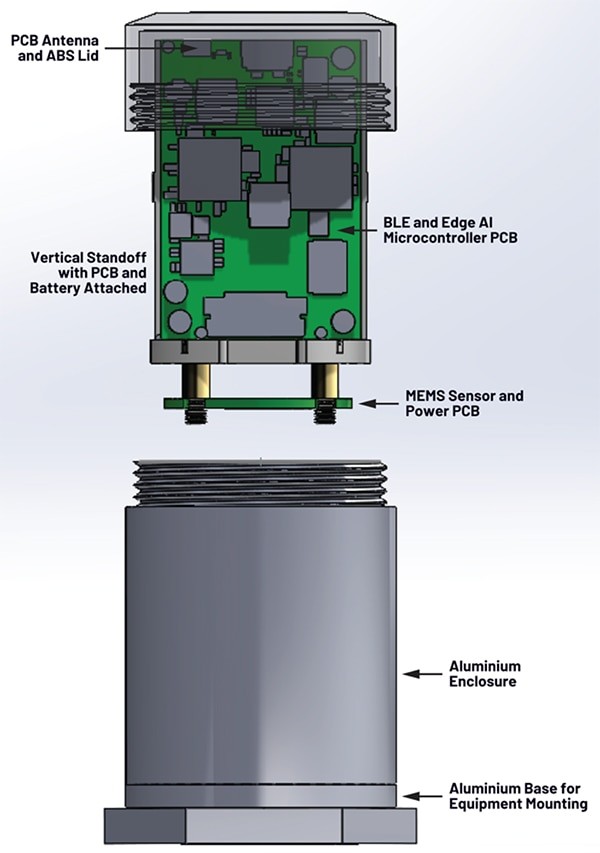
Analog Devices’ EV-CBM-VOYAGER4-1Z Voyager 4 kit addresses the challenges of deploying wireless CbM with Edge AI by providing a complete battery-powered vibration monitoring platform for ongoing evaluation of CbM technology or immediate deployment in predictive maintenance applications. The kit is designed to withstand harsh environments, using a vertical standoff (Figure 1, top) that firmly holds the main printed-circuit board (PC board) in place on one side and a battery on the other. A power PC board and sensors are located at the bottom of the standoff, close to the vibration source to be monitored. For deployment, the vertical standoff assembly is placed in a protective aluminium enclosure (Figure 1, bottom) with a diameter of 46mm and a height of 77mm. The enclosure is topped with an ABS acrylic lid to allow BLE connectivity.
Built around an Analog Devices MAX32666 BLE microcontroller unit (MCU) and an Analog Devices MAX78000EXG+ AI MCU, the wireless sensor system design integrates a comprehensive set of low-power devices for delivering precision vibration measurement and anomaly detection with extended battery life (Figure 2).
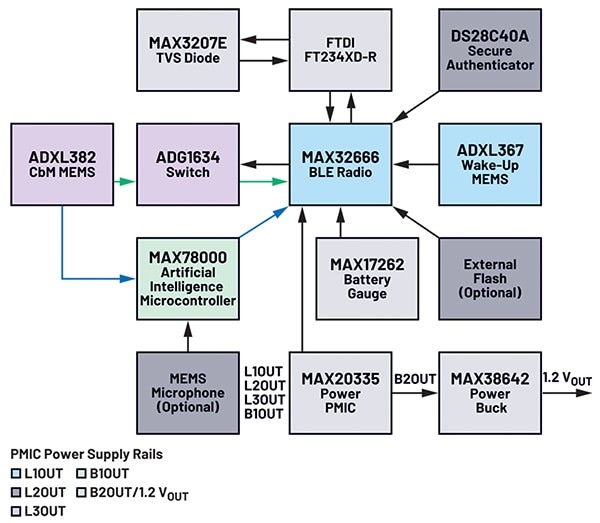
For vibration measurement, the Voyager 4 uses Analog Devices’ ADXL382-1BCCZ-RL7 three-axis accelerometer, which combines microelectromechanical systems (MEMS) sensors, an analog front-end (AFE), and a 16-bit analog-to-digital converter (ADC). Featuring an 8kHz measurement bandwidth, this device is designed to deliver accurate measurements even in high-vibration environments. It is well-suited for low-power designs, consuming only 520μA in high-performance mode with 8kHz bandwidth, or just 32μA in a low-power mode with 400Hz bandwidth.
In the Voyager 4’s system design, the ADXL382’s output passes to the Analog Devices ADG1634BCPZ-REEL7 CMOS switch, which the MAX32666 BLE MCU controls. The combination of this BLE MCU and an Analog Devices ultra-low power ADXL367BCCZ-RL7 MEMS accelerometer plays a central role in the Voyager 4’s operating modes (Figure 3).
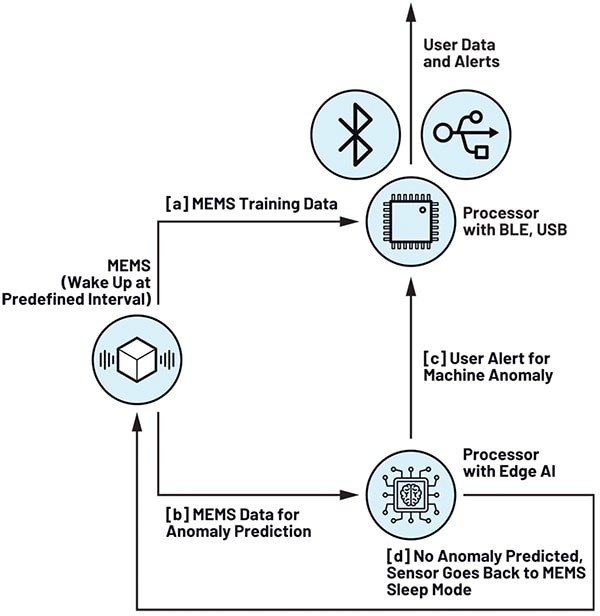
During training operations (path ‘a’ in Figure 3), the MAX32666 MCU channels raw vibration data from the ADXL382-1BCCZ-RL7 for transmission to the user’s host system through the MAX32666 BLE radio or through the Voyager 4’s USB connection. This operating mode provides the training data needed to generate custom inference models underlying Edge AI for CbM.
During anomaly-detection operations (path ‘b’ in Figure 3), the Voyager 4’s MAX78000EXG+ AI MCU uses its direct connection to the ADXL382-1BCCZ-RL7 to read raw vibration data and execute a custom inference model with its integrated CNN accelerator for anomaly prediction. If the inference results indicate the presence of an anomaly, the MAX78000EXG+ issues an alert, which the MAX32666 BLE MCU passes to the user for action.
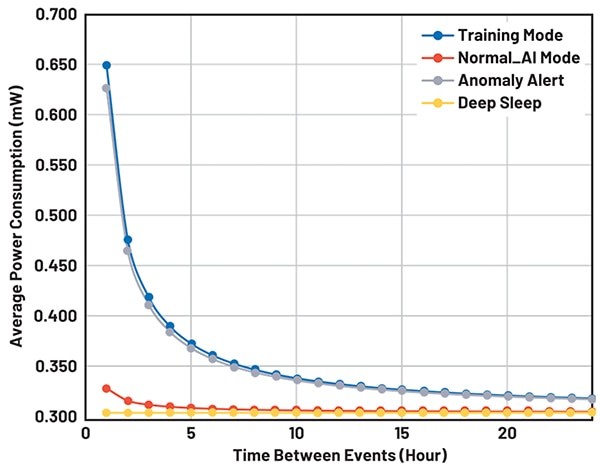
If no anomaly is detected, the sensor enters sleep mode. In this quiescent state, the ADXL367BCCZ-RL7 accelerometer draws only 180nA in motion-activated wakeup mode, triggering when vibration exceeds an adjustable threshold. When this motion-activated wakeup occurs, the ADXL367BCCZ-RL7 in turn wakes the MAX32666 BLE MCU, which initiates a new vibration measurement and inference cycle. This approach helps minimise power consumption during normal operation, restricting power-intensive BLE radio use to training sessions and anomaly alerts (Figure 4).
Along with system-level power savings enabled through the Voyager 4’s motion-activated wakeup operation, the Voyager 4 integrates an Analog Devices MAX20335BEWX+T power management integrated circuit (PMIC) to deliver the required voltage supplies. In addition, an Analog Devices MAX17262 fuel gauge monitors battery current and supports battery-life estimation. During the Voyager 4’s various operating modes, the MAX32666 MCU can enable or disable individual MAX20335BEWX+T outputs to match specific power needs, further optimising power consumption.
At the device level, low-power operation is a core feature of the individual devices used in the Voyager 4 kit. For example, the MAX32666 BLE MCU requires only 27.3μA/MHz when executing from cache at 3.3V; the MAX78000EXG+ AI MCU uses 22.2μA/MHz (while loop execution) from cache at 3.0V with its Arm Cortex-M4 core processor active. Furthermore, both MCUs integrate a dynamic voltage scaling controller that further minimises active core power consumption.
This combination of system-level and device-level power optimisation effectively minimises power consumption during the Voyager 4’s various operating modes. In its normal anomaly detection mode, the Voyager 4’s power consumption is about 0.3mW with the sensor active once per hour, translating to as much as two years of battery life for a 1,500mAh battery under typical conditions. In contrast, training mode requires extensive use of the BLE radio to transmit vibration data for use in model training and validation, resulting in power consumption over 0.65mW (see Figure 4 again).
Training and deploying a vibration monitoring model for Edge AI
In training models for Edge AI applications, the resource limitations of Edge processors and MCUs have driven the development of more specialised tools created to optimise models for individual target devices. Analog Devices provides such tools in its AI on a Battery GitHub repository, which guides users through a documented workflow. Analog Devices breaks the model workflow down into a sequence of three stages and provides a dedicated GitHub repository for each (Figure 5).
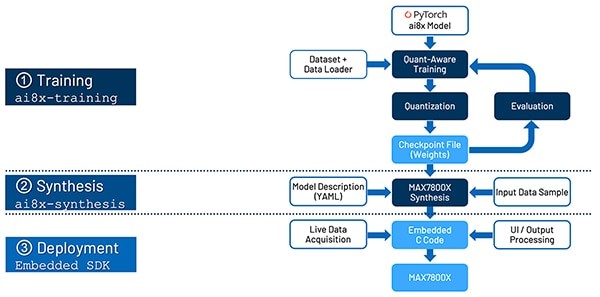
In the initial stage, the ai8x-training repository provides detailed, step-by-step instructions for preparing the work environment and performing training with the included train.py Python script. In the next stage, the ai8x-synthesis repository provides a similarly detailed set of instructions for setup and operation of the tools used to convert a trained model into C code.
A critical factor in achieving success in Edge AI is understanding the capabilities and limitations of the target CNN execution environment. Contained within the ai8x-training and ai8x-synthesis repositories, Analog Devices includes a detailed tutorial to help developers understand the relationship between the CNN model implementation decisions and the capabilities of the MAX7800x AI MCU.
The final stage, documented in the software development kit repository, provides the instructions and tools used to develop firmware that embeds the inference model for the target MAX7800x MCU. After generating the firmware, users load it into the Voyager 4 via wired or wireless update. At this point, the user can connect with the Voyager 4 over BLE and issue commands using a Python graphical user interface (GUI) running on a Windows host. In normal run mode, the AI MCU performs inference as directed by the MAX32666 BLE MCU or automatically on wakeup.
Conclusion
Unplanned downtime due to equipment failure drives cost and risk. Although CbM can help reduce cost and mitigate risk through predictive maintenance, the design of suitable wireless sensor systems with analysis remains complex. Analog Devices’ Voyager 4 wireless vibration evaluation kit provides a drop-in solution that overcomes these challenges, enabling rapid deployment of predictive maintenance with precision sensing, efficient power utilisation, wireless connectivity, and robust processing with Edge AI.

By Rolf Horn, Applications Engineer, DigiKey
This article originally appeared in the January’26 magazine issue of Electronic Specifier Design – see ES’s Magazine Archives for more featured publications.