





Google has announced a milestone in quantum computing with experimental results demonstrating what it described as the first-ever verifiable quantum advantage – showing a quantum processor outperforming the world’s fastest classical supercomputers by a factor of 13,000.
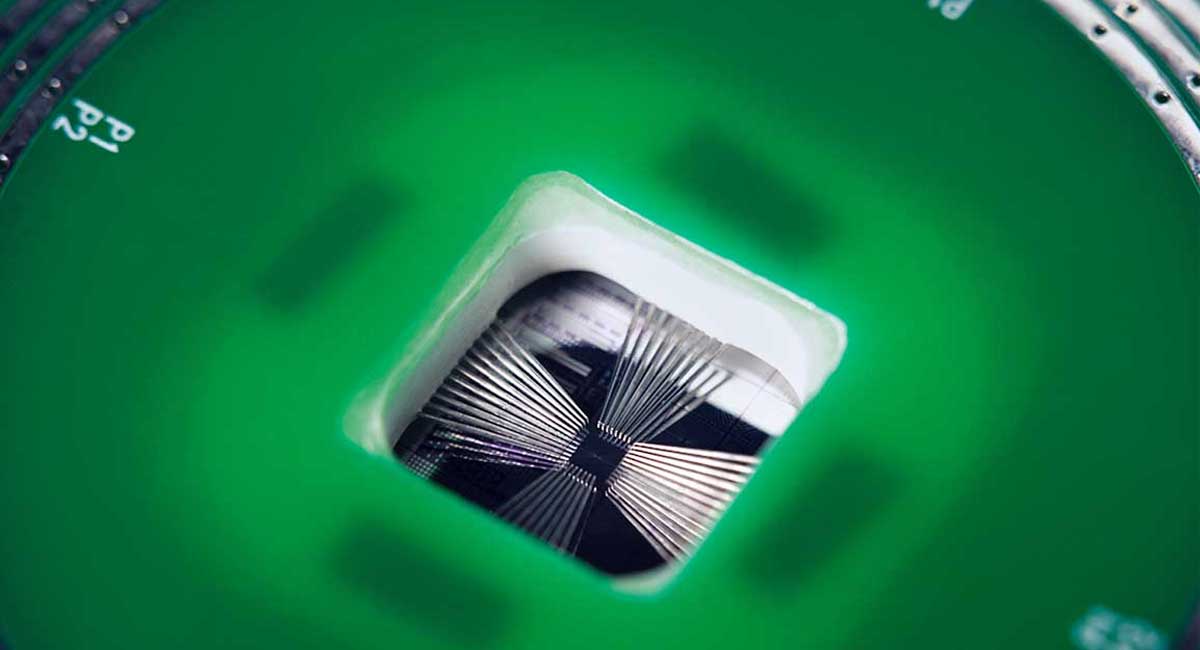
Published in Nature, the study centred on a new algorithm known as Quantum Echoes, which ran on Google’s Willow quantum chip. This algorithm, formally referred to as the out-of-order time correlator (OTOC), allows researchers to model the structure of physical systems ranging from molecules to magnetic materials and even black holes.
According to Google, this achievement marks the first time a quantum computer has successfully executed an algorithm whose results could be independently verified and repeated – a major step towards the practical deployment of quantum hardware in scientific applications.
The path to verifiable quantum computing
Quantum verification refers to the ability to reproduce a result on another quantum system of comparable capability, confirming that a computation is both correct and scalable. This has been a long-standing challenge in the field, as quantum states are fragile and prone to error.
Google’s Willow chip, introduced in 2024, addresses this issue through an architecture that significantly reduces quantum error rates – a problem that has constrained the performance of quantum processors for decades.
In this latest research, Google’s Quantum AI team likened its new technique to sending a signal into a quantum system and then precisely reversing it to capture a returning ‘echo’. This echo, enhanced by constructive interference between quantum waves, provides an exceptionally sensitive measurement, enabling more accurate and complex simulations.
From molecules to materials science
In collaboration with the University of California, Berkeley, Google’s team demonstrated how Quantum Echoes could be applied to chemical research by analysing the structure of two molecules containing 15 and 28 atoms respectively. The quantum-derived results matched those of Nuclear Magnetic Resonance (NMR) measurements but also revealed additional information typically inaccessible through traditional NMR techniques.
This proof-of-principle experiment points towards what Google termed a “quantum-scope” – a tool that could reveal molecular and atomic-scale phenomena beyond the reach of existing instruments.
Such capabilities could be transformative in fields including drug discovery, materials science, and renewable energy, where understanding the quantum interactions between atoms and molecules is key.
A step closer to real-world quantum computing
Google first demonstrated quantum advantage in 2019, when its Sycamore processor solved a benchmark problem infeasible for classical systems. However, the new work differs in that the algorithm is verifiable and applicable to real scientific problems, not just a computational benchmark.
With the Quantum Echoes algorithm and Willow’s high-precision, low-error design, Google said it had moved closer to the long-term goal of developing quantum computers capable of driving discovery across chemistry, biology, and physics.
As Ashok Ajoy, Assistant Professor of Chemistry at UC Berkeley and collaborator on the project, noted: “Google’s Quantum Echoes algorithm showcases the potential for quantum computers to efficiently model and unravel the intricate interactions of these spins, possibly even across long distances. As quantum computing continues to mature, such approaches could enhance NMR spectroscopy, adding to its powerful toolbox for drug discovery and the design of advanced materials.”
While commercial applications remain several steps away, this development highlights the growing maturity of quantum computing hardware – and signals the beginning of a transition from theoretical capability to scientific utility.