




Quantum computers are designed to solve complex problems outside the scope of classic computing. Classic computers use conventional bits, which can be easily managed and are stored only as a 1 or a 0, while quantum computers use qubits that can be stored as a 1, a 0, or both. These qubits can be multiplied, resulting in the excellent computing potential of quantum computers. While quantum computing is still in its infancy, it is undergoing several significant developments.
According to MarketsandMarkets The quantum computing market is expected to be valued at USD 2,701.0 million in 2024 and reach USD 20,200.8 million by 2030, registering a CAGR of 41.8% during the review period. The early adoption of quantum computing in the banking & finance sector is expected to fuel the growth of the market globally. Other key factors contributing to the growth of the quantum computing market include rising investments by governments of different countries to carry out research and development activities related to quantum computing technology.
Quantum computing is gaining traction in the banking & finance services industry, which is focusing on increasing the speed of trade activities, transactions, and data processing. One of the significant potential applications of quantum computing is simulation. Quantum computing helps identify an improved and efficient way to manage financial risks. The processing time and the costs of high-quality solutions can increase exponentially if financial institutions use classical computers. In contrast, quantum computers can carry out speedy operations at optimised costs, resulting in cost savings and new opportunities for revenue generation.
The potential benefits of quantum computing in financial services include providing relevant and required cybersecurity solutions to safeguard consumers’ financial data using next-generation cryptography. Moreover, detecting fraudulent activities by recognizing consumers’ behaviour patterns is fast using quantum computing technology, which leads to proactive fraud risk management. Additionally, the optimisation of portfolio management of assets with interdependencies and predictive analytics in customer behaviour can be achieved by combining quantum computing with artificial intelligence (AI). A combination of quantum computing and blockchain technology is expected to lead to the development of the most hack-proof technology in this era of IoT. This combination is also expected to significantly increase the transaction speed and reduce processing costs in the banking & finance industry, thereby reducing infrastructural downtime.
The adoption of quantum computing in government is still in its early stages, but many governments have started to invest in research and development of this technology. Governments from all over the world have launched several initiatives to increase the use of quantum computing. For instance, the European Commission’s 10-year Quantum Flagship program aims to accelerate the advancement of quantum technology in Europe. The Chinese government placed a high priority on quantum technologies in its 13th Five-Year Plan. The government has established the National Laboratory for Quantum Information to advance the national development of quantum technology. These initiatives demonstrate governments’ significant interest and investment in developing and adopting quantum computing.
Quantum computers tap into the bizarre world of quantum mechanics through a principle called superposition. Unlike classical bits in regular computers that are restricted to either O or 1, qubits, the building blocks of quantum machines, can exist in both states simultaneously. Imagine a coin spinning in the air – it is both heads and tails until it lands. A qubit in superposition is like that spinning coin, simultaneously holding the possibility of being 0 and 1. This seemingly impossible feat allows quantum computers to explore many calculations concurrently, making them exceptionally powerful for specific tasks. However, this advantage comes with a caveat. When a qubit is measured, its superposition collapses, forcing it to become a definitive 0 or 1. The probability of obtaining each outcome depends on the qubit’s state before measurement. Despite this quirk, superposition empowers quantum computers to tackle problems that would take classical computers an unreasonable amount of time, making them potentially groundbreaking for fields like encryption and complex molecule simulations.
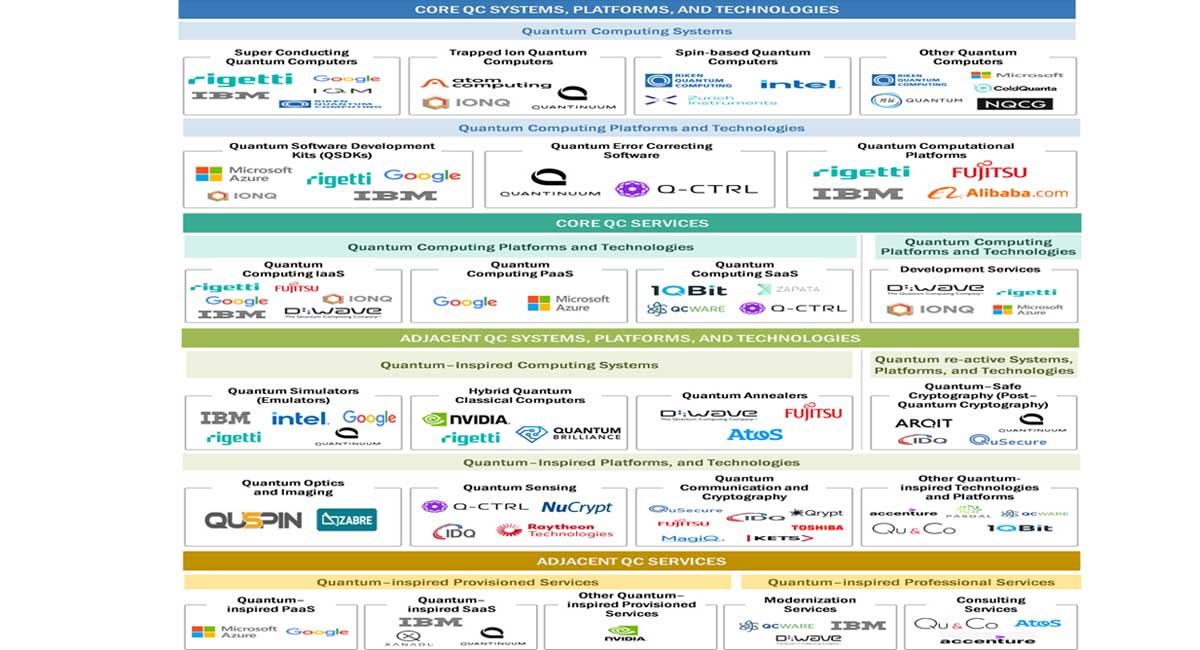
Stakeholders in quantum computing ecosystems
Quantum computing for large language model workloads
Large language models (LLMs) are data-hungry and computationally expensive to train. Here is where quantum computing emerges as a potential game-changer. Quantum algorithms like Grover’s search promise to drastically accelerate the training process by exploring many possibilities simultaneously. Quantum Neural Networks (QNNs) could usher in a new era of LLM learning efficiency. By harnessing the unique properties of superposition and entanglement, QNNs might be able to extract deeper and more intricate relationships within the data, leading to superior LLMs.
High-performance computing
High-performance computing (HPC) is the muscle behind tackling problems that would leave regular computers feeling strained. Imagine a team of super-powered calculators working together – that is essentially what HPC is. It utilises powerful supercomputers packed with thousands of processors to solve complex problems or analyse massive datasets at lightning speed. Alternatively, HPC can leverage clusters, groups of powerful servers working together as a single, high-performance unit.
AI
Artificial Intelligence (AI) is a broad field of computer science focused on creating machines that can mimic human intelligence, such as reasoning and problem-solving. Machine Learning (ML) is a core subset of AI where systems learn from data and improve their performance without being explicitly programmed. By identifying patterns and making predictions, ML algorithms enable a wide range of applications from image recognition to personalised recommendations, effectively automating tasks and extracting valuable insights from large datasets. These technologies are foundational to modern innovations and continue to advance rapidly.
Quantum communication
Quantum communication is a branch of quantum information science that focuses on the secure transmission of information using principles of quantum mechanics. Unlike classical communication, which relies on classical bits (Os and 1s), quantum communication uses quantum bits or qubits. Qubits can exist in multiple states simultaneously due to quantum superposition, which allows for the encoding of more information. A key feature of quantum communication is its ability to provide unconditional security through quantum cryptography.
Quantum sensing
Quantum sensing refers to using quantum phenomena to enhance the sensitivity and precision of sensors beyond the limits achievable with classical methods. These sensors leverage the principles of quantum mechanics to find and measure various physical quantities such as magnetic fields, gravitational forces, and electromagnetic radiation with unprecedented accuracy. One prominent example of quantum sensing is atomic magnetometry, which utilizes the precise control and measurement of atomic spins to detect extremely weak magnetic fields. This technology has applications in geophysics, medical imaging, and navigation systems.