




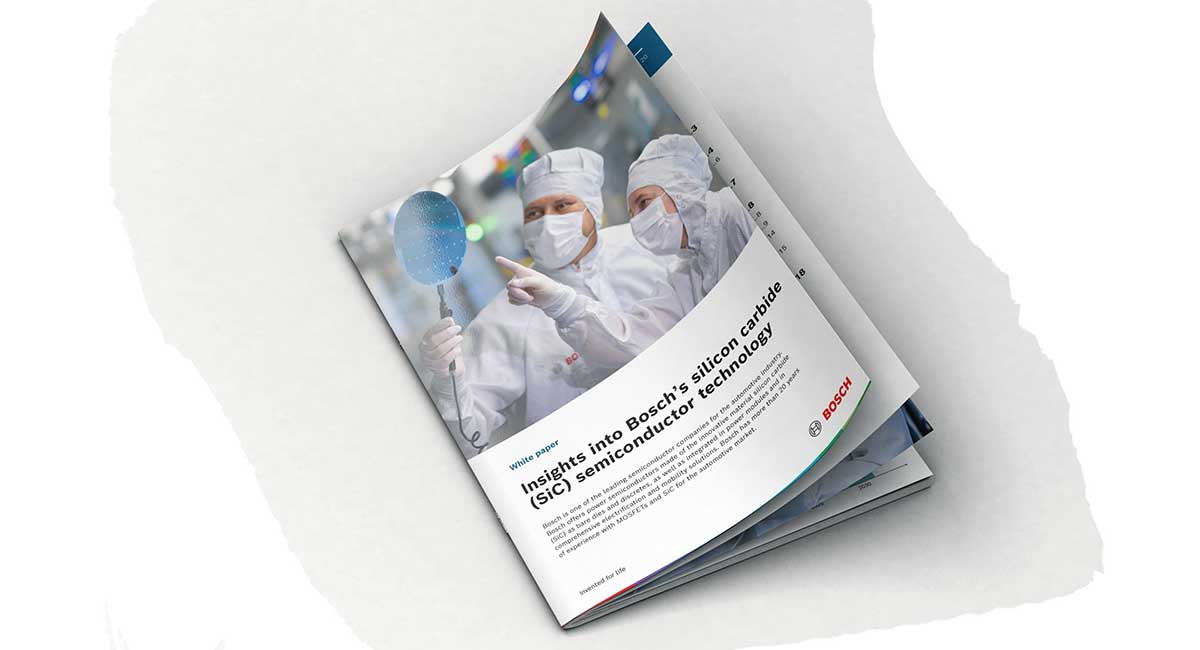
Bosch has published a new technical whitepaper on silicon carbide, highlighting more than two decades of research into what it views as a core technology for electric mobility.
The paper, titled Everything You Always Wanted to Know About SiC, was released in partnership with distributor Rutronik, which has worked closely with Bosch for many years.
The document sets out the case for SiC power semiconductors in applications such as traction inverters, on-board chargers, and DC/DC converters, and outlines how Bosch’s next generation of devices aims to deliver higher efficiency, improved robustness, and greater power density. It also details the company’s proprietary dual-channel trench MOSFET technology, designed to cut switching and conduction losses in high-voltage systems. Bosch offers its SiC MOSFETs as bare dies, discrete parts, and power modules in 750 and 1,200V versions.
A significant portion of the paper is devoted to manufacturing strategy. Bosch describes a shift from 150 to 200mm wafers, process optimisation programmes, defect-analysis methods, and measures intended to reinforce supply chain resilience. According to the company, these investments are essential for scaling SiC production for vehicle platforms with long operating lifetimes.
The publication follows technical training sessions held in October 2025 for Rutronik field application engineers, covering areas including Automotive MEMS, Consumer MEMS, SiC, and Automotive ICs. Rutronik said the initiative reflects its aim to expand its role as a design-in partner for automotive and industrial developers.
The paper also provides an overview of Bosch’s SiC product range, explains the operation of its trench MOSFET architecture, and sets out guidance for developers working on 400 V and 800 V platforms in both automotive and industrial settings.