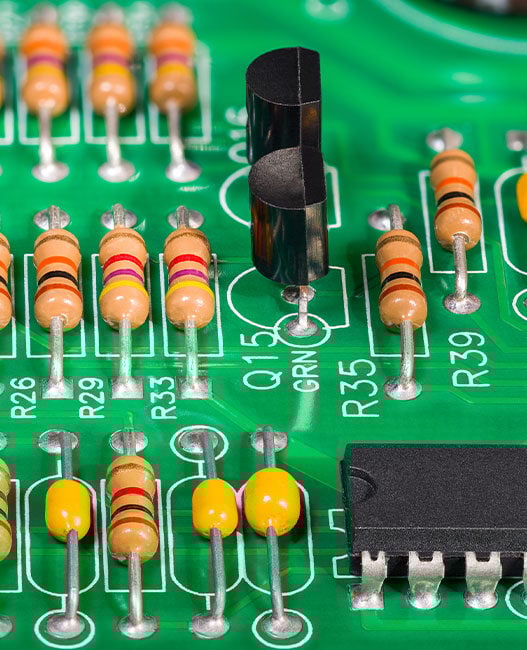





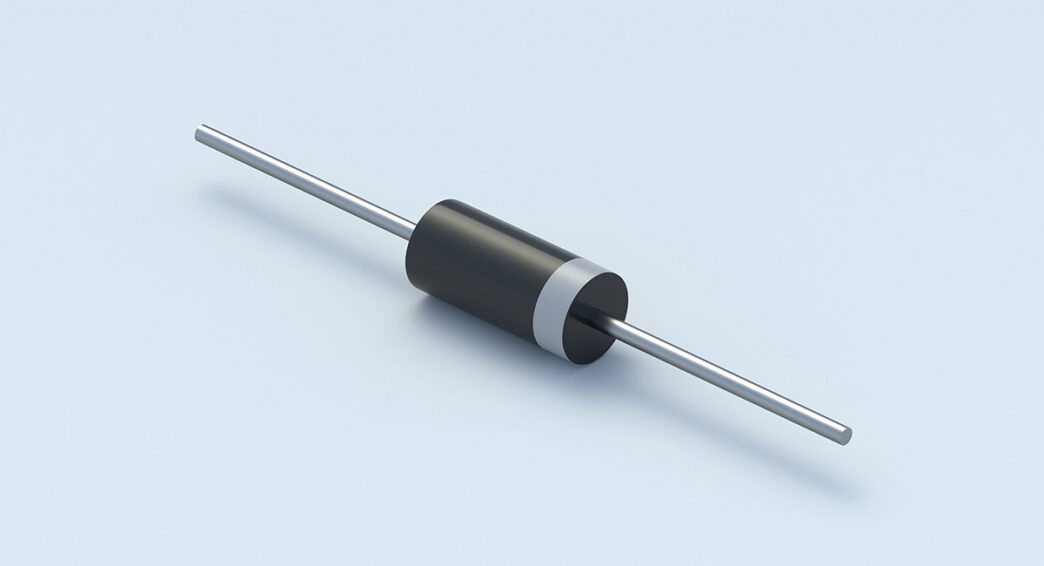
A diode is a semiconductor device that allows electrical current to flow in one direction while blocking it in the other. In electronic circuits, where control over the direction of current is required, the one-way behaviour of diodes makes them fundamental components.
One of a diode’s most common uses is in converting alternating current (AC) into direct current (DC), a process known as rectification.
This article looks at what a diode is, how it works, and how it is used to convert AC to DC, as well as briefly looking at some additional applications.
What is a diode?
A diode is made from a semiconductor material, most commonly silicon. Silicon is neither a full conductor nor a full insulator. In its pure form, known as intrinsic silicon.
Because silicon is a semiconductor, it does not behave like a perfect conductor, such as copper, nor like a perfect insulator. Instead, its ability to carry electricity depends on how much energy is available.
Inside a silicon atom, electrons sit in specific energy levels. The valence band is the energy level where electrons are normally bound to atoms and cannot move freely, so no current flows. Above this sits the conduction band, where electrons have enough energy to move through the material and carry electrical current.
In silicon, the energy gap between these two bands is relatively small. When extra energy is applied, like from an external voltage, some electrons can move from the valence band into the conduction band. Once in the conduction band, these electrons are free to move, allowing current to flow. This ability to switch between insulating and conducting behaviour is what makes silicon useful in electronic components.
Pure silicon still has very few free electrons, which limits its usefulness on its own. To improve its electrical behaviour, engineers add small amounts of other elements in a process known as doping. This involves adding small amounts of other elements to the silicon. When silicon is doped with an element that has extra electrons, it becomes an N-type material. When it is doped with an element that has fewer electrons, it becomes P-type material.
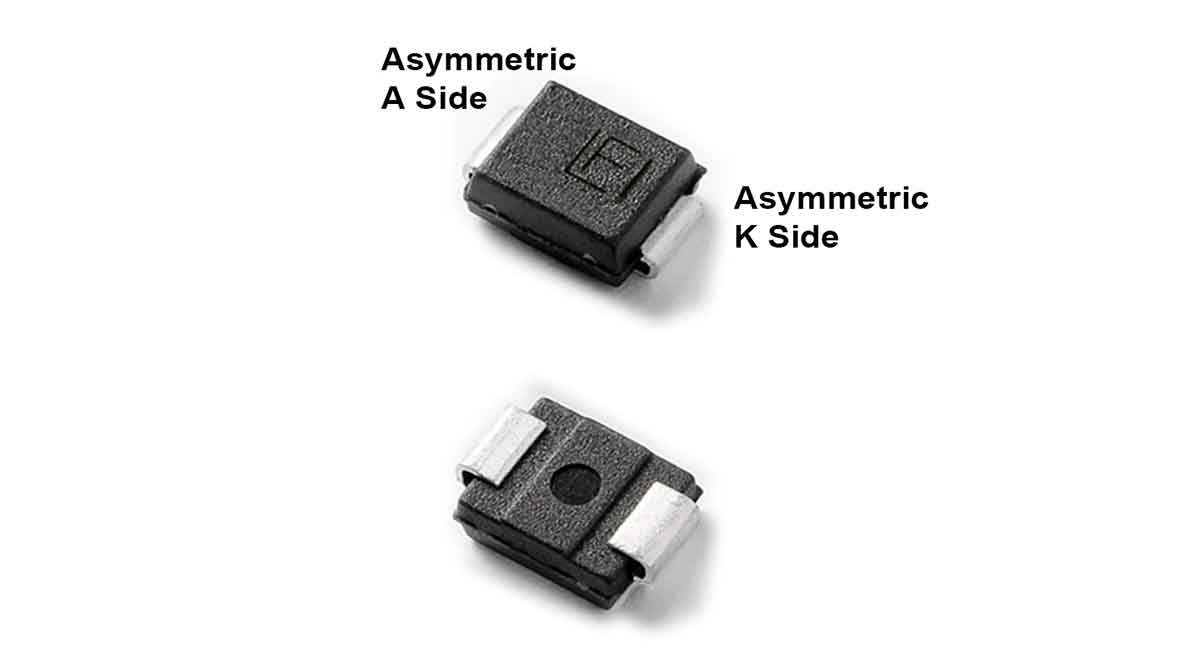
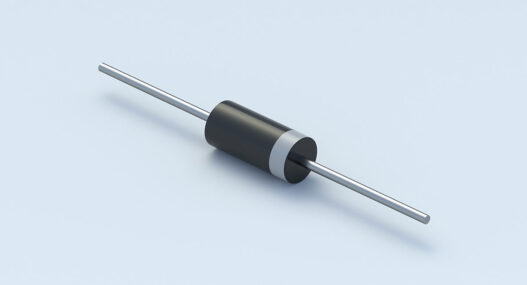
A basic diode is formed by joining P-type and N-type silicon together, creating what is known as a P-N junction. This junction sits between two terminals: the anode and the cathode. The entire structure is typically enclosed in a protective resin package.
At the boundary between the P-type and N-type materials, electrons and holes recombine, creating a region with no free charge carriers. This area is called the depletion region. As charges build up on either side, an internal electric field is created, which prevents further charge movement unless an external voltage is applied.
The physical size and electrical rating of a diode must match its intended application. If a diode is exposed to excessive current or voltage, it can overheat and fail, potentially damaging the surrounding circuit.
Forward and reverse bias
A diode’s behaviour depends on how it is connected in a circuit. When the anode is connected to a higher voltage than the cathode, the diode is said to be forward-biased. In this state, the depletion region narrows, allowing current to flow.
When the polarity is reversed, and the cathode is at a higher voltage than the anode, the diode is reverse-biased. The depletion region widens, and current is effectively blocked. This directional behaviour is often represented in circuit diagrams by a triangle pointing towards a line, where the triangle represents the anode and the line represents the cathode.
How does a diode convert AC to DC?
To convert AC to DC, a diode is used as a rectifier. AC continuously changes direction, meaning the current alternates between positive and negative half cycles. A diode allows current to pass during one half of the cycle while blocking it during the other.
In its simplest form, this process is known as half-wave rectification. The output is not a perfectly smooth DC signal, but rather a pulsating voltage that flows in only one direction. Additional components, such as capacitors and voltage regulators, are often added to smooth this output into a more stable DC supply.
Rectification is essential because many electronic components require a steady DC voltage to operate correctly. For example, if light-emitting diodes were powered directly by AC, they would switch on and off rapidly, resulting in visible flicker. Using DC ensures a consistent and stable output.
Protection against reverse polarity
Another important application of diodes is protection against reverse polarity. Reverse polarity occurs when a power supply is connected the wrong way around, causing current to flow in an unintended direction.
A diode placed in series with the power supply can block this reverse current, preventing damage to sensitive components. In some configurations, diodes are used to divert reverse current safely away from critical parts of a circuit.
Signal modulation and demodulation
Diodes are also used in signal processing applications. Signal modulation involves encoding information onto a high-frequency carrier wave for transmission. Because a diode has a non-linear current–voltage characteristic, it can be used to mix signals, clip waveforms, or extract information from a modulated carrier. This principle is commonly used in radio receivers for signal demodulation.
Common applications of diodes
Diodes are used across a wide range of electronic systems. Typical applications include light emission in LEDs, voltage regulation, logic functions in digital circuits, rectification in power supplies, and signal processing in communication equipment.
Diodes are available in many different types and power ratings, and selecting the correct device is essential for reliable operation. Understanding their basic behaviour provides a foundation for analysing and designing a wide variety of electronic circuits.