


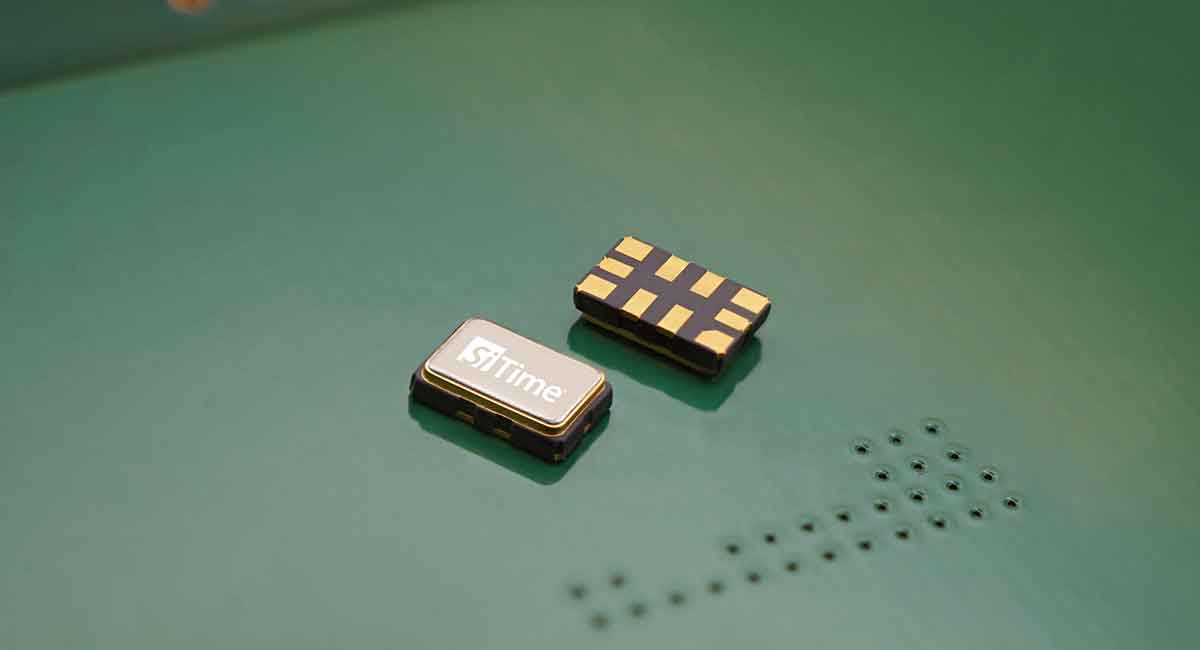
SiTime has launched the Endura temperature compensated oscillator (Super-TCXO), ENDR-TTT, for position, navigation, and timing (PNT) applications.
Engineered for superior holdover – uninterrupted operation when GNSS is not available – and resistance to jamming and spoofing, ENDR-TTT is an ultra-stable, low-power product for GNSS receivers in aerospace, defence, and industrial markets.
When GNSS signals are dropped due to unavailability or degradation – including signal jamming or extreme environmental conditions – holdover maintains timing stability locally to enable uninterrupted network operation. The ENDR-TTT Endura Super-TCXO provides up to 20x longer holdover and 20x better PNT accuracy, improving spoofing resistance.
“SiTime’s Endura Super-TCXO, ENDR-TTT, allows us to create a multi-layer anti-spoofing methodology,” said Paul McBurney, GNSS expert, CTO and Co-Founder at OneNav. “The first layer minimises the search window, preventing spoofing because signals outside the window are never tracked. The second layer addresses exceptionally large search windows, such as in first acquisition, where spoofers can be tracked. In this case, the spoofer signals can be identified and removed due to SiTime’s ultra-stable reference clock.”
Additional features for SiTime ENDR-TTT Endura Super-TCXO include:
• ±50 ppb stability over temperature (FvT); up to 10x better frequency stability over temperature versus quartz alternatives
• -55 to +125ºC operating temperature range
• 30,000g operational shock; up to 20x better resistance to shock
• 0.004 ppb/g typical g-sensitivity; up to 50x better than quartz alternatives
• ±0.5 ppm 20-year aging – eliminates field recalibration
• Optional I2C/SPI digital pulling capability for system frequency fine-tuning
“SiTime’s ENDR-TTT Endura Super-TCXO accelerates GNSS recovery by narrowing the resynchronisation window, reducing spoofing and setting a new standard for ruggedised precision timing,” said Piyush Sevalia, Executive Vice President of Marketing at SiTime. “Our latest product delivers a powerful combination of superior performance, low power, and small size, that leads the industry for PNT applications.”
I spoke with Steve Pratt, Sr. Director, Marketing – Aerospace & Defence, SiTime to learn more about the new release.
How did SiTime approach the design of ENDR-TTT to improve holdover performance, and what mechanisms underpinned the claim of up to 20x longer holdover in PNT applications?
ENDR-TTT delivers 20x longer holdover in PNT applications thanks to its superior acceleration sensitivity of just 0.004 ppb/g, a direct result of its MEMS resonator architecture. Unlike quartz resonators, which have roughly 1,000x more mass, the MEMS design dramatically reduces vibration sensitivity, ensuring timing accuracy in dynamic environments. Combined with ENDR-TTT’s ±50 ppb frequency stability over temperature and low aging enabled by SiTime’s advanced MEMS manufacturing process, the result is resilience and precision that provides extended holdover for mission critical systems when GNSS signals are lost.
How does ENDR-TTT strengthen resistance to jamming and spoofing in comparison with quartz-based solutions?
ENDR-TTT enhances GNSS resilience compared to quartz-based solutions by delivering 20x longer holdover during GNSS jamming in harsh environmental conditions such as temperature and vibration, ensuring local time remains accurate enough to synchronize critical systems like imaging, datalinks, and control functions which extend mission operations even without satellite signals. Once GNSS becomes available, ENDR-TTT’s superior aging and frequency stability enable faster signal reacquisition, minimising downtime. In GNSS spoofing, its tight frequency stability over temperature and vibration (±50 ppb) allows GNSS receivers to use narrower tracking loops, reducing the ‘window’ for false signals and making the system harder to spoof. No quartz based TCXO’s offer the combination of low power, small size, and tight stability over temperature and vibration to enable this jamming and spoofing resilience in PNT applications.
Which aerospace, defence, or industrial use cases stand to benefit most from the extended holdover and ruggedised operation?
A&D: unmanned aerial vehicles (UAVs), missile guidance systems, military ground vehicles, mounted and dismounted military radios, military GPS receivers, Low Earth Orbit satellites, secure datalinks and communication networks, assured-PNT systems for land, air, sea, any airborne application.
Industrial: civilian GNSS receivers, power grid synchronisation, oil & gas explorations, undersea exploration, robotics.
How does this release fit within SiTime’s wider timing roadmap for PNT and GNSS-dependent systems?
SiTime is committed to advancing technology for the PNT and GNSS markets, investing heavily in solutions that deliver assured timing under the most demanding environmental conditions. ENDR-TTT stands as our flagship Super-TCXO, purpose-built for resilient PNT applications requiring low SWaP with exceptional stability and extended holdover. Complementing the ENDR-TTT Super-TCXO is the SiT7101 OCXO, designed for even longer holdover (up to 24 hours) making it ideal for mission critical systems that demand the highest level of timing assurance. Looking ahead, SiTime will continue to expand its Endura product family, developing innovative solutions that support an even broader range of PNT and GNSS-dependent platforms across the aerospace, defence, and industrial sectors.
SiTime’s ENDR-TTT is sampling now. Mass production is expected in 1Q2026.