



Scottish deeptech company Vector Photonics has reached a landmark milestone in laser communications, completing the world’s first public demonstration of photonic crystal surface emitting laser (PCSEL) technology for real-world optical data transmission – moving this next-generation laser out of the laboratory and into the open air for the first time.
A beam across the Clyde
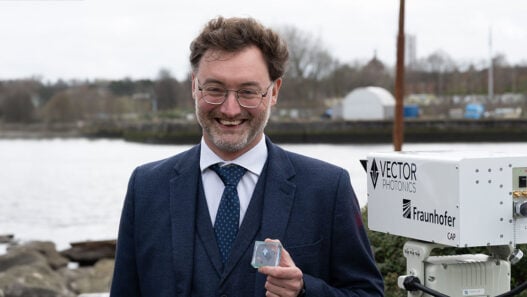
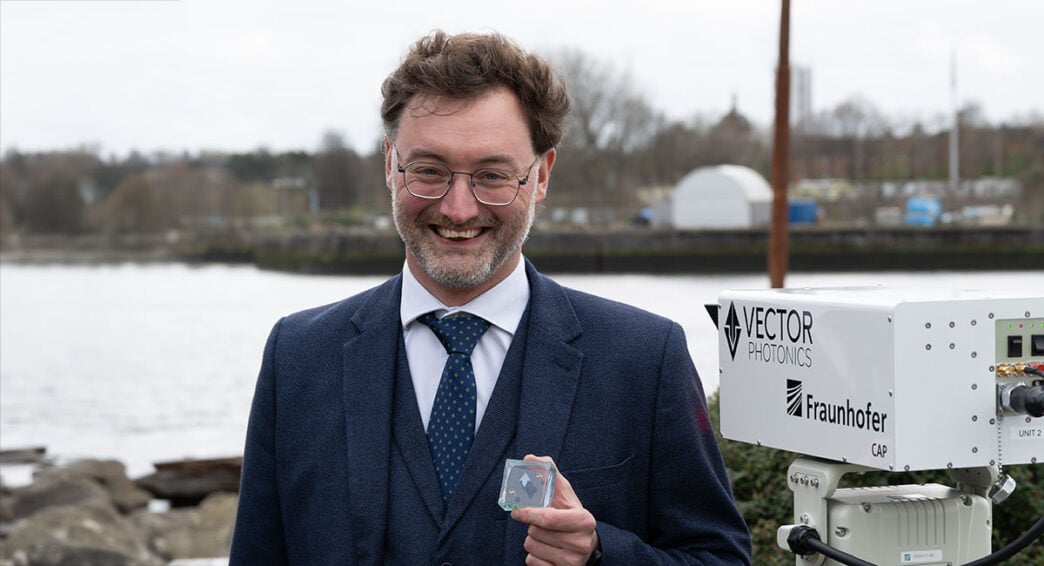
On 31st March 2026, Vector Photonics‘ PCSELs successfully transmitted live data across the River Clyde in Glasgow – spanning 500 metres from the Glasgow Science Centre to the Clydeside Distillery. The free-space optical communication system was engineered and built by the Fraunhofer Centre for Applied Photonics (Fraunhofer CAP), part of Fraunhofer UK, and achieved data transfer speeds of 50Mbps with error rates below standard forward error correction thresholds – twice the performance required by the experiment’s original specifications.
Why this matters
Until now, PCSEL development had been confined to controlled laboratory environments using ideal conditions and theoretical simulations. This live demonstration exposed the technology to real-world variables – fluctuating temperatures, humidity, precipitation, and wind turbulence – across a meaningful open-air distance, validating that PCSELs can perform reliably outside carefully engineered conditions.
In technology development terms, the demonstration advances PCSELs from Technology Readiness Level (TRL) 4/5 to 6/7, a significant leap toward full commercial deployment.
Dr Richard Taylor, Chief Executive Officer and Founder of Vector Photonics said: “This is a major step forward for Vector Photonics, proving that our technology is a commercial reality in real-world applications. We believe that the demo is the most advanced application of a PCSEL to date.”
What makes PCSELs different?
PCSELs represent a new generation of laser diodes that combine capabilities previously unavailable in a single device. They merge the high output power of edge-emitting lasers with the speed and surface-emission characteristics of vertical cavity surface emitting lasers (VCSELs) – giving them a rare combination of attributes particularly suited to free-space optical communications:
- Narrow, high-brightness beams with low divergence, reducing signal loss across long distances
- Coherent, single-mode output enabling direct coupling into free-space optics without complex beam-shaping hardware
- Wide wavelength flexibility spanning ultraviolet to far-infrared
- Naturally high data rates – the 50Mbps achieved in testing remains well below what PCSELs are inherently capable of
How fast can PCSELs really go?
The 50Mbps demonstrated across the Clyde may have been twice the system spec but PCSELs can go far beyond that.
“Our biggest challenge was that the tools needed to design our PCSEL devices didn’t exist. We had to develop proprietary simulation environments capable of assessing the device’s unique physics, then validate those designs through exhaustive manufacturing cycles. Breaking through that barrier – aligning theoretical simulation with high-tolerance manufacturing – is exactly what allowed us to reach this successful FSOC demo,” the company told Electronic Specifier.
According to Vector Photonics, the 100mW PCSEL described in its published research has a 3dB bandwidth thermal limit expected to reach 20GHz. With further design optimisations that exploit the inherent structural advantages PCSELs hold over other semiconductor laser architectures, modulation rates in excess of 40GHz are considered achievable.
There is, however, an important engineering trade-off to understand: modulation rate and output power pull in opposite directions. A system optimised for maximum data rate will operate at shorter ranges, while one tuned for longer-range transmission will carry lower data rates. Rather than being a limitation, this flexibility means PCSEL-based systems can be purpose-designed to meet very different use cases.
Applications
Vector Photonics’ breakthrough has implications well beyond a single river crossing. The technology has the potential to underpin faster, more secure wireless optical links between buildings, across campuses, and even between ground stations and satellites – all without dependence on physical cables or radio frequency spectrum.
Beyond secure communications, PCSEL technology is also being developed for application in AI data centres, LiDAR sensing systems, and additive manufacturing (3D printing).
“We are engaging with a range of industries, including vertically integrated laser manufacturers, systems integrators in civilian sectors such as ground and space communications, and data centre operations, as well as those in the defence sector. These organisations vary in scale and capability, from large multinational corporations with end-to-end production capacity to specialised firms focused on niche applications or subsystem integration,” the company told us.
Dr Gerald Bonner, Principal Researcher at Fraunhofer CAP, said: “This project has been a great opportunity to deploy Fraunhofer CAP’s capabilities in the development of optical systems to assist Vector Photonics in demonstrating the growing maturity of PCSELs and the potential of this important new diode laser technology in optical communications.”