



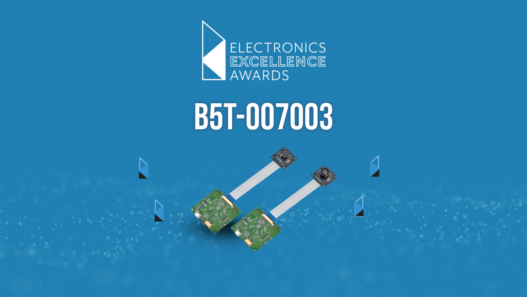


Concerning the camera sensor, there are various possibilities. The standard sensor is a CMOS matrix gray-scale sensor. But there are also other options, such as e.g. a color sensor for color inspections, or line scan and thermal imaging sensors.
The EyeCheck 9000 has a complete SDK for the programming of FPGAs, which means that the integrated FPGA can be programmed freely. Therefore the EC9xxx cameras have ZYNQ boards. The EyeCheck 9xxx-15 has the Raze1-15 board with 74K Logic Cells and a maximum frequency of 667 MHz (-1) up to 766 MHz (-2). The EC9xxx-30 has a Raze1-30 ZYNQ board, which has 125K Logic Cells and a maximum frequency of 667 MHz up to 800 MHz. Additionally, both boards have a Dual ARM Cortex A9 MPCore with CoreSight.
In addition there are hardware features such as for example 8 in- and outputs, the GigE and RS232 interfaces (optionally USB 2.0), as well as a LVDS interface. Thanks to the M12 connector and the robust housing, the camera has a protection class of IP65. The EC9xxx smart camera series has also a mini-PCI-Express card and 2 x Micro-USB connectors.
An important advantage is the easy integration via the EVT hardware access (e.g. image data, IO-digitalization, or various busses) with the EVT IP-Core such as e.g. for Vivado.
The integrated EyeVision software combines a graphical, ready-to-use user interface and a variety of libraries for C/C++ programming. The camera provides plug-and-play features with versatile programming possibilities.