








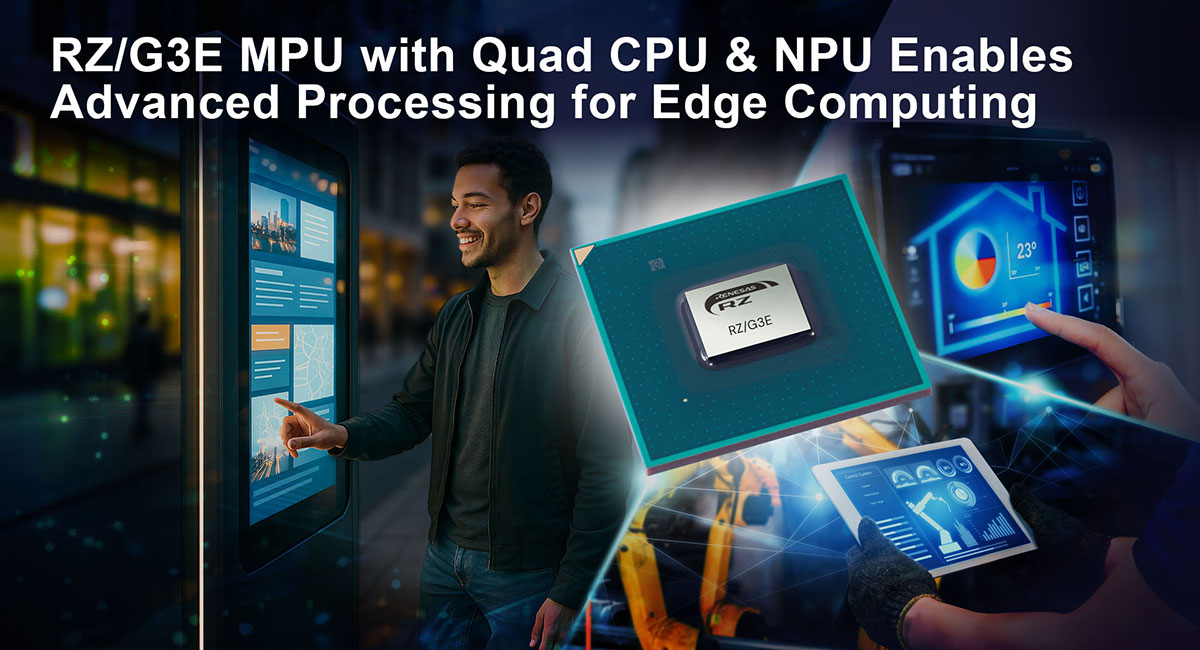
Renesas has released its latest 64-bit microprocessor, the RZ/G3E, a versatile and powerful solution aimed at high-performance AI-centric HMI designs.
This MPU is designed for HMI systems that support Full HD graphics and high-speed connectivity, as currently required in the industrial and consumer sectors.
In an exclusive interview with Electronic Specifier, Yasushi Iwase, Senior Manager, Embedded Processing Product Group at Renesas Electronics Corporation, emphasised that the RZ/G3E is designed to meet the growing demands of Edge computing, enabling accelerated AI inference and real-time local data processing.

64-bit microprocessor make up
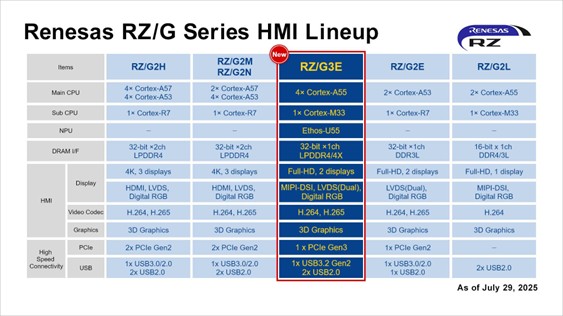
At the heart of the RZ/G3E is a quad-core Arm Cortex-A55, a Cortex-M33 core, and the Ethos-U55 NPU for AI tasks. The performance of an MPU is critical for smooth drawing, as it directly impacts the speed and efficiency of graphic displays.
Iwase added: “Faster MPU processing allows more complex images to display in real-time, enhancing the overall user experience. The RZ/G3E’s quad-core Arm Cortex-A55 CPU runs at 1.8GHz and is an extremely powerful CPU that performs not only HMI applications and various Linux operations, but also processing applications related to Edge computing.”
Its arithmetic processing performance is 3.4 times higher than that of the current mid-class RZ/G2E MPU in the second generation of RZ/G series, and is close to that of the high-class RZ/G2M MPU. The RZ/G3E MPU offers excellent cost performance to the users.
“In addition to the high-performance CPU, the RZ/G3E has integrated the 3D GPU Arm Mali-G52 (equivalent to 30GFlops) and H.264/265 video codec that strongly support HMI functions. Furthermore, two channels of the LCD controller are built into the RZ/G3E to simultaneously output two screens in Full-HD size and independently control both screens,” Iwase explained.
RZ/G3E key components
- CPU: Quad-core Cortex-A55 (up to 1.8GHz), Cortex-M33
- NPU: Ethos-U55 (512 GOPS)
- HMI: dual Full HD output, MIPI-DSI / Dual-link LVDS / Parallel RGB, 3D graphics, H.264/H.265 codec
- Memory interface: 32-bit LPDDR4/LPDDR4X with ECC
- Connectivity for 5G communication: PCIe 3.0 (2 lanes), USB 3.2 Gen2, USB 2.0 x2, Gigabit Ethernet x2, CAN-FD
Iwase added: “The RZ/G3E is equipped with the Arm Ethos-U55 as an NPU (Neural Processing Unit) dedicated processor for AI inference with 512 GOPS performance at 1.0GHz operation, offering vision AI for object detection, face recognition, and people counting, as well as voice AI and sensing AI.”
Another advantage of the Ethos-U55 is that it can offload AI processing from the main CPU, allowing users to build more power-efficient systems.
“Including the high-performance 3D GPU and video codec, the MPU delivers smooth Full HD (1920×1080) video at 60fps on two independent displays, with output interfaces including LVDS (dual-link), MIPI-DSI, and parallel RGB. A MIPI-CSI camera interface is also available for video input and sensing applications,” Iwase underlined.
The RZ/G3E comes with a range of high-speed communication interfaces essential for Edge devices. These include PCI Express 3.0 (2 lanes) for up to 8Gbps, USB 3.2 Gen2 for fast 10Gbps data transfer, and dual-channel Gigabit Ethernet for seamless connectivity with cloud services, storage, and 5G modules.
Meeting the growing demands of Edge computing
In the world of embedded HMI applications, small displays are common, but recently there has been an increase in relatively large-scale embedded display devices of 10 inches or more.
Iwase added: “For display devices of this size, a resolution of the Full-HD (1920 x 1080 pixels) class is preferred so that the image does not look grainy. In addition to resolution, these displays have become more sophisticated and increasingly used to connect to the Internet.”
Furthermore, in recent years, there is a growing need for AI-based intelligence, enabling the devices to recognise users and support data collection and analysis.
“Despite such advanced functionality, eco-friendly products with low power consumption are also desired to minimise environmental impact and address rising resource prices. Renesas’ new RZ/G3E MPU is designed to solve many of these challenges,” Iwase noted.
Serving industrial and consumer HMI systems
With these five key features, the new MPU powers applications in HMI systems:
- Combining 1.8GHz Quad Cortex-A55 for main Linux operation and 1.0GHz NPU (Ethos-U55) for AI edge inference allows for advanced HMI application
- Equipped with GPU, Video Codec engine support displaying high-definition GUI. Support two Full-HD display outputs
- Communicate with the Cloud using 5G generation by built-in high-speed interfaces – PCIe Gen3, USB3.2, and Gbit Ethernet
- Integrated power domain separation and support both ‘minimal standby power’ and ‘fast Linux resume’ for HMI application
- Provide multiple Linux software packages to meet customers’ diverse S/W requirements. Verified Linux Package (VLP), Linux BSP Plus, SDK
Offering exceptional energy efficiency
As typical HMI products do not operate continuously at full power for 24 hours in 365 days, reducing standby power consumption when not in use is especially important.
Iwase added: “For smaller display devices, RTOS-based MCUs are often used, and the short start-up time from power-off status allows the power to be turned off when not in use.”
However, it is hard to develop application programs using RTOS for large display devices with higher functions in general. Hence Linux-based application programs tend to be adopted for those devices.
Iwase said: “The program size of Linux is basically much larger than the RTOS program, causing it to take more than 10 seconds to start up the system from power-off status in some cases.”
To solve this issue, RZ/G3E implements a partial power shut-off function, which can significantly reduce power consumption by keeping the minimum power supply required to hold data in DRAM memory and turn off the power supply in other areas.
Since the power consumption is reduced to a minimum supply, the standby power of the MPU can be achieved with a very low standby power of around 1mW.
Supporting the Renesas software ecosystem with Linux
In deep standby mode, the Linux programs in DRAM memory do not disappear, so there is no need to reload Linux programs from external nonvolatile memory, which significantly reduces the time to return from standby status.
“VLP (Verified Linux Package) is a software package developed based on the Linux kernel provided by the Civil Infrastructure Platform, with over 10 years of maintenance support. Renesas continues to offer VLP for customers who require super long-term Linux Kernel maintenance,” Iwase added.
For users requiring the latest versions, Renesas provides Linux BSP (Board Support Package) Plus with support for the latest LTS (Long-Term Support) Linux kernel and Yocto.
Considerations to keep in mind
A broad range of SoM solutions will be available from Renesas’ ecosystem partners such as a SMARC module from Tria, an OSM (Size-M) from ARIES Embedded and an OSM (Size-L) from MXT. Customers can select a preferable form factor as they like.
As these SoMs are technically vetted systems to bring an optimised, low-risk design for faster time to market, customers can accelerate the development process and bring their products to market more quickly.
“For large-scale display devices that are frequently used in our daily lives and have become more sophisticated, Renesas’ brand-new RZ/G3E MPU is designed to meet market needs by providing better intelligence and less power consumption, and making our lives easier,” Iwase concluded.
About the author:

Diego de Azcuénaga, Contributing Writer


