





Smart meters and Edge AI data loggers are integral to modern energy management and industrial automation systems as they enable accurate, real-time monitoring of energy consumption and key industrial parameters such as environmental data or failure detection. They continuously record data, transmit it wirelessly, and support over-the-air (OTA) updates. Thus, the choice of memory technology impacts the performance, reliability, and longevity of these devices.
The list of requirements is not short: smart meters and Edge AI data loggers must offer fast write speeds, low power consumption, high endurance, and reliable data retention. Traditionally, SRAM, DRAM, and EEPROM have been used in this type of device. With FeRAM and MRAM, two new contenders have entered the scene that don’t only check all the marks but also bring a host of new options.
Choosing the right memory
Looking at the different memory technologies, it’s clear why SRAM and DRAM have been top on the list for so long. They both are very fast and have unlimited write endurance. However, their high power consumption and non-volatility have become hindering factors, especially for Edge AI applications where power consumption and data retention are important aspects. And while EEPROM retains data for more than 10 years and has moderate energy consumption, the fact that it only supports up to 1 million write cycles and has a lower write speed makes it less ideal for many applications.
MRAM and FeRAM on the other hand are non-volatile with high write endurance and fast write speeds, making them suitable for applications requiring durability and speed. Their low power consumption is an additional bonus for smart meters and Edge AI applications.
The proliferation of IoT has led to the adoption of OTA updates in vehicles, smart home speakers, and Industrial IoT devices. For devices that want to use this option, the logical choice of memory is MRAM. Especially in AI-enhanced Edge systems, memory must support rapid and frequent access. MRAM’s read/write characteristics align well with requirements for embedded AI model execution, sensor data fusion, and predictive analytics. But also, modern smart meters with OTA updates and local AI-based decision-making benefit from a design that integrates MRAM.
It’s a key component for processing and communication and ensures power-efficient operations.
Architecture of an AI-enhanced smart meter
The architecture of an AI-enhanced smart meter integrating MRAM (Fig.1) is built around a modular embedded system comprising five principal components: a microcontroller unit (MCU), MRAM for non-volatile memory, an AI accelerator, a power management unit (PMU), and the metering/load interface. This configuration is designed to deliver high-performance, energy-efficient data acquisition, processing, and logging in Edge environments.
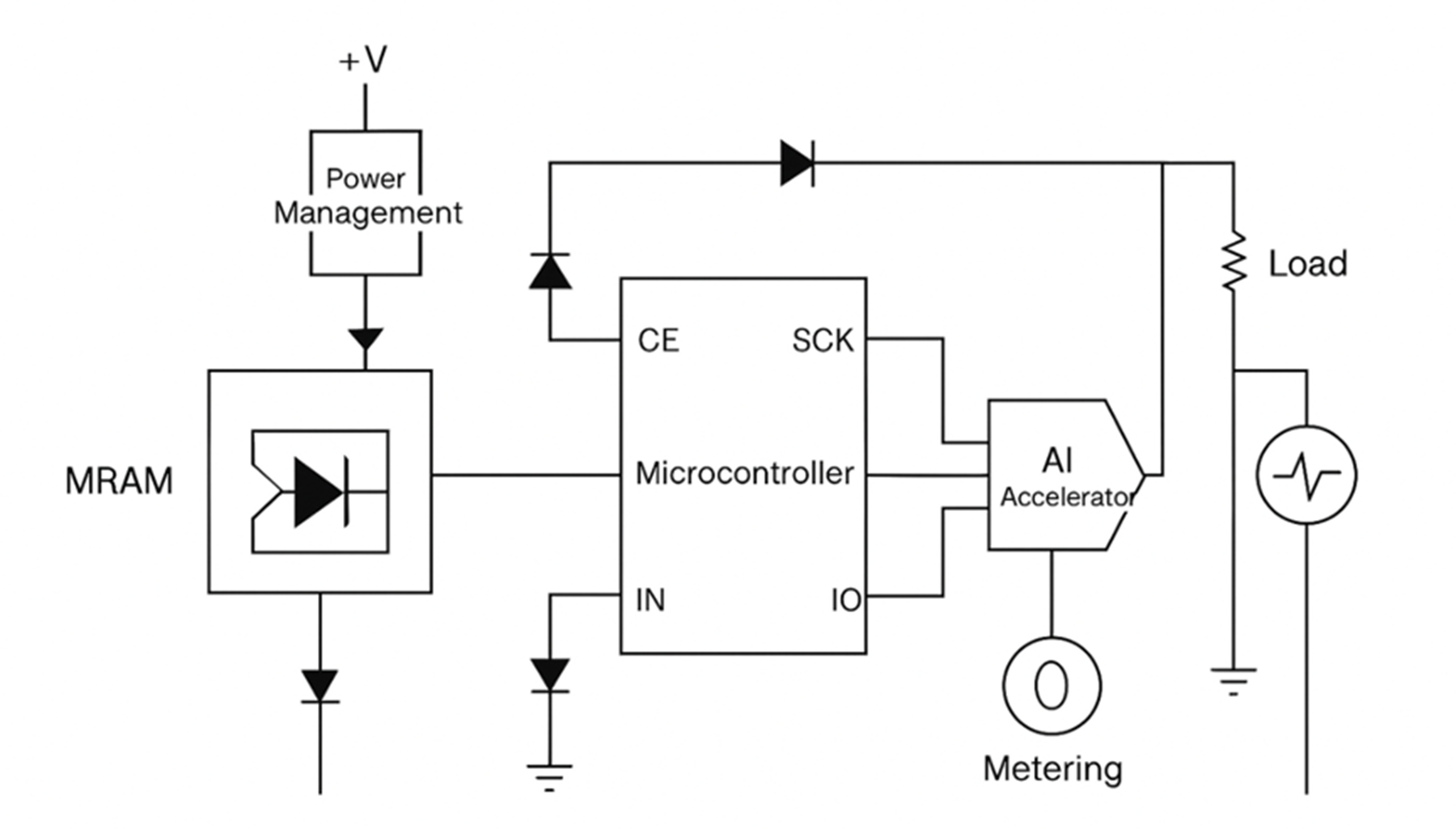
Figure 1: Architecture of an AI-enhanced smart meter integrating MRAM
At the core, the microcontroller serves as the system’s command centre, orchestrating data flow, managing peripheral interfaces, and executing firmware tasks including real-time metering, communication handling, and power control. It is connected to MRAM, which acts as the primary non-volatile memory. MRAM offers byte-level access, write endurance exceeding 10¹⁴ cycles, and data retention beyond 10 years without the need for refresh cycles or wear-levelling algorithms, making it vastly superior to EEPROM or Flash in this context. The fast access time (~10ns) also supports OTA firmware updates and instantaneous data logging.
The AI accelerator, tightly coupled with the MCU via digital I/O or memory-mapped interfaces, performs local inferencing tasks such as anomaly detection, consumption forecasting, and pattern recognition, enabling autonomous Edge intelligence without reliance on Cloud processing. The outputs of these computations can be stored in MRAM, ensuring secure and persistent retention of inference results or model updates.
Supporting these processing elements, the power management unit provides a regulated supply voltage derived from either mains or battery sources. The PMU incorporates diodes and filter capacitors to protect against surges and reverse polarity while optimising power sequencing to minimise consumption during standby. This allows the system to operate with ultra-low power budgets – critical for remote and battery-operated deployments.
The metering interface connects analog front-end sensors, such as current transformers (CTs) and voltage dividers to the system, enabling accurate sampling of real-time electrical parameters. The MCU processes this data and, when needed, triggers AI-based evaluations or control actions. The system also includes a load control mechanism, allowing it to modulate or disconnect loads based on predefined rules or learned behaviour.
Overall, the architecture delivers a high degree of integration and resilience. It enables persistent, high-speed data logging, real-time control, and AI-driven analytics in a compact, energy-efficient platform. The use of MRAM eliminates conventional NVM bottlenecks, while the AI accelerator ensures the system can adapt and respond intelligently to dynamic operating conditions. This makes it ideally suited for next-generation smart meters deployed in both residential and industrial energy monitoring systems.
Further design considerations
Based on outlined architecture, there are two critical design considerations for future Edge AI data loggers and smart meters that need to be taken into account:
- Scalability and density: advances in MRAM fabrication continue to increase density and capacity, making it viable for more data-intensive applications. This progress allows for the integration of larger data storage solutions within Edge devices, supporting more complex processing and analytics at the edge of the network
- Cost implications: while the initial cost of MRAM may be higher compared to traditional memory technologies, its durability and minimal maintenance requirements contribute to a lower total cost of ownership over time. This economic benefit is particularly significant for large-scale deployments where maintenance costs can accumulate substantially
MRAM’s distinctive blend of durability, rapid performance, energy efficiency, and reliable data retention establishes it as an ideal memory solution for smart meters and Edge data loggers. Its capabilities for AI processing and over-the-air firmware updates further enhance its role as a critical component in the development of future smart infrastructure.
 Nick Florous, Global Product Marketing Director, MEMPHIS Electronic
This article originally appeared in the July’25 magazine issue of Electronic Specifier Design – see ES’s Magazine Archives for more featured publications.