



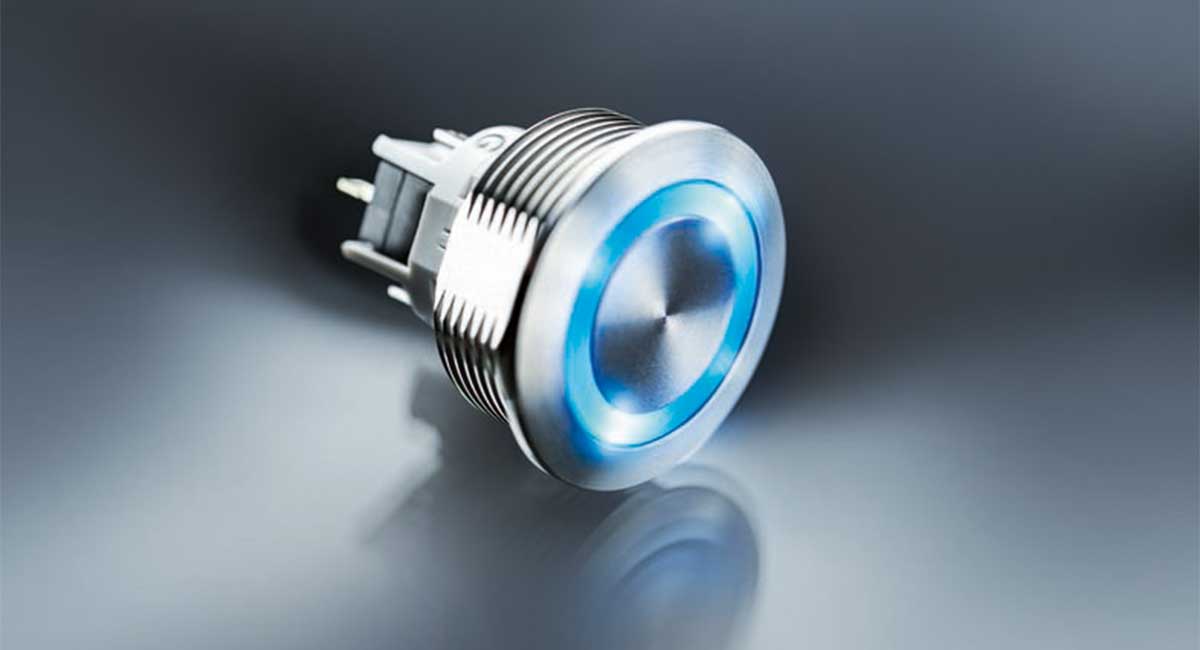
The proven MSM II switch family continues to grow: With the Common Anode variant, SCHURTER offers maximum compatibility with modern control architectures. Robust metal mechanics, IP67 protection, precise tactile feedback and flexible RGB visualisation ensure clear status indication and highest reliability. Optimised for PLCs, driver ICs and microcontrollers – ideal for demanding industrial HMI and control applications.
MSM II – now available with Common Anode RGB LED
The well-established MSM II mechanical switch family is growing. With the MSM II (Common Anode), SCHURTER is introducing a variant that uses a common anode to control the RGB LED illumination. This combines the familiar robust mechanics with visualisation technology for clear feedback, easy integration, and maximum reliability in control and operating solutions.
RGB LEDs can be controlled either via a common anode (+) or a common cathode (–). While with common cathode all negative poles are connected and the colours are controlled individually via the positive pole, the common anode variant does the opposite: all positive poles are connected, and the colour channels are switched separately to ground.
Key facts:
- Optimised for industrial control architectures
- Usual SCHURTER Metal Line quality
- Protection class IP67
In practice
The MSM II (common anode) offers maximum compatibility with modern driver ICs, PLC outputs, and microcontrollers, which are predominantly designed for common anode control. This facilitates integration thanks to a simple signal structure and reduced wiring requirements.
Application areas
The combination of tactile precision, IP67 protection, robust design, and flexible RGB signalling makes the MSM II switch ideal for a wide range of applications, particularly in industrial control units such as control panels, production facilities, building automation, and access solutions.
The new variant of the MSM II series provides OEMs and system integrators with an additional switch solution. It simplifies implementation in industrial control systems, increases operational reliability, and ensures clear visual feedback.