

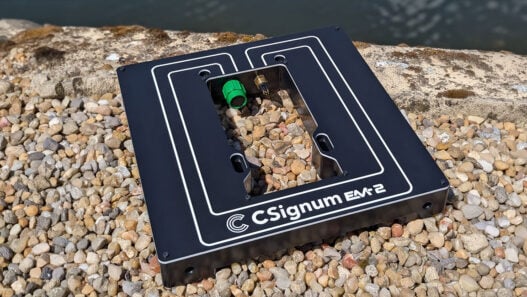


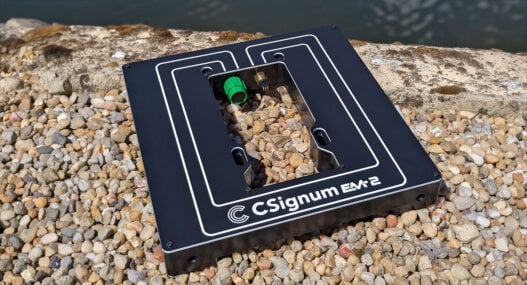
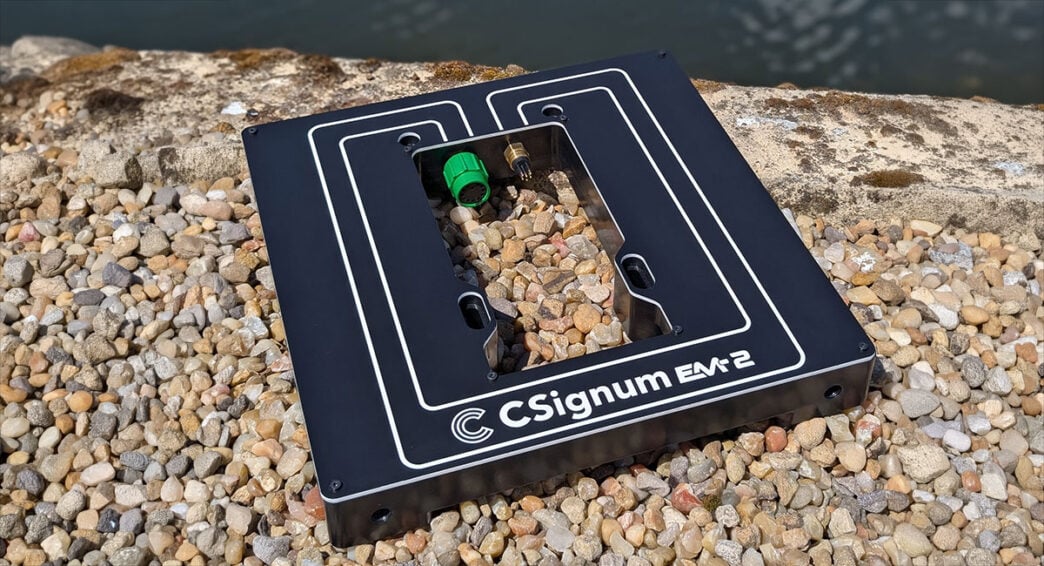
CSignum, a specialist in subsea wireless communication, turned to Intertronics when developing the EM-2 – a device that transmits data from beneath the water’s surface using electromagnetic (EM) fields.
To protect the EM-2 in harsh underwater environments, CSignum needed a reliable potting compound solution. With expert support from Intertronics and its IRS 3071 polyurethane encapsulation, the company overcame critical structural challenges and fast-tracked product certification. Today, the EM-2 is commercially available, providing an environmentally safe alternative to cabled or acoustic transmission methods.
Customer challenge
CSignum has developed the EM-2, a wireless communication system that uses low-frequency electromagnetic fields to transmit data directly from underwater sensors to a receiver on the surface – without the need for cables, acoustics, or optical links. It reliably pushes real-time sensor readings through water, ice, soil, or concrete up to ~200m distance, with even longer reach when paired with boosters, and doesn’t harm aquatic life or suffer in murky or choppy conditions.
Applications include environmental monitoring, for example transmitting water quality data from lakes, rivers, or coastal areas to shore-based stations, and feeding structural and environmental data from subsea installations (e.g., offshore wind bases, pipelines) to surface hubs. The EM‑2 platform bridges the typical communications gap at the water‑air barrier, offering robust, bi‑directional data links in environments where conventional wireless methods can fail.
The EM-2 can be mounted on the shore or on piles, buoys, and on structures such as wind turbines in the sea or bridges. They are often positioned above, on, or below the water, so they need good protection.
The company packaged its initial product in a sealed pressure vessel, the industry standard for subsea electronics. The EM-2’s new design, incorporating a three-axis antenna and transmission loop, is structurally unsuitable for this approach. A decision was made to try a polymer encapsulation.
Choosing a potting solution
Following a search for providers of potting compounds for electronics, Mechanical Engineer Kyle Watson turned to Intertronics. With no previous experience in specifying this kind of material, Kyle consulted with Ian Mann, Sales Specialist at Intertronics. After discussion about options, it was decided to evaluate Intertronics IRS 3071, a two-part polyurethane potting compound that can be cured at room temperature. The compound is designed for low to medium voltage electrical and electronic applications and has a successful history in similar applications (e.g. protecting devices for deep sea fishing).
CSignum trialled IRS 3071 for EM-2. The first challenge was air pockets in the potted device, leading to some process-orientated design changes. “We knew the air pockets and bubbles would be an issue. During the potting process, part of our product had a tunnel like feature, where potting compound was going in both ends and trapping the air, creating voids,” explained Watson. “As soon as I had an issue, I spoke with Intertronics to come up with a solution.”
Air pockets and voids are a threat to the product’s structural integrity at greater depths (~100m), where the pressure differential could cause the product to implode. Intertronics advised CSignum to create vents in parts of the housing, allowing air to escape during potting and providing evidence of a complete fill.
Results and market launch
Working with Intertronics allowed CSignum to design and protect its product in a way that’s affordable and accessible. As well as purchasing 1kg twin-packs of IRS 3071 which facilitated manual mixing and application, CSignum received advice from Intertronics on how they could scale this up for larger production runs.
“Intertronics has been a key part in getting this product to market, without it we would’ve come into a lot of difficulties. It has probably saved money because the pressure vessel approach would have cost a lot of engineering time to make something that works at these depths,” Watson added.
Ongoing partnership
CSignum continues to work with Intertronics as the company scales up production in terms of material supply, technical support, and advice on sourcing a dispensing machine to automate its manufacturing process.
“Intertronics have been very helpful and responsive throughout this entire process. They have proven themselves to be a single point of contact for buying the product to technical advice on implementing it and are very helpful in procuring more potting compounds and related products,” concluded Watson. “Intertronics’ materials and expertise enabled the EM-2 to become a market-ready, certified product.”