





Every component of an electronics circuit board has a role to play. Like an orchestra, each piece understands its role, timings, and limits. No single part carries command on its own. Everything is connected and controlled.
Sticking with the orchestral analogy, let’s look at the components this way: the microcontroller is the conductor; the power supply provides the breathwork; passive components become sheet music and acoustics; active components must surely be the musicians. Sensors can act as both the audience and microphones, while communication interfaces coordinate the ensemble. Finally, the PCB, the base upon which the magic happens, is the concert hall.
Designing a circuit board to work in harmony requires functionality, size, and manufacturing considerations, all of which determine how a board is laid out. Even boards that have similar purposes rarely look the same because the combination of components, layout, and routing is tailored to each design.
Let’s take a closer look at the components of an electronic circuit to understand how they work together.
Microcontrollers or processors
At the centre of an electronic circuit is the microcontroller or processor. It controls timing, logic, and sequence, ensuring that data moves correctly between components. Clock signals act like the conductor’s baton, keeping instructions, data transfers, and switching events in precise order. Without proper timing, even well-designed circuits can behave unpredictably or fail entirely.
ICs and power management
Every circuit requires power. Voltage regulators and power management ICs ensure each section receives the correct voltage and current. Too little power, and the system fails to operate as intended; too much, and components risk overheating or permanent damage. Some circuits also include battery management systems, especially for portable electronics.
Passive components
Passive components shape and control the flow of electrical energy. Resistors limit current, which can control brightness or volume. Capacitors smooth voltage changes and store energy temporarily. Inductors manage energy flow over time and can filter or shape signals. Together, passives ensure that electrical signals arrive where needed, cleanly and predictably. Without them, signals would be abrupt, distorted, or unstable.
Active components
Active components, such as transistors, diodes, and operational amplifiers, amplify, switch, and modulate signals. They transform small control inputs into electrical actions. Analog components handle continuous waveforms like audio signals, while digital logic operates in discrete steps, such as 1s and 0s. Each active component responds to the design intent of the circuit.
Sensors
Sensors act as the circuit’s interface to the outside world. They convert temperature, light, pressure, or motion into electrical signals. These inputs allow the circuit to respond, adapt, and interact, rather than repeating the same output without regard for changing conditions.
Communication interfaces
Communication interfaces coordinate the ensemble of components. Buses such as I²C, SPI, USB, and Ethernet ensure that different parts of a circuit exchange information without conflicts. Protocols define who speaks, when, and how, preventing collisions or misinterpretation of signals.
The PCB
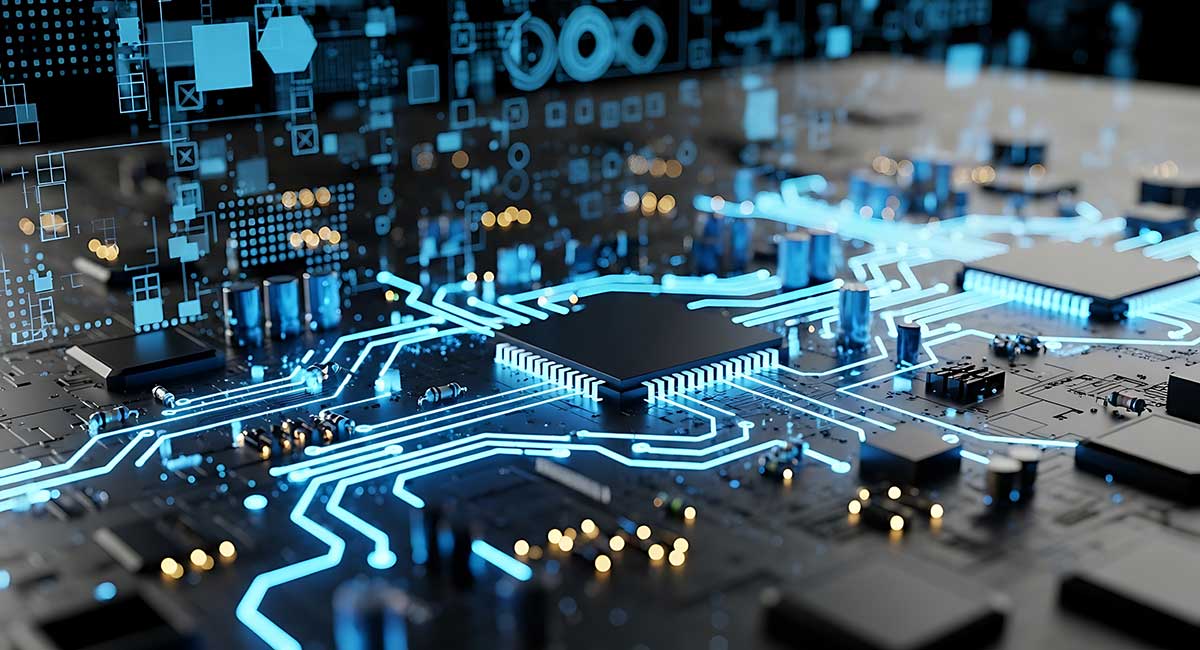
PCBs provide the foundation upon which the circuitry works. Trace layout, grounding, and shielding determine how cleanly signals travel, how much interference is picked up, and how heat is dissipated. A poorly designed PCB can ruin the performance of even the best components. Proper layout ensures signal integrity, reduces electromagnetic interference, and allows heat to be managed effectively.
The musicality of circuitry
When each of these elements is thoughtfully designed and the outputs considered, they work together harmoniously. The result is a predictable, efficient, and purposeful system. Like a well-rehearsed orchestra, the performance depends on every element playing its part correctly.