







“With currently up to eight performance cores in parallel to 16 efficient cores, the socketed variants of the 13th Gen Intel Core processors empower our COM HPC modules to offer even more options for making edge computing more performant and efficient through workload consolidation,” explains Jürgen Jungbauer, Senior Product Line Manager at Congatec. IoT-connected systems have many tasks to process in parallel, and if OEMs do not want to realise this connectivity through adaptive systems, OEMs need to embed virtual machines into their solutions. The more cores a Computer-on-Module provides, the easier this becomes.
Major features that have been improved
The most remarkable improvement of the socketed 13th Gen Intel Core processors is the up to 34% multi-thread and up to 4% single-thread performance gain as well as an impressive 25% faster image classification inference performance, compared to 12th Gen Intel Core processors. The added DDR5-5600 support as well as an increased L2 & L3 cache on select variants contribute to even more outstanding multi-threaded performance. The computing core improvements of this performance hybrid architecture, which currently provides up to eight performance cores and 16 Efficient cores, are complemented by enhanced USB3.2 Gen 2×2 bandwidth of up to 20Gbps on the new Congatec COM-HPC Size C Computer-on-Modules.
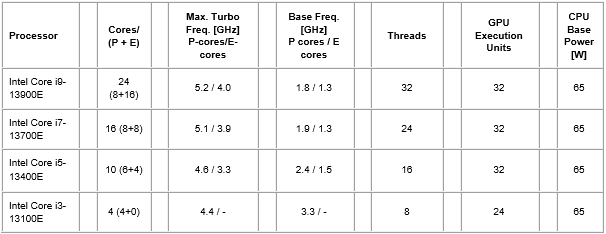
The new conga-HPC/cRLS Computer-on-Module in COM-HPC Size C form factor will become available in the below variants:
Application engineers can deploy the new COM-HPC Computer-on-Modules on Congatec’s Micro-ATX Application Carrier Board (Conga-HPC/mATX) for COM-HPC Client type modules to instantly capitalize on all the benefits and improvements of these new modules in combination with ultrafast PCIe connectivity.