




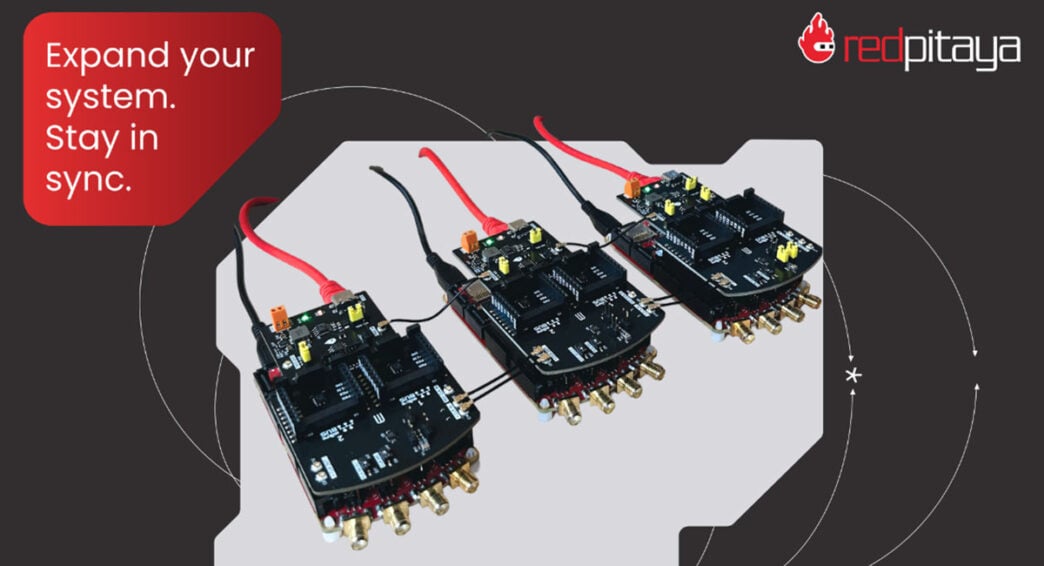
At embedded world 2026, Red Pitaya announced a major expansion of its multichannel synchronisation and high-speed streaming capabilities across its STEMlab 125-14 Gen 2 platform.
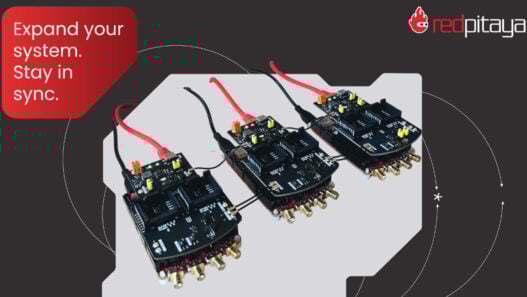
Following the introduction of the STEMlab PRO Gen 2 series at last year’s embedded world, this year’s showcase focuses on system-level performance. Engineers can now combine multiple STEMlab boards into tightly synchronised, fully configurable setups – significantly extending input and output capacity while maintaining precise clock and trigger alignment across the entire system.
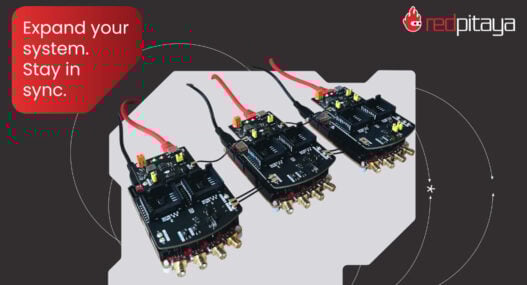
Using Red Pitaya Click Shields and shared clock distribution, users can synchronise combinations of STEMlab 125-14 PRO Gen 2, STEMlab 125-14 PRO Z7020 Gen 2, STEMlab 125-14 4-Input, and SDRlab 122-16 boards into a single, coherent measurement system. For example, pairing a STEMlab 125-14 PRO Gen 2 with a STEMlab 125-14 4-Input creates a synchronised 6-input, 2-output system – and larger configurations can be assembled to suit specific application requirements.
This expanded flexibility builds on the clock-select architecture first introduced with the STEMlab 125-14 4-Input, which allowed users to switch between the internal 125MHz oscillator and an externally supplied reference clock. With that same functionality now available across the Gen 2 125-14 platform family, synchronisation possibilities have broadened considerably. The Click Shield architecture handles clock and trigger distribution via the ZL40213 LVDS clock fanout buffer, delivering deterministic alignment with sharp edge control across all boards in a configuration.
Alongside the synchronisation upgrades, Red Pitaya has substantially enhanced the streaming architecture of its Gen 2 boards. Through software optimisation, streaming throughput between board and host computer has increased from 20 to 62.5MB/s per board, enabling significantly higher sustained data rates in both acquisition and generation workflows.
The updated Deep Memory Mode now supports both acquisition and generation, capturing incoming signals directly into memory or playing back data to the outputs at full core clock speed. The enhanced streaming application handles both short, high-speed bursts and longer continuous streams at up to 62.5MB/s. All of these modes work across synchronised multiboard setups, enabling high-throughput, distributed systems built from standard modular components.
“These updates reflect what our users have been asking for – the ability to scale their systems without sacrificing precision or speed,” said Mateja Lampe Rupnik, CEO of Red Pitaya. “With the expanded multichannel synchronisation and upgraded streaming architecture, engineers can now build customised, high-channel-count instrumentation from our standard boards, dramatically cutting the cost and complexity of what used to require purpose-built hardware.”