



Anna Wood, Editor at Electronic Specifier, picks her top 5 AI products released in March 2026.
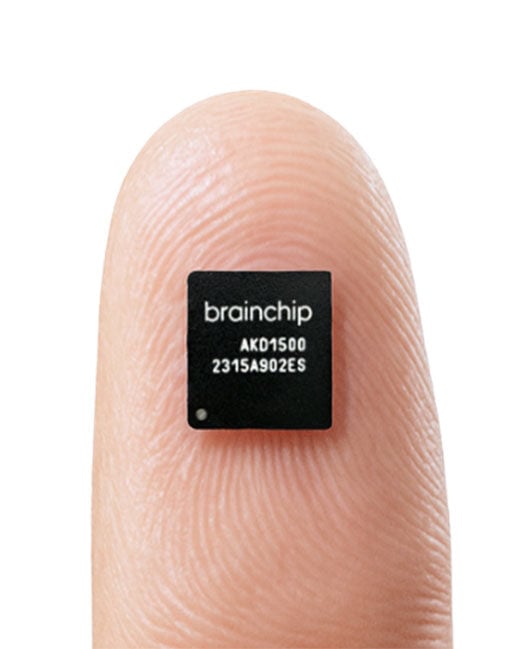
BrainChip launches AKD1500 Edge AI co-processor
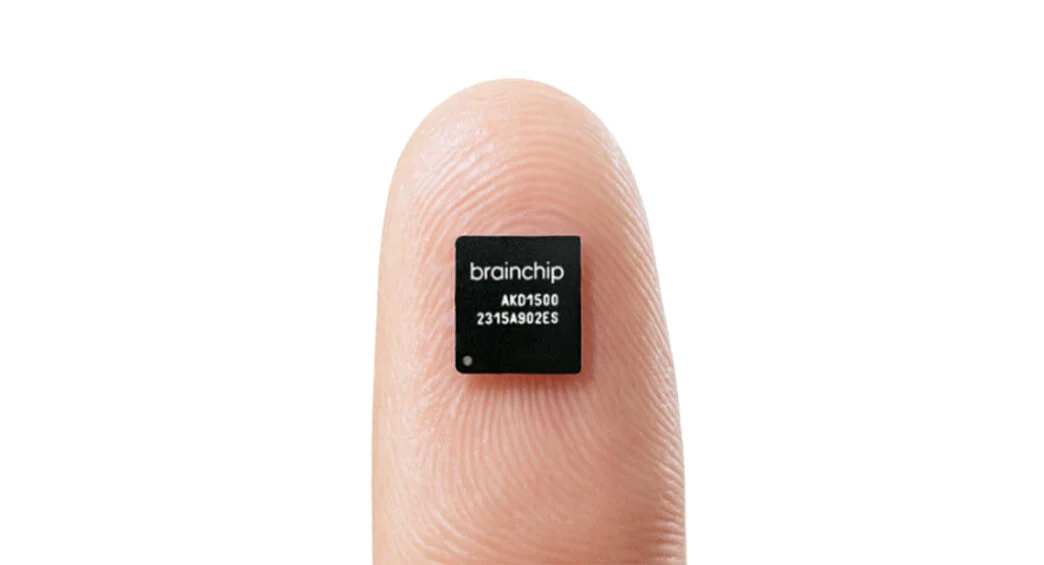
The AKD1500 is a neuromorphic Edge AI accelerator co-processor chip designed to deliver exceptional performance with minimal power consumption, achieving 800 giga operations per second (GOPS) while operating under 300 milliwatts.
The new AI co-processor is optimised for battery-powered wearables and smart remote sensors, providing essential efficiency for heat-constrained environments.
By upgrading SoCs and microcontrollers without a total redesign, the AKD1500 provides an efficient AI path for industrial, consumer, and medical applications.
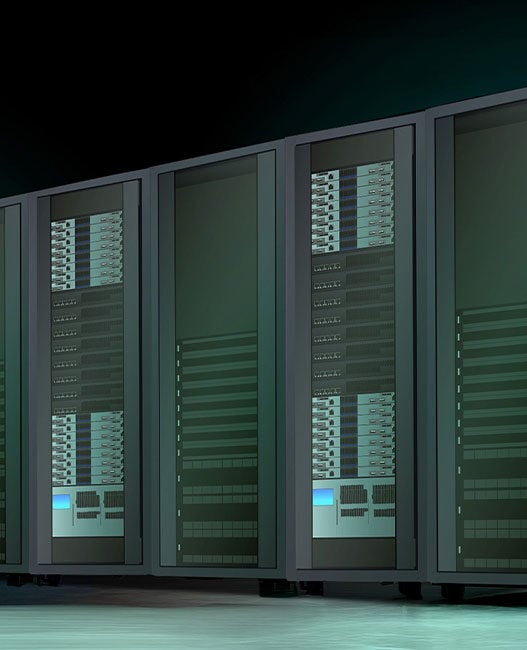
TI unveils complete 800VDC power architecture for future generation AI data centres with NVIDIA
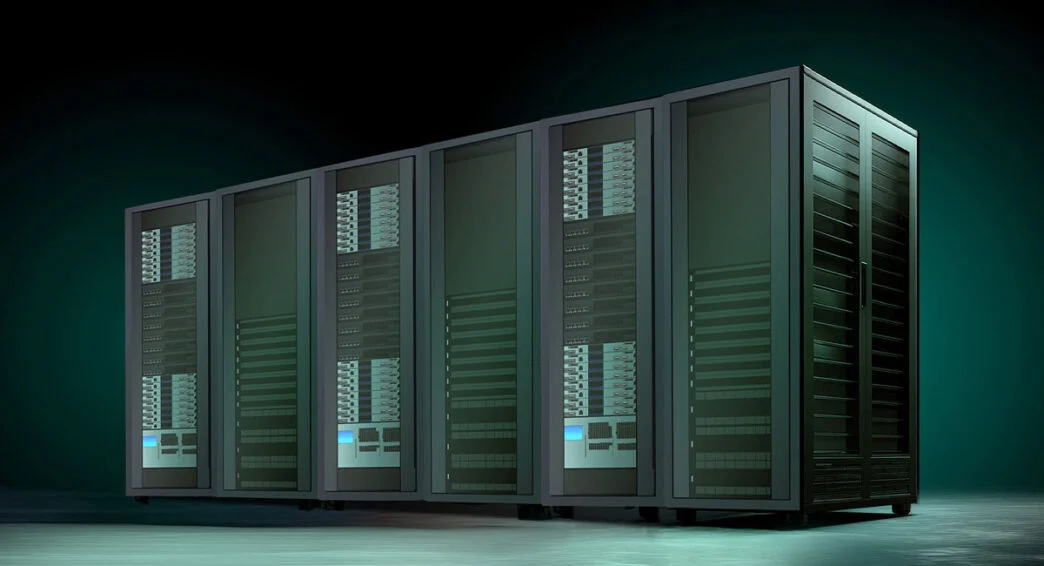
Texas Instruments unveiled a complete 800V direct current (DC) power architecture for next-generation AI data centres built with the NVIDIA 800 VDC reference design. The solution demonstrates how TI’s analogue and embedded processing technology supports NVIDIA’s vision for advancing high-voltage systems in AI data centres.
As AI workloads continue to drive unprecedented power requirements in data centres, traditional power distribution architectures are reaching their limits. TI’s 800 VDC architecture addresses these challenges by maximising conversion efficiency and power density across the entire power path, simplifying the power architecture and enabling more scalable and reliable AI data centre operations.
TI’s approach requires only two conversion stages from 800V to GPU core power: compact 800V to 6V isolated bus converter with higher peak efficiency, followed by a 6V to <1V multiphase buck solution with high current density generation-over-generation. This streamlined architecture supports the NVIDIA reference design.
NXP delivers new innovations for advanced physical AI with NVIDIA
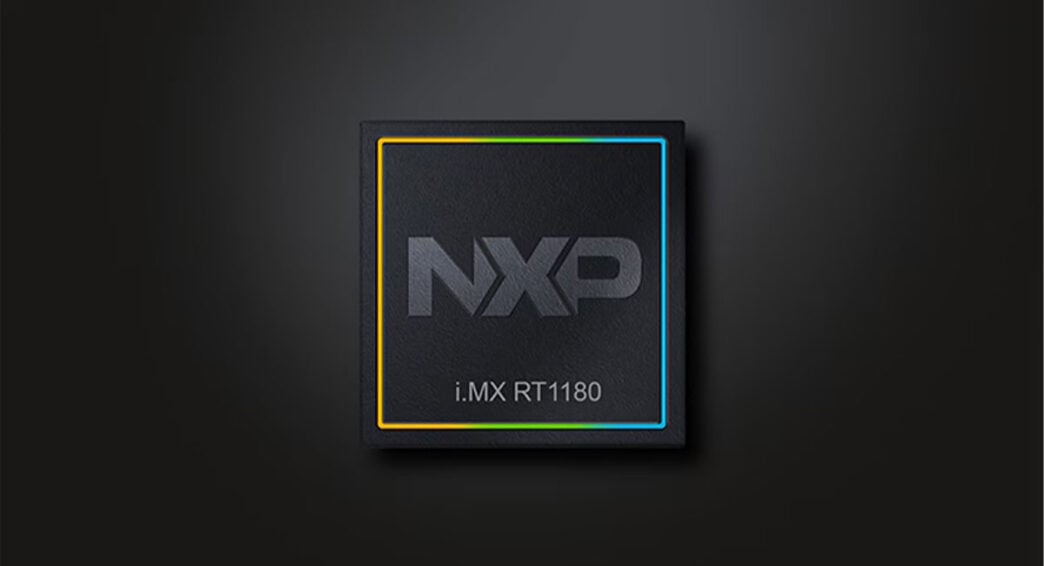
NXP Semiconductors announced innovative robotics solutions for reliable, secure, real-time data processing and transport and advanced networking, enabling sensor fusion, machine vision and precision motor control. First in a series of NXP’s foundational robotics solutions, these ready-to-deploy solutions were developed in collaboration with NVIDIA and implement NVIDIA Holoscan Sensor Bridge with NXP’s highly integrated SoCs. This reduces discrete components, significantly shrinking footprint, power and cost, while also simplifying the software complexity of robotic sensing and actuation, including humanoid form factors.
Physical AI is the next frontier of innovation, featuring systems that can sense, interpret, and interact with their surroundings with precision, reliability and safety. Humanoid robots are one of the most advanced embodiments of physical AI, requiring secure, reliable, low-latency data processing and transport throughout the robot body to enable synchronised motion, dense sensor fusion and advanced actuation.
NXP’s new integrated robot body solutions directly address this challenge, delivering powerful Edge intelligence and low-latency networking to enable safe, secure, real-time communication. These solutions seamlessly integrate NVIDIA Holoscan Sensor Bridge into NXP’s software enablement, allowing developers to easily implement real-time processing and establish a direct transport route between the body and pre-specified regions of the robot brain, substantially reducing latency. This significantly simplifies the challenges of bringing AI into the physical world, where real-time decision making is a critical requirement.
Keysight expands 1.6T validation for AI data centres

Keysight Technologies has introduced the Functional Interconnect Test Solutions (FITS) portfolio and FITS-8CH, the suite’s first product. FITS-8CH delivers digital-layer bit error ratio (BER) and forward error correction (FEC) performance validation for high-speed optical and copper interconnects used in network equipment and production network infrastructures.
As interconnect speeds increase and designs grow more complex, manufacturers of chips, optical and copper interconnects, and network equipment face mounting pressure to ensure reliability before products reach mass production and throughout the manufacturing process. Traditional physical-layer test tools play a vital role in validating electrical lanes against industry specifications, establishing a strong compliance baseline. Building on this foundation, system-level validation helps extend insight into the performance of fully integrated interconnects and operational sub-assemblies, including error behaviour in realistic environments.
Accurate assessment of real world system conditions is only possible when all interconnect electrical or optical lanes undergo high-speed error-performance validation. Without this testing, the risk of production delays or costly failures in the field increases. This includes validating error performance for high speed PAM4 electrical lanes operating at 53Gb/s, 106Gb/s, and 212Gb/s, which underpin today’s 400GE, 800GE, and 1.6T Ethernet network architectures.
TI expands microcontroller portfolio and software ecosystem to enable Edge AI in every device
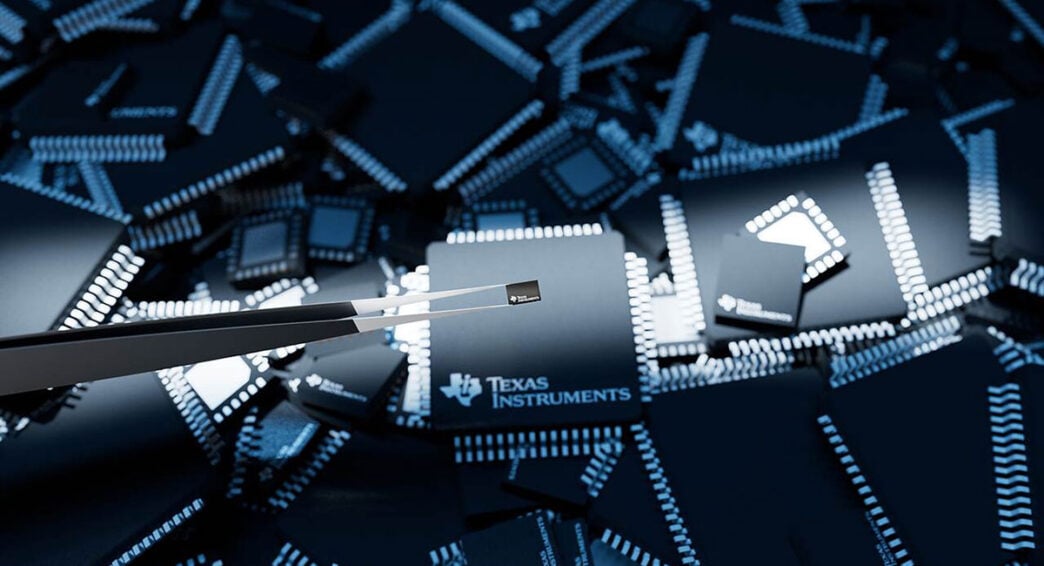
Texas Instruments introduced two new microcontroller (MCU) families with Edge artificial intelligence (AI) capabilities, supporting the company’s commitment to enabling Edge AI across its entire embedded processing portfolio. The MSPM0G5187 and AM13Ex MCUs integrate TI’s TinyEngine neural processing unit (NPU), a hardware accelerator for MCUs that optimises deep learning inference operations to reduce latency and improve energy efficiency when processing at the Edge.
TI is integrating the TinyEngine NPU across its entire microcontroller portfolio, including general-purpose and high-performance, real-time MCUs.
TI’s embedded processing portfolio is supported by a comprehensive development ecosystem, including the CCStudio integrated development environment (IDE). Its generative AI features allow engineers to use simple language to accelerate code development, system configuration and debugging through industry-standard agents and models paired with TI data. Altogether, TI is accelerating the adoption of edge AI in any electronic device, from real-time monitoring in wearable health monitors and home circuit breakers to physical AI in humanoid robots.