




Microcontrollers (MCUs) have widely been considered the workhorses of embedded design – responsible for reading inputs, controlling outputs, and running essential logic in everything from home appliances to industrial systems.
However, with the growing demand for artificial intelligence (AI) and machine learning (ML) at the Edge, the role of the MCU is changing. They are evolving into highly integrated, low-power compute engines capable of handling tasks that were once sent to the Cloud.
Alif Semiconductor, founded in 2019 and now operating across the US, India, Singapore, and Europe, was built around this shift. But what’s so special about the Edge?
The company’s Co-Founder and President Reza Kazerounian explained: “We wanted to create the next generation of embedded microcontrollers and microprocessors with a scalable compute engine that could handle a broad range of use cases – from single-core MCUs to multi-core fusion processors – while being extremely low power and secure.”
Why run AI locally?
The drive to process data at the Edge is fuelled by three main factors:
- Power efficiency: continuous Cloud communication drains energy, which is especially problematic for battery-powered devices
- Latency: local processing enables real-time responses in critical applications
- Security and privacy: keeping data on the device reduces exposure to external networks
“You cannot constantly connect billions of devices to the Cloud to run AI,” said Kazerounian. This is because it’s not practical. However, devices at the Edge are becoming more powerful, so they can handle local processing in a much more power-efficient way than constantly communicating.
Real-world examples
Explaining the benefits of this approach in clear practical scenarios, Kazerounian likened it to a security camera. For instance, it could analyse its video feed in real time, detecting unusual behaviour and alerting the system only when necessary. This avoids the need to stream all data to the Cloud, saving bandwidth and battery life.
Similarly, Kazerounian described how a connected appliance could monitor its own performance: “If your washing machine is about to break, it might start to vibrate differently or make unusual sounds. AI running locally can pick up on that pattern, and after a few days say, ‘something is not right.’ At that point, it can send a message to the Cloud or a service centre.”
Wide-ranging applications
The move to AI-capable MCUs is already impacting a wide variety of markets including wearables and healthcare devices, smart home systems, industrial monitoring, mobility solutions, robotics, and smart city infrastructure.
“Almost every piece of machinery, big to small, is going to become smarter,” said Kazerounian. “It will have some form of AI, some connection to the Cloud – but also the ability to process locally.”

AI-first integration
What makes Alif Semiconductor different is that from the outset the company deliberately designs its architecture to run advanced workloads at the Edge rather than shoehorning AI features into existing MCUs.
“We wanted to create the next generation of embedded microcontrollers and microprocessors with a scalable compute engine that could go from a single-core MCU to multi-core fusion processors – and do it in an extremely low-power, secure way,” said Kazerounian.
Alif achieved this by bringing the compute cores, neural processing unit, secure enclave, memory, sensor interfaces, analogue and digital blocks, graphics, and power management together on a single piece of silicon. Because of the high level of integration, the need for external components is reduced and operations are kept local, minimising energy use and latency.
“The challenge is to integrate as many functions as possible inside one silicon … so as much as possible happens on one chip versus having to do chip-to-chip communication,” Kazerounian explained.
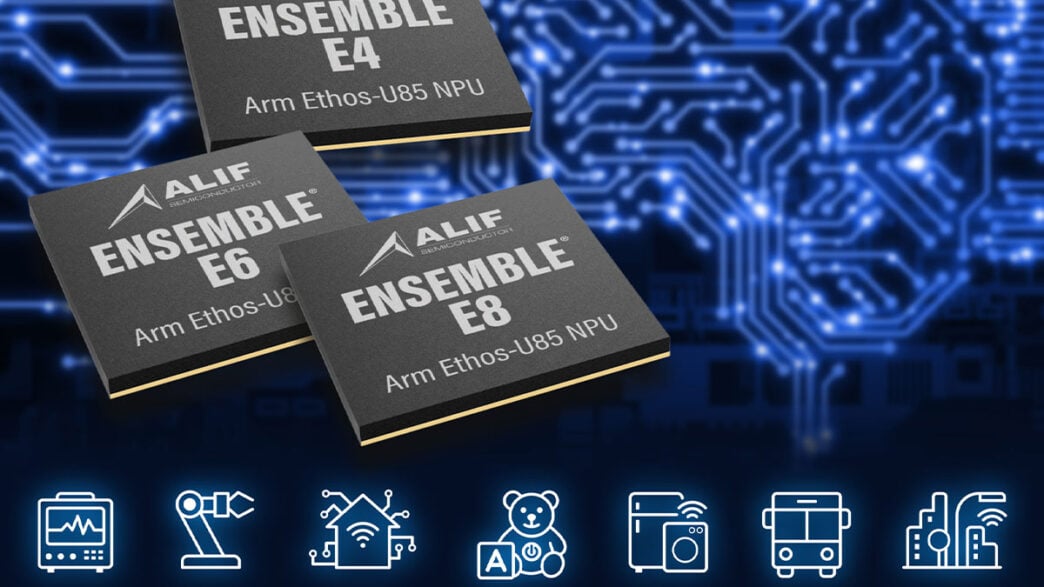
Alif’s E4, E6, and E8 MCUs feature NPUs capable of running transformer-based models – the same architecture used in Generative AI – enabling small language models and real-time image analysis to run directly on the MCU.
Building on common IP to enable innovation
Part of Alif Semiconductor’s strategy makes use of widely adopted processor and accelerator IP as a foundation; this allows the company to focus on innovation where it matters – at the system level.
“There’s a certain type of function that has to be part of what we call a common IP … The use of a common IP enables the ecosystem that has to be developed around that IP to become more universal.”
By building on a foundation that is already familiar to the broader developer community, Alif Semiconductor ensures its products fit into an established ecosystem that customers can readily work with. This approach benefits engineers by ensuring compatibility with widely used development tools and third-party software, reducing integration friction.
“People who use products like ours need an ecosystem all the way from development tools, software tools, to be widely available,” Kazerounian explained.
Alif Semiconductor complements this with its own SDK, providing drivers, operating systems, and system-level integration to help customers get started quickly.
“We have our own SDK. It has a whole set of drivers and OSs … Without those types of enablement, it’s going to be very difficult to get a user to use an MCU.”
By combining a familiar ecosystem with in-house support tools, it means that Alif Semiconductor can make AI-capable MCUs more accessible to engineers who are tackling complex Edge applications.
The next steps
Alif Semiconductor is already on its second generation of devices and sees the demand for AI at the Edge only increasing. Kazerounian expects this growth to be driven by portable, battery-powered applications, where power efficiency and local intelligence are essential.
“The desire [to run AI] is widespread,” said Kazerounian, explaining that the applications are evolving very fast, and the hardware and software will continue to evolve to meet that demand. “Five years from now, we’ll be a lot further than we are today.”
As the technological world evolves and MCUs continue their journey from simple controllers to intelligent Edge processors, companies like Alif Semiconductor are showing what’s possible – and shaping how the next generation of embedded systems will make decisions faster, use less energy, and protect data more effectively, all without leaving the device.
As Kazerounian put it: “[Our microcontrollers are] the most advanced, broad, scalable, AI enabled, integrated microcontrollers.”

By Sheryl Miles, Associate Editor, Electronic Specifier