







A team of scientists from Harvard University’s Wyss Institute for Biologically Inspired Engineering has created a new kind of durable, soft–bodied jumping robot that blends both soft and rigid components.
What makes this 3D-printed robot so unique is that it can transition its body from hard to soft. If you’ve seen traditional robots, then you know they are usually made of more rigid materials and components like metal and hydraulic parts, but scientists have been moving away from these robots and dealing with softer materials. Now they’ve integrated both sets of materials to create one robot.
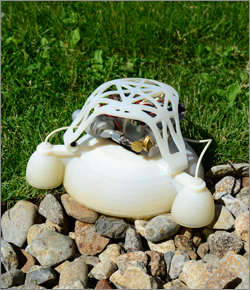
“We leveraged additive manufacturing to holistically create, in one uninterrupted 3D printing session, a single body fabricated with nine sequential layers of material, increasing in stiffness from rigid to soft towards the outer body,” said Robert Wood, Ph.D,Core Faculty member and co–leader of the Bioinspired Robotics Platform at the Wyss Institute for Biologically Inspired Engineering at Harvard University, in a press release.
And, while typically 3D printing is employed to print particular parts of robots, the researchers printed the entire robot in this way. This jumping robot is the first entire robot to ever be 3D-printed using a gradient rigid–to–soft layering strategy.
The bot in the video below is powered by an explosive actuator on its body that harnesses the combustion energy of butane and oxygen. It has three tilting pneumatic legs that control the direction of its jumps, and its soft exterior reduces its risk of being damaged when it lands, so it is safer for humans to operate in close proximity.
According to Wyss researchers, this technology paves the way for mass production of robots that can be easily integrated into daily life with humans.