




On 30 July 2025, Professor Michele Dougherty was appointed as the UK’s first female Astronomer Royal. The title was established in 1675 and is considered a prestigious position.
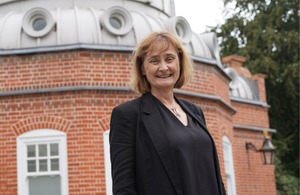
Professor Michele Dougherty, Astronomer Royal
The role, now principally honorary, sees the title-holder act as the official adviser to King Charles III on astronomical matters. The position was originally created to assist mariners in determining longitude by navigating the stars, however, today, it acts as a bridge between astronomy and the broader public discourse.
A distinguished career
Prof Dougherty has a distinguished record in space physics, beginning her career with NASA’s Cassini mission where she led the magnetometer instrument team. One of her biggest contributions to the field came from detecting a tiny magnetic anomaly during Cassini’s fly‑by of Enceladus in 2005 – a clue that revealed jets of water vapour erupting from the moon’s south pole, suggesting it may harbour the ingredients for life.
Since April 2023, she has served as principal investigator for the magnetometer aboard the European Space Agency’s Jupiter Icy Moons Explorer (JUICE) mission, which is currently en route to Jupiter and is expected to arrive in 2031 before operating until 2035. Her instrument will probe Ganymede, Europa, and Callisto, with a view to measure subsurface oceans, salt content, and magnetic fields – which are key factors in assessing the potential to support life.
A path unwritten at school
Prof Dougherty was born in South Africa in 1962, and while her curiosity about space was sparked when she was about 10 years old – when her father built a 10” telescope allowing her to glimpse Jupiter’s four large moons and Saturn’s rings – she had a choice to make when it came to secondary school – she could go to one that taught science, or she could go to the one her friends were attending. She chose the latter. However, she excelled at maths regardless and went on to study applied mathematics and physics at university. The transition period was tricky as she caught up to speed, but the move prevailed.
She told BBC Radio 4’s Today programme that she had never imagined that she would work on planetary spacecraft missions.
A landmark appointment for women in science
Her new role follows in the footsteps of Professor Catherine Heymans, who became the first female Astronomer Royal for Scotland in May 2021. However, Prof Dougherty is the first to hold the UK‑wide post. In her announcement she emphasised that her appointment was earned on merit, not gender, yet she recognised its potential symbolic value for young women in STEM.
Speaking about her new role, Prof Dougherty said: “I am absolutely delighted to be taking on the important role of Astronomer Royal. As a young child I never thought I’d end up working on planetary spacecraft missions and science, so I can’t quite believe I’m actually taking on this position. In this role I look forward to engaging the general public in how exciting astronomy is, and how important it and its outcomes are to our everyday life.”
Prof Dougherty chairs the Science and Technology Facilities Council (STFC), and is President-elect of the Institute of Physics, and a Professor of Space Physics at Imperial College London. As Astronomer Royal, she has expressed her ambition to use the position to engage the public in science, advocate for funding, and inspire others – especially young girls – to consider careers in science.
Although she did not choose to study science in secondary school, Prof Dougherty’s career demonstrates the value of following something that interests you and persevering with it – even if it’s later in life. That perseverance often opens the door to new possibilities – and those possibilities can, in time, shape the work for which scientific leaders are remembered to future generations.
It is also a reminder to always say yes to opportunities when they arise, even when you’re unsure. You can always learn from the opportunities you take. Not so much from the ones you let pass you by. And it is often those uncertain moments that lead to the greatest growth.