




For more than two decades, Debbie McDade, Managing Director of Advanced Rework Technology (A.R.T.), one of Europe’s longest running IPC Certification Centres, has led the company – building on a base of integrity, expertise, and passion for quality in electronics manufacturing.
Not only this, but she has to be one of the most recognisable names in the UK electronics training landscape. But ask McDade if she considers herself a role model, and she deflects: “I wouldn’t say I was a role model. People know me, and I’m sure it’s purely because I am female … If it was a man in my position, it wouldn’t be anything special, as it’s normally a given.”
Yet, in speaking to her, I beg to differ. Her passion for an industry she loves is palpable from the outset – so much so, I felt like by the end of our chat that I wanted to learn to rework circuitry. More than this, McDade has also been voted Industry Personality of the Year multiple times – a reflection not just of her visibility, but of her impact.
Though her entry into the industry, she explained, was far from straightforward, it did shape the ethos she now brings to IPC training and to the many individuals she mentors.
From MechEng to electronics Master
McDade’s academic background in mechanical manufacturing engineering grounded her with a solid theoretical technical foundation, but when the time came to enter the workforce, she realised that theory alone wasn’t going to be enough.
“I spent four years studying a subject, but it was all theory. Even though I was at the engineer level, I couldn’t put it into practice.”
The realisation that she needed hands-on experience to complement her theoretical expertise led her to pursue a technician’s role – only, she found herself being rejected time and again. Feeling confused as to why this could be, she phoned one of the company’s to ask for feedback and that’s when she found out that she was technically overqualified for the role. Undeterred, she not only talked her way into an interview, she also attended it, prepared with a two-year commitment contract to her employer that she had written herself.
She did this for a very simple reason: “If a technician comes to me and says, ‘Deb, we’ve got a problem with this tooling,’ I shouldn’t have to go get a book. I need to know hands-on what to do.”
The gamble paid off: she got the job, stayed for five years, and became the company’s QA Manager overseeing military-grade manufacturing.
This practical mindset is what makes her a Master and drives her passion for IPC certification – a globally recognised standard that supports electronics professionals across design, manufacture, and repair.
IPC certification: more than a piece of paper
IPC training is a layered system, from Certified IPC Specialist (CIS) for technicians, through to Certified Standards Expert (CSE), and Certified IPC Trainer (CIT). Each level equips the trainee with deeper knowledge tailored to their role in the production lifecycle.
“It’s a standardised training programme that builds essential skills. From design to bare board manufacture, inspection, soldering, and final assembly – IPC ensures consistent quality and reliability.”
For companies, having IPC-certified staff offers them a competitive advantage. It means they can demonstrate competence to clients and regulatory bodies, which in turn boosts trust, quality, and reliability.
“It’s great for the companies, but it’s also good for the individuals. The certificate belongs to them. If they leave their job, it goes with them,” said McDade.
This portability is crucial – particularly in a sector facing skills shortages and high turnover.
Keeping standards aligned with industry change
What sets A.R.T. apart is not only its longevity but its involvement in developing the IPC standards themselves. McDade serves as Chair of the European IPC Training Committee, helping to write the very materials she teaches.
“When people say, ‘Why should we book with A.R.T.?’ I say: we don’t just teach the standards – we help to write them.”
This insider knowledge allows McDade and her team to explain not just what a standard says, but why it says it. That context, she believes, is vital for technicians, engineers, and trainers alike.
Training for resilience and sustainability
We are living in a time when the electronics supply chain is under pressure from shortages, costs, and sustainability demands, and so getting things right the f irst time has never been more important. Emphasising this point, McDade said that IPC training isn’t just about quality – it’s also about avoiding unnecessary rework, waste, and risk.
“Companies want perfection, but that doesn’t always mean reliability. Cosmetic rework can reduce the design life of a product. We teach people to meet or exceed the minimum requirements – not go beyond what’s necessary and cause unintended issues.”
In teaching rework and repair methods, A.R.T. also helps reduce scrap rates and material waste. Properly trained technicians can save expensive components, rather than binning them due to small defects or unqualified rework.
Opening doors for individuals
Beyond the technical, McDade is also passionate about how training can change lives.
“Even when I advertise for training positions here, I get a pile of CVs. If someone already has an IPC qualification, it puts them head and shoulders above the rest.”
She views IPC as a tool for individual empowerment – particularly for those entering the workforce or seeking to retrain. A certificate offers a clear demonstration of skill and commitment, and helps candidates stand out in a crowded field.
“It’s portable, and it shows you’ve got what it takes,” she added.
Tackling the skills gap
Taking a hands-on approach to addressing the UK’s engineering skills shortage, after industry feedback highlighted a lack of technicians and a disconnect between education and real-world manufacturing, McDade initiated a series of joint roadshows with IPC.
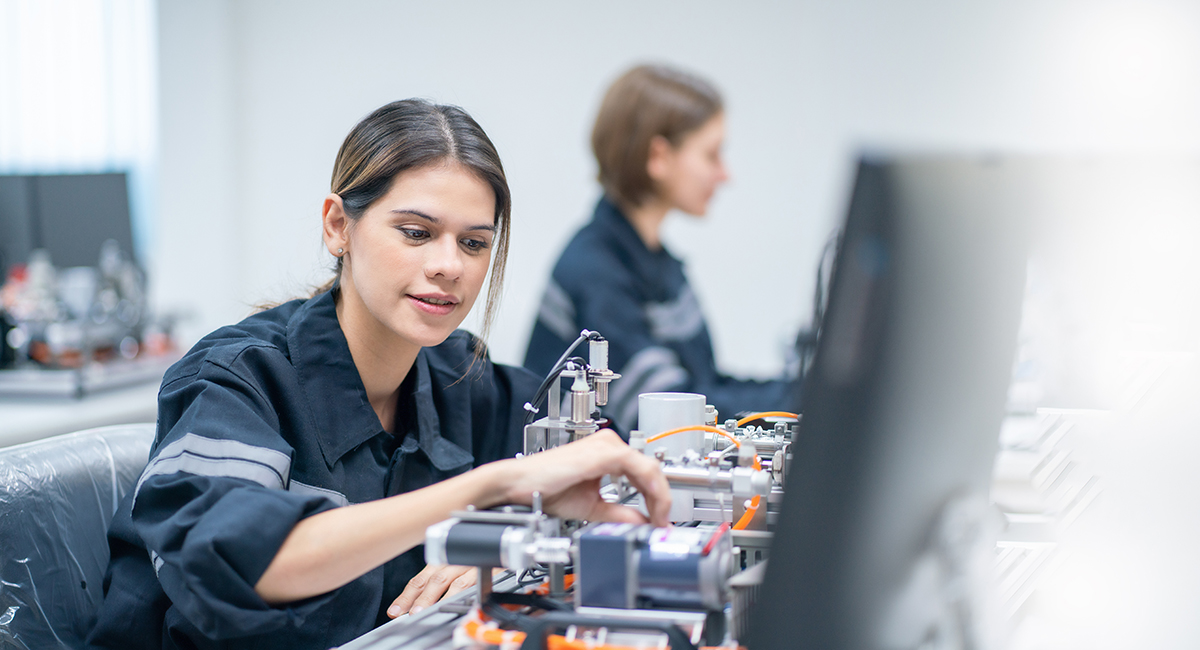
Held at production sites rather than training centres, these ‘Insight into Electronic Manufacture’ events bring students into real factory environments. They include tours, talks, job fairs, and hands-on soldering workshops.
“One student said, ‘I’m only in my first year, but could I do an unpaid internship?’. That student is now doing a mini apprenticeship over the summer before their second year.”
Such engagement, she believes, is key to changing perceptions, especially among young people who may only associate electronics with consumer devices.
“Today’s kids are surrounded by technology. They want to know how it works. These workshops let them see that building electronics can be fun, rewarding, and varied.”
There’s room enough for everyone
When McDade entered the electronics industry, she recalls how it was “95% men.” Things today, however, look very different.
“In some classes now, it’s 50/50. A large proportion of IPC trainers are women. A large proportion of emerging engineers are women. And more women are chairing IPC committees.”
She credits this change not to any lowering of barriers, but to growing confidence and visibility.
“They walk into the room and say, ‘I’m an engineer’ – not ‘I’m a female engineer.’ The qualifications are the same. The knowledge is the same.”
That message – that skills matter more than stereotypes – is one she wants every aspiring technician and engineer to hear.
Standing out by doing what matters
Despite her success, McDade remains grounded. As we spoke, she laughed as she recalled assembling a curriculum from her hospital bed just 45 minutes after surgery, and how she was using a colleague’s tools to train and ended up slicing her hand and then bleeding through a training session – soldering with her left hand instead of her right.
In speaking to her, I realised that her passion, energy, and commitment are not just admirable – they’re infectious, and it’s not hard to see why she is the Industry Personality of the Year.
When asked what advice she gives to newcomers, she is unequivocal: “Don’t let anyone hold you back. If you want to do it – do it. Technician, engineer, apprentice – none of it is beneath you. And none of it is out of reach.”
And though she may not call herself a role model, it is hard to imagine a more fitting one for those considering a future in electronics.
This article originally appeared in the August’25 magazine issue of Electronic Specifier Design – see ES’s Magazine Archives for more featured