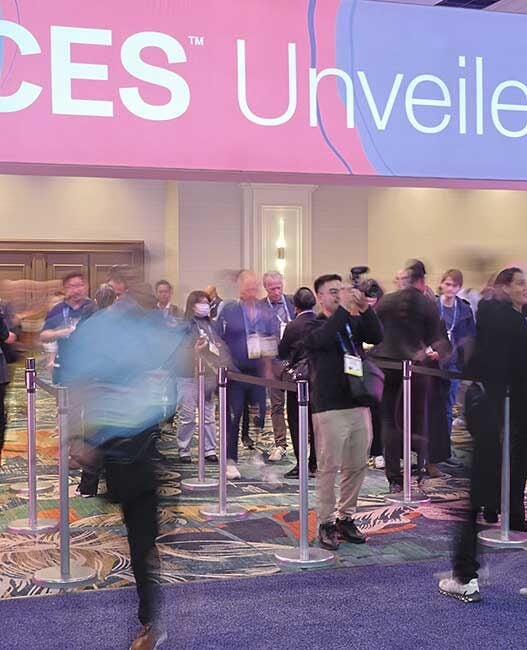




At CES 2026, Dr. Lisa Su, CEO and Chair, AMD, unveiled a whole host of new products across the client, graphics, embedded, and commercial segments.
Here is a recap of AMD’s key announcements at the event.
Client and graphics
- New Ryzen AI 400 and Ryzen AI PRO 400 Series processors for Copilot+ PCs to deliver AI experiences for both consumer and commercial users. Built on Zen 5 architecture and featuring AMD XDNA 2 NPUs, both series offer up to 60 TOPS NPU of AI compute
- Additional SKUs in the AMD Ryzen AI Max+ Series extend the portfolio’s high-performance AI compute, integrated desktop-class graphics, and unified memory architecture to ultra-thin laptops, workstations, and compact mini-PCs. These processors are optimised for demanding creative and AI workloads, as well as immersive gameplay
- The new AMD Ryzen AI Halo mini-PC has been designed to accelerate AI development. Built on the Ryzen AI Max+ platform, it offers desktop-grade AI compute, integrated graphics, and easy access to pre-installed applications and models
- For the gaming market, AMD has launched the Ryzen 9850X3D processor, which joins the Ryzen X3D family as one of the fastest gaming processors on the market. Using powerful Zen 5 CPUs and 2nd Gen AMD 3D V-Cache technology, the processor delivers performance gains and maximum efficiency
- The ROCm 7.2 update supports the Ryzen AI 400 Series processors and is now available as an integrated download through ComfyUI
Jack Huynh, Senior Vice President and General Manager, AMD Computing and Graphics Group, commented: “Across consumer, commercial, and enthusiast systems, we’re delivering platforms that bring high-performance computing, leadership AI, immersive graphics, and a growing software ecosystem that empowers developers and creators, so intelligence is built in, performance and efficiency scale seamlessly, and innovation extends to every form factor. Our full-stack approach is coming to life, enabling smarter, faster, and more immersive experiences for users, today and tomorrow.”
Data centres
“At CES, our partners joined us to show what’s possible when the industry comes together to bring AI everywhere, for everyone,” said Dr. Lisa Su, Chair and CEO of AMD. “As AI adoption accelerates, we are entering the era of yotta-scale computing, driven by unprecedented growth in both training and inference. AMD is building the compute foundation for this next phase of AI through end-to-end technology leadership, open platforms, and deep co-innovation with partners across the ecosystem.”
At the event, AMD unveiled the full MI400 Series lineup, built to serve the AI market. Leading the portfolio is Helios, AMD’s blueprint for yotta scale compute, delivering up to three AI exaflops in a single rack for trillion-parameter training with maximum bandwidth and efficiency, creating the blueprint for yotta-scale compute. Helios is powered by AMD Instinct MI455X accelerators, AMD EPYC Venice CPUs, and AMD Pensando Vulcano NICs for scale-out networking, all unified through the open AMD ROCm software ecosystem.
The lineup also includes:
- AMD Instinct MI440X, an eight GPU on-premise solution targeting enterprise AI for training, fine-tuning, and inference workloads that integrates into existing infrastructure
- AMD Instinct MI430X, a high-precision GPU solution targeting sovereign AI and HPC and hybrid computing
- AMD disclosed MI500 Series details (launching in 2027), which is set to deliver up to a 1,000x increase in AI performance compared to the AMD Instinct MI300X with AMD CDNA 6 architecture, 2nm process technology, and HBM4E memory
Embedded
“As industries push for more immersive AI experiences and faster on-device intelligence, they need high performance without added system complexity,” said Salil Raje, Senior Vice President and General Manager, AMD Embedded. “The Ryzen AI Embedded portfolio brings leadership CPU, GPU and NPU capabilities together in a single device, enabling smarter, more responsive automotive, industrial, and autonomous systems.”
New launches in this segment include:
- New Ryzen AI Embedded P100 and X100 Series processors with Zen 5 CPUs, RDNA 3.5 graphics, and XDNA 2 NPUs, deliver up to 50 AI TOPS in a single compact chip and feature 3x AI performance and 35% faster GPU rendering power for real-time 4K/8K visualisation. The space-efficient design and unified open software stack help to accelerate and simplify embedded system development for AI-driven automotive, industrial, and autonomous systems
- AMD will announce its collaboration with Generative Bionics to develop the GENE1.0 next-generation humanoid robot powered by AMD, showcasing a new category of compute merging robotics, AI, and human-centric design
Working with the US government
Lisa Su was also joined on stage by Michael Kratsios, Director of the White House Office of Science and Technology Policy, to discuss the role AMD has in the US government’s Genesis Mission. This ambitious public/private technology initiative aims to secure US leadership in AI technologies and shape scientific discovery and global competitiveness for years to come. Genesis includes two recently announced AMD-powered AI supercomputers at Oak Ridge National Laboratory, Lux and Discovery.
You can watch the full keynote below: