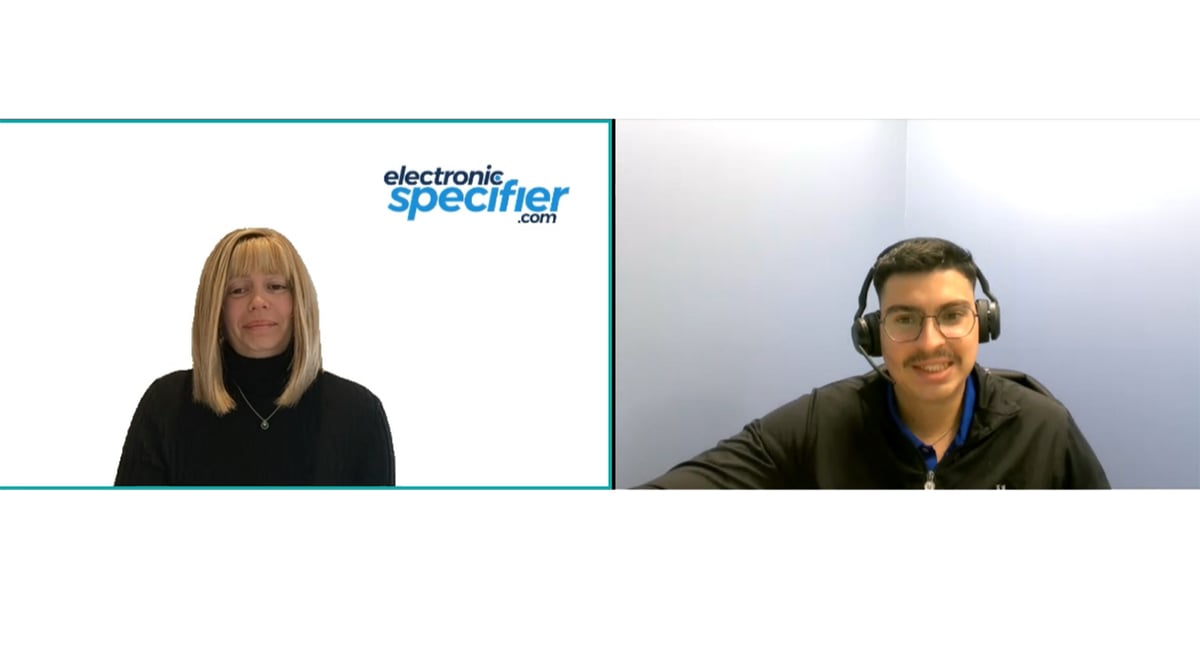





Paige Hookway, Managing Editor, Electronic Specifier, recently hosted a webinar on Precision Meets Endurance: Advanced Solutions for AI and Automotive alongside Sando Takeshi, Product Marketing Manager for Crystal and SAW products at Kyocera AVX and Guenter Rienesl, Senior Marketing Manager, Crystals & SAW.
The conversation centred on advanced timing solutions for the rapidly evolving fields of AI and automotive technology. The session opened with an overview of Kyocera AVX’s comprehensive product portfolio and its relevance to applications demanding high data processing speeds and system accuracy, such as AI servers, robotics, and networking.
Takeshi introduced Kyocera AVX’s manufacturing strategy, which includes three main factories – two in Japan and one in Vietnam. This approach is designed to reduce geopolitical risks and ensure stable product procurement for customers. In-house production of critical components, like ceramic packages, allows Kyocera AVX to tightly control quality and quickly adapt to market requirements.
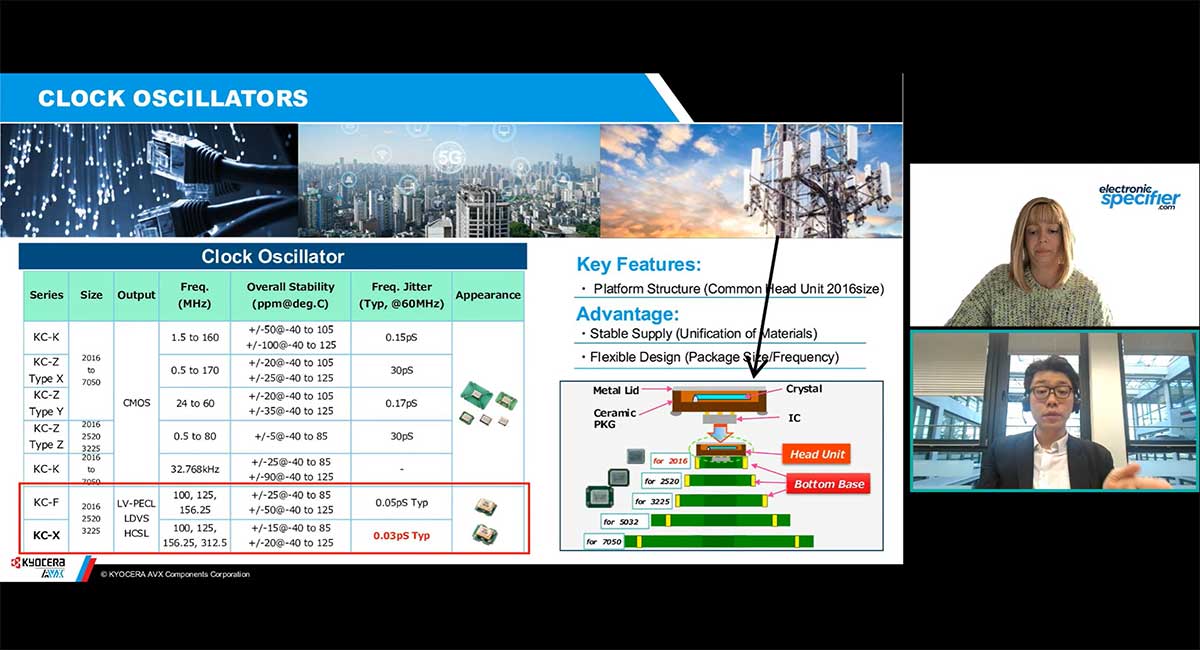
A significant portion of the webinar focused on the advantages of differential crystal oscillators over conventional CMOS types, highlighting their ability to deliver higher frequencies, lower phase noise, and superior signal integrity. These features are particularly important for modern AI and high-speed networking applications, which require tightly controlled clock signals for reliable, high-bandwidth data communication. Takeshi showcased the F-series and newer X-series differential oscillators, explaining how the latter achieves tighter frequency tolerances and improved phase noise, meeting the demanding requirements of advanced customers in the field.
The webinar also demonstrated Kyocera AVX’s commitment to reliability. Its unique platform structure allows for higher temperature annealing during manufacture, improving long-term aging characteristics and detecting early failure, which distinguishes its products from conventional one-package oscillators. Extensive testing, including up to 3,000 thermal cycles, shows strong mechanical and solder joint reliability, particularly relevant for automotive applications where strict durability standards exist.
Rienesl added context on the strategic choice of product design, emphasising the just-in-time flexibility, procurement stability, and enhanced mechanical performance achieved through their platform approach – qualities that outperform standard industry packaging in both cost and reliability.
The Q&A segment addressed audience concerns on product frequencies, phase noise, bonding strength, production cost, and broader market adaptability.