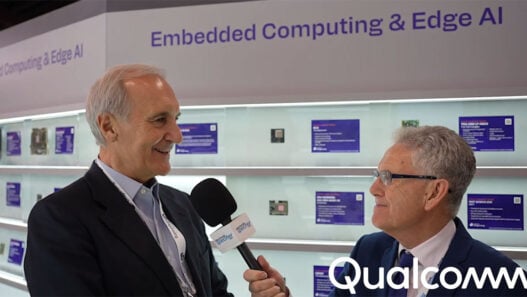



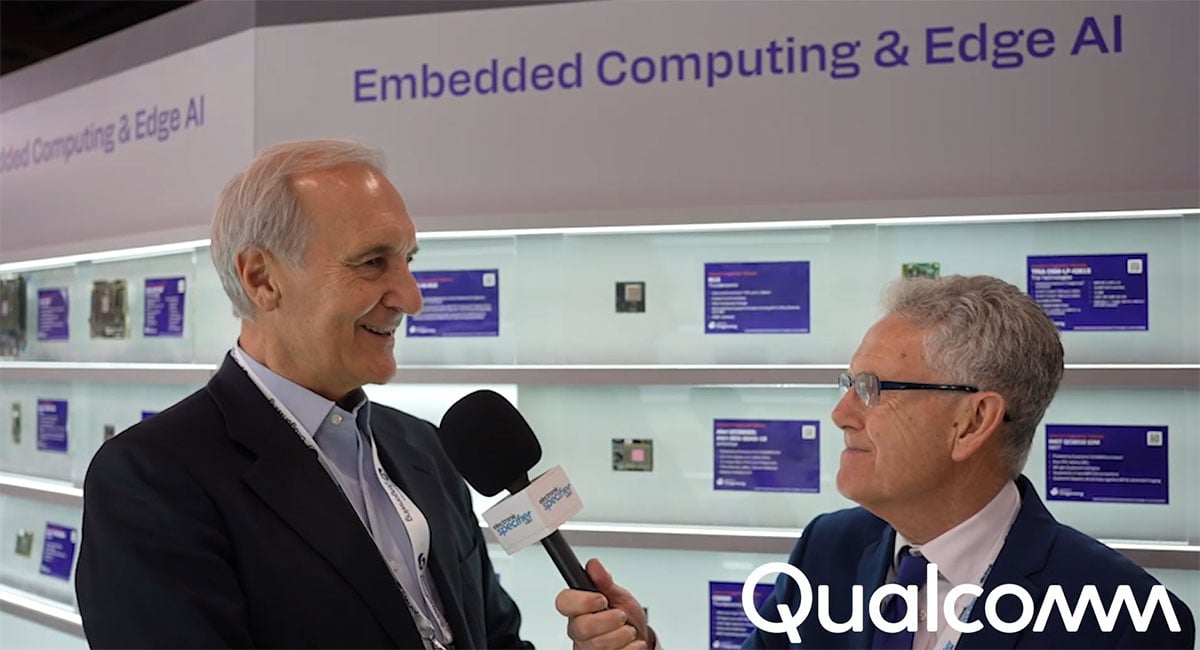
At embedded world 2026, Editor Mick Elliott spoke to Enrico Salvatori, Senior Vice President and President, Qualcomm Europe Inc.
Qualcomm’s evolving AI-at-the-Edge strategy is firmly centred on what Salvatore describes as “hybrid AI,” where Edge processing works in tandem with the Cloud to deliver better performance and user experience across a wide range of devices and use cases.
Salvatore explained that Qualcomm is investing heavily in platforms designed specifically to run AI inference at the Edge. “We are here to present our evolution of the investment and development for the AI at the Edge,” Salvatore said, adding that this is “where we contribute more, making available a platform at the Edge that is able to run in particular inference for the AI.”
This approach underpins Qualcomm’s hybrid AI vision, as Salvatore explains: “Edge AI works in combination with the Cloud AI, so that the users can achieve the best performance, user experience […] receiving all the applications needed for whatever they want to deliver.”
At embedded world 2026, Qualcomm showcased its product roadmap for Edge AI under the Dragon Wing branding, spanning multiple performance tiers.
“We are here with our product roadmap for the Edge AI, so Dragon Wing, that is the marketing broad name we use, IQ6, IQ8, IQ9, IQ10,” Salvatore said. These platforms are built around a heterogeneous compute architecture. “The platform is based on heterogeneous AI, so we have a CPU, GPU, and NPU. That is the important part that allows us to support the TOPS needed at the Edge in order to achieve [the required performance]”, he explained.
The scalability of the roadmap is a key theme, covering everything from modest AI workloads to demanding robotics applications. According to Salvatore, Qualcomm’s offering “is spanning across multiple categories of devices,” including home and industrial gateways as well as robotics and humanoids. He noted that performance can “go up to the 100 TOPS that can be achieved at the end, but also scaling down depending on the application,” highlighting Qualcomm’s ability “to go from entry level […] in performance AI up to the high performance AI at the Edge.”
Looking ahead, Salvatore said the strategy is now about disciplined execution rather than redefining the vision. “First of all [it is] focus on execution, because the vision, the strategy has been set,.” That execution extends beyond hardware and software into building a robust ecosystem. “Not only as hardware [and] software, but also as an ecosystem to enable our customer to be in that market,” he said.
A cornerstone of that ecosystem is the new Arduino VENTUNO Q development board, based on Qualcomm’s IQ Edge product platform. “Here [we] are announcing the new board by Arduino, and that is the Arduino VENTUNO Q that is based on our IQ Edge product platform, and that is giving up to 40 TOPS of performance,” Salvatore said. “[This] is enabling the developers to start being familiar with the AI also in the application that they do for testing, pre-commercial phase.”
Qualcomm is also pushing AI models to the Edge through its integration of Edge Impulse. Salvatore described it as “the company now part of Qualcomm, that is working and delivering that kind of product, so from the developers’ pre-commercial AI models, up to the commercial product with the IQ product family.”
Developer support spans the entire lifecycle from concept to deployment. “We provide [an] SDK toolkit on our pre-commercial [and] commercial platform, so they can have a full journey working with us, from the pre-commercial phase, development, testing, validation, and then to the commercial phase,” Salvatore said. “That is the way we cover the end-to-end, from the concept down to the commercial device.
“We have here at the show also more than 50 companies showcase in their own devices or their products based on our technology and products,” Salvatore noted. Board makers such as Tria and others form “one of the channel[s] that is definitely” helping Qualcomm’s go-to-market strategy, he said, emphasising “the traction at the show … really the request of more technology at the Edge, more performance at the Edge, with the initial AI demand.”
The company’s booth is divided into three main sections. One focuses on test and development boards from partners; a central area showcases robotics, including a new collaboration. The third area highlights end-use cases such as industrial video surveillance, accuracy control, retail analytics, and electronic signage—practical demonstrations of AI at the Edge moving from concept into real-world deployment.
Watch the full video here.