

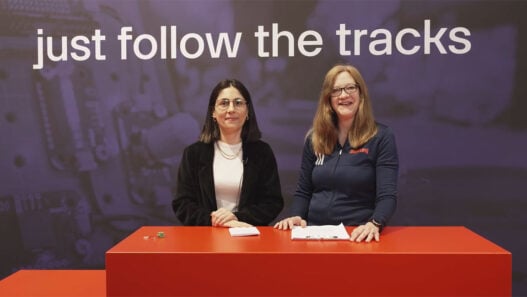
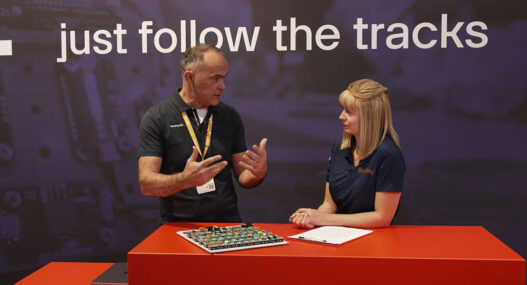
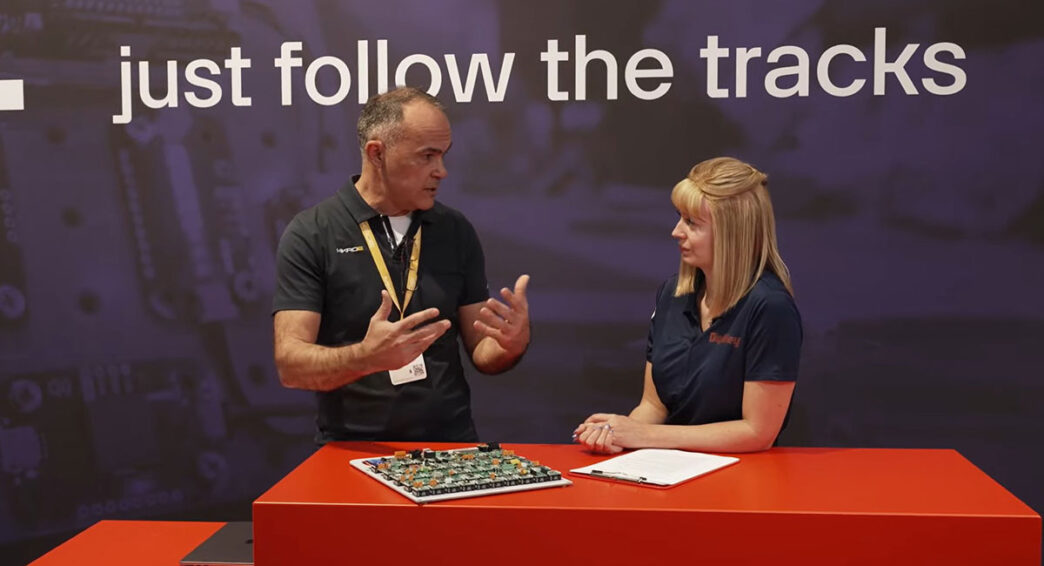
At embedded world 2026, on the DigiKey booth, Paige Hookway speaks with Nebojsa Matić, CEO of Mikroelektronika about AI code generation and its unpredictability.
Matić began by explaining that Mikroelektronika’s mission is not simply to sell development tools, but to help engineers maximise their time. Through its hardware and software ecosystem, the company aims to simplify complex development processes so engineers can achieve more within the same timeframe.
A key focus of the conversation was the difference between AI code generation in traditional software environments and in embedded systems. In the PC software world, Matić noted, development is highly standardised: operating systems, application frameworks, and development environments follow common structures. This consistency allows AI tools to generate reliable code more easily. Embedded systems, however, are far less standardised, with thousands of microcontrollers, boards, and peripheral devices all requiring different implementations.
To address this challenge, Mikroelektronika has spent years building a large, standardised code base. The company has developed around 2,000 Click boards, with software written using consistent coding standards, and supports approximately 8,000 microcontrollers. In addition, its NECTO Studio development environment is supported by millions of lines of code and over 1.7 million projects hosted on the company’s embedded development resources. According to Matić, this large and structured dataset enables the company’s AI tools to generate more reliable embedded firmware.
Despite these advances, Matić emphasised that AI-generated code in embedded systems should not be expected to achieve perfect accuracy. Engineers may encounter situations where generated code works repeatedly but occasionally fails, highlighting the inherent complexity of embedded development. Given the enormous number of possible hardware combinations, he argued that achieving around 95% accuracy is already a significant achievement and that the industry may currently be setting unrealistic expectations for AI performance.
To improve results, Mikroelektronika applies AI not only to code generation but also to the prompt itself. The system automatically refines prompts and regenerates code in the background to increase accuracy. Another approach the company uses is “visual prompting,” where engineers select hardware components graphically instead of manually writing complex prompts. This reduces the chance of errors when specifying combinations of boards, sensors, and microcontrollers.
Matić also addressed concerns about AI hallucinations. Because Mikroelektronika’s dataset is tightly structured and standardised, the AI is less likely to invent incorrect functions or behaviour. Instead, it may occasionally omit elements rather than generate incorrect ones, which he believes is easier for engineers to correct.
Looking ahead, Matić views AI primarily as a tool that will work alongside engineers rather than replace them. Drawing parallels with technologies such as spreadsheets, he argued that new tools historically enhance productivity rather than eliminate jobs. Ultimately, he believes AI will give engineers greater freedom to experiment with different hardware combinations, enabling faster prototyping and more creative design.