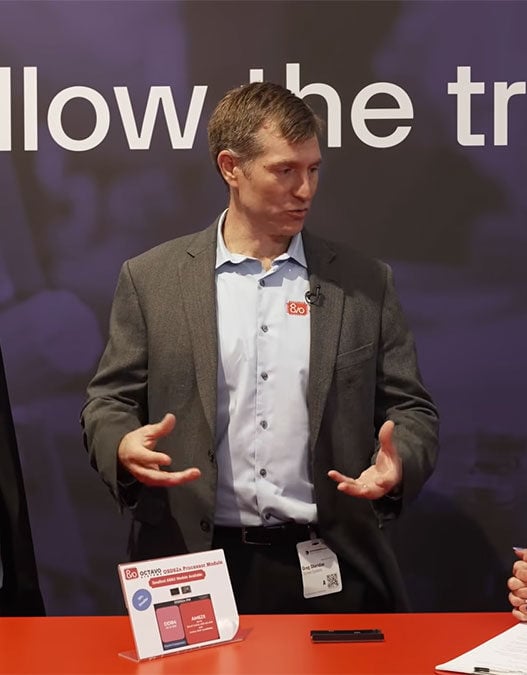

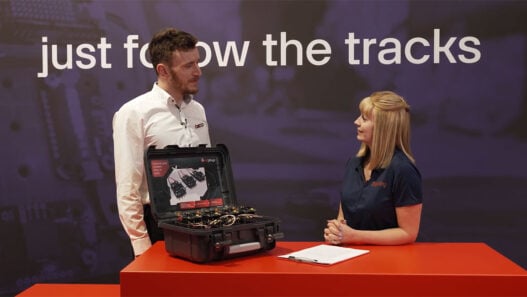

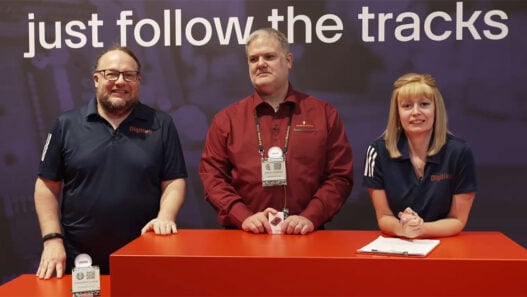

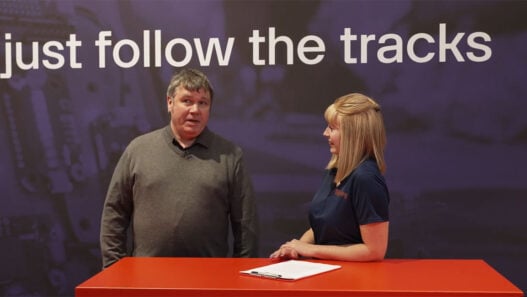


At embedded world 2026 on the DigiKey booth, Paige Hookway spoke with Jason Kridner the founder of BeagleBoard and Robert Nelson, Applications Engineer at DigiKey, to explore what’s new in open‑source hardware, embedded systems, and the maker ecosystem. It has been a year since their last conversation, and in that time BeagleBoard’s momentum has only grown – especially around the PocketBeagle 2.
BeagleBoard is a non-profit corporation existing to provide education in and collaboration around the design and use of open-source software and hardware in embedded computing.
Jason explained that the PocketBeagle 2, launched roughly a year ago, has been a runaway success. Demand has repeatedly outstripped supply: “We’ve had a hard time keeping up with the demand,” he said, noting that DigiKey is only just now able to hold a bit of stock – though even that may disappear quickly. Over the past year, much of the team’s effort has gone into catching up with demand, improving teaching materials, and refining the distro builds and supporting infrastructure that make the board so approachable for learners and professionals alike.
The discussion then turned to broader trends in the open‑source hardware and maker communities. One of the biggest shifts has been the dramatic increase in memory costs. Jason called it “the elephant in the room,” explaining that the rising price of memory is pushing designers to “trim the fat” and solve problems with far leaner systems. That’s driving more interest in Zephyr, a lightweight real‑time operating system, as an alternative to heavier Linux‑based solutions. As he put it, “The demand for trimming the fat in the systems… has gone up tremendously,” and consequently, BeagleBoard is “doing more and more with Zephyr, and not just Linux.”
In response to user feedback, BeagleBoard has expanded the PocketBeagle 2 family with the new PocketBeagle 2 Industrial. Where PocketBeagle 2 gave users 512MB of memory, the industrial variant targets those for whom “that 512MB is not enough.” PocketBeagle 2 Industrial steps up to 1GB of RAM and 64GB of onboard flash, and is designed for harsh environments, with components rated for industrial temperatures. Jason described it as an option for people who want their existing PocketBeagle 2‑based designs to be “more robust, longer lived, more hard,” turning a much‑loved platform into a serious industrial workhorse.
Technically, the Beagle platforms continue to emphasise low‑latency control and open GPU acceleration. PocketBeagle 2 increases the clock of its programmable real‑time units (PRUs) from 200MHz to 333MHz and offers single‑cycle I/O to pins, enabling “super, super tight control loops” for applications like drones, audio synthesis, and complex lighting control. Jason highlighted that the new quad‑core, 64‑bit platform provides GPU acceleration via Vulkan using fully open‑source drivers.
One of the most eye‑catching innovations Jason wore around his neck: the new Beagle Badge, a $100 computer featuring a 4.2‑inch e‑paper display, controls for interactive user interfaces, and support for LVGL and MicroPython. Powered by TI’s low‑power AM62L processor – a dual‑core Cortex‑A53 running at 1.25 GHz – the badge can run Linux or Zephyr and is packed with connectivity: Wi‑Fi 6, Bluetooth Low Energy, LoRaWAN, and an array of onboard sensors including light, accelerometer, temperature, and humidity. Jason emphasised that it’s more than just a wearable; it’s a teaching tool.
Looking ahead, Jason stressed that BeagleBoard’s roadmap is largely driven by community feedback. Many of the refinements in Beagle 2 Industrial and BeagleConnect Zepto came directly from users asking for “just a little bit more memory,” onboard eMMC, or different configurations.
“Where the community takes us” will shape the next 12 months, he said, hinting at more microcontroller work, faster spins, and accessories that make Beagle platforms even easier to use. As BeagleBoard continues to blend open hardware, affordable pricing, and education‑first design, it’s clear their ecosystem is poised to keep empowering makers, students, and professionals around the world.
Watch the full interview below.