



This Saturday (24th January) marks the International Day of Education, celebrating young people and the role they play as agents of change in advancing inclusive and equitable education.
The day is also a chance to reflect on how education and careers in technology can benefit society – by improving communication, widening access to education, and supporting economic growth.
Green skills
As the UK Government prepares to step up its youth employment schemes to 50,000 places over the next three years, data from E.ON UK points to a growing appetite for alternative pathways into work, with UK school leavers actively seeking out green skills and future-focused career paths.
The energy supplier provider says it has seen a 500% increase in interest for its apprenticeship programmes since 2023. With more young people seeking opportunities that blend paid work with hands-on training, this trend is in line with broader attitudes on what young people are seeking from their careers.
Last year, research from E.ON found that 52% of UK school leavers now consider roles that benefit the planet to be more valuable than those that do not, with the majority attracted to green jobs to take pride in their work (44%), closely followed by a desire to help the environment (39%).
Naomi Furlonger, Early Careers Talent Consultant at E.ON UK, said: “Supporting young people to play an active role in the energy transition isn’t just about filling skills gaps, it’s about unlocking potential … we’re investing in early career pathways to give the next generation – especially women and girls – the opportunity to build meaningful careers while shaping a cleaner, fairer energy future.”
Lucia’s lightbulb moment
Lucia Bond, 22, found her passion after being curious about different routes to success. Now, as one of E.ON’s Project Management Degree Apprentices, she’s sparked a new way forward.
From an early age, Lucia’s natural instinct for organisation set her apart. But it wasn’t until her brother left for university that she realised the traditional full-time university route might not be for her.
When she discovered E.ON’s Project Management Degree Apprenticeship, she realised it was possible to learn, earn and build a career at the same time.
“Throughout my journey at E.ON, I’ve completed a range of exciting placements across the business. Recently I’ve stepped into a new role in Site Management that has helped me realise how apprenticeships can unlock fulfilling careers as a young woman. You don’t need to be an engineer to help build a sustainable future. All it takes is passion, purpose, and the drive to make a real difference, and apprenticeships give people like me the chance to turn that energy into real impact.”
Undergraduate degree in autonomous robotics
From green jobs to dream jobs, back in December 2025, the New Model Institute for Technology and Engineering (NMITE) announced new Autonomous Robotics degree.
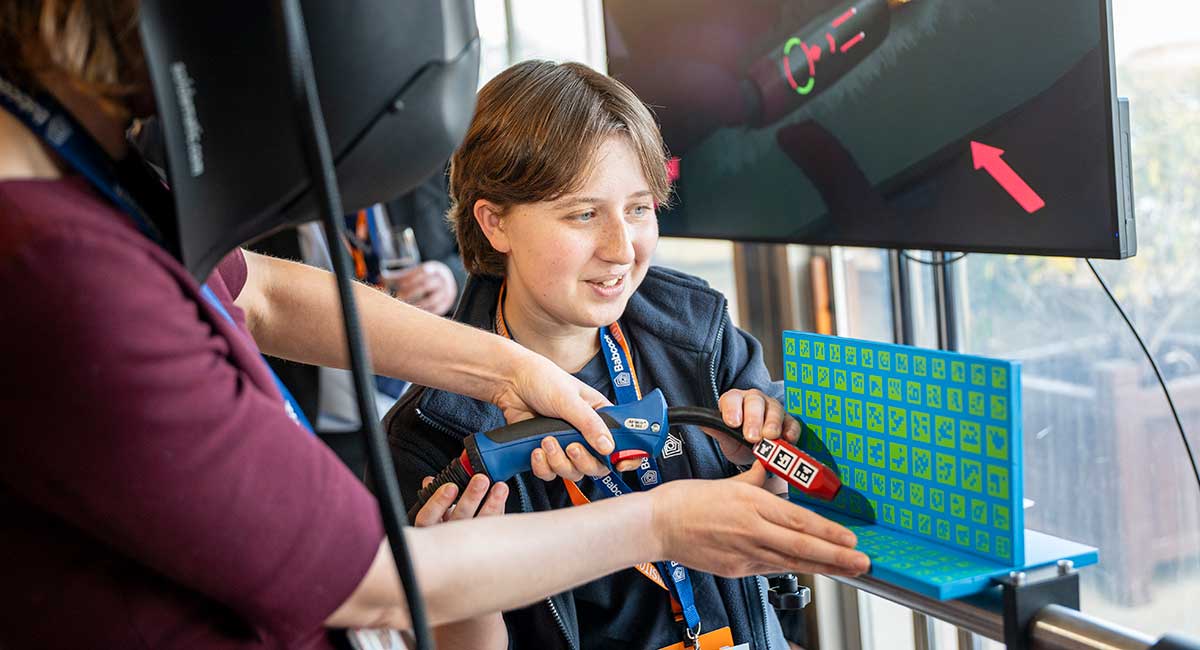
Planning to welcome its first students in September 2026, the NMITE recently hosted an event in conjunction with the British Army to provide more information. Attended by Al Carns MP, Minister for the Armed Forces, the event was hosted by NMITE’s James Newby, President and Chief Executive Officer, Jesse Norman, Chair, and Professor Alexandru (Alex) Stancu who is the Academic Lead for this degree with current NMITE students and their examples of real-world autonomous systems, drone technologies, and robotics drones on display. Brigadier Mike Cornwell Head of Future Force Development, Army Command represented the Army and also present were Members of the Army’s Experimentation and Trials Group who are the types of soldiers who could also be potential students of this degree.
James Newby, President and Chief Executive Officer at NMITE said: “This degree reflects the scale of the opportunity in front of us – to equip the next generation of engineers with skills that matter now, and to quickly deliver positive impacts in terms of skills, defence and a security capability and regional growth. The fact that we expect many local young people to take on the degree and build their futures with us, is incredibly exciting.”
Talking about the progress that has been made since the December announcement, Professor Alexandru (Alex) Stancu, Academic Lead for this degree said: “The curriculum has been designed from the ground up to combine rigorous engineering fundamentals with hands-on experience in autonomous systems, ensuring students engage with the technologies and challenges facing the country today. I am incredibly excited to be involved and can’t wait to start working with students on this exciting project.”
Built on NMITE’s hands-on pedagogy, the new degree will lead to a Master’s in Engineering (MEng) in three years, rather than the normal four years in traditional universities, and will prepare students to be broadly trained, highly effective engineers with a specialised focus on drone technologies. The programme will place a strong emphasis on the dual-use potential of drone technologies. Just as many technologies originally developed for defence are now commonplace in civilian life, from GPS to the internet, NMITE’s Autonomous Robotics degree will equip graduates to drive innovation for civilian, commercial, and humanitarian applications as well as for defence.
Skills for life
Taken together, these stories highlight a clear shift in how young people view education and work. Traditional, linear routes are no longer the only measure of success. Instead, flexible pathways that combine real-world experience, social impact and future-facing skills are increasingly seen as the most meaningful way forward. Whether through apprenticeships, accelerated degrees or hands-on learning models, today’s students are seeking education that prepares them not just for a job, but for a changing world.
Yang Hao, IEEE Member and Professor at Queen Mary University of London, has shared some important considerations for students thinking about a career in technology: “Students should focus on developing a range of skills to future-proof their careers. As AI and ML advance, human value shifts upwards in the decision stack.
“While machines optimise, predict and generate, humans reason, contextualise, govern and lead. Those who cultivate cross-disciplinary thinking, ethical responsibility, and leadership under uncertainty are less likely to be displaced by intelligent systems. They will be the ones directing them.
“The most valuable career advice in today’s fast-moving tech landscape is to learn from first principles. As tools, languages, and platforms change, the ability to understand fundamentals, question assumptions, and adapt quickly will remain valuable. Students who anchor their learning in core concepts and independent thinking will be able to retrain, pivot, and lead as technology evolves, especially in an AI-driven world.”